China to India Air Freight Head Haul Space: A Capacity-Secure Walkthrough from Booking to Airport
China to India Air Freight Head Haul Space: A Capacity-Secure Walkthrough from Booking to Airport
For freight forwarders, consolidators, and supply chain teams moving cargo from China to India, the most critical variable is often head haul space. Without controlled space on the China side, even the strongest India-side customs clearance or last-mile plan cannot start. This article explains how a capacity-secure China–India air freight head haul service can be structured, what the first-leg operation actually involves, and where JTUO Logistics fits as a China-side partner for long-term and peak-season bookings.
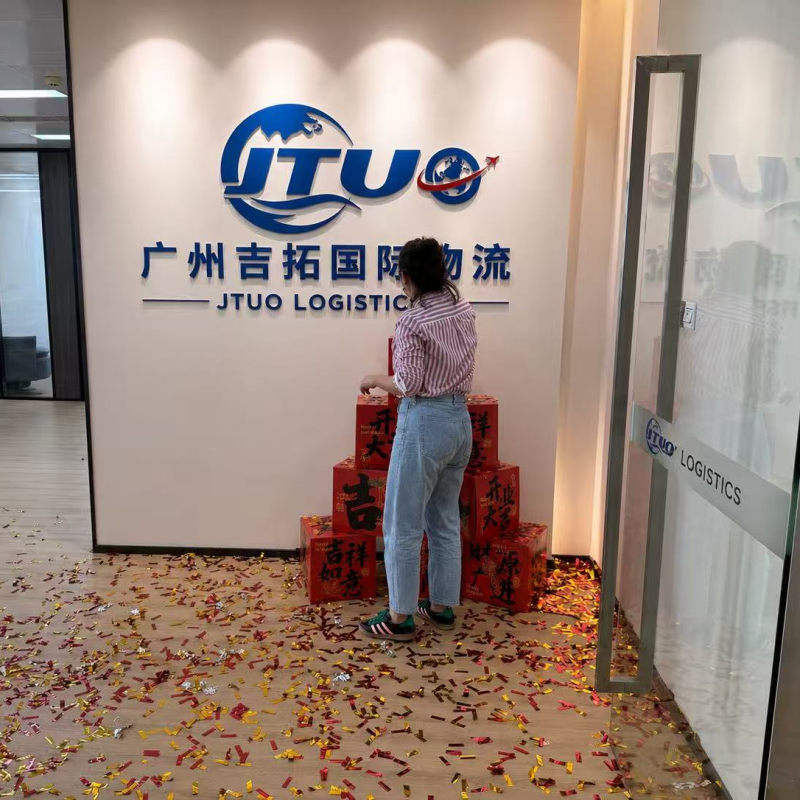
Problem Definition: Why Head Haul Space Becomes the Bottleneck
On the China–India air freight corridor, head haul capacity rarely follows a straight line. Demand shifts around peak seasons, new e-commerce launches, and manufacturing cycles, while space is controlled by a limited number of direct airline contracts and block space arrangements. Forwarders and importers that rely on ad-hoc bookings frequently face three recurring issues:
- Booking rejection or offloading risk: When airline space is tight, non-contracted cargo is often the first to be rolled to a later flight.
- Fragmented warehouse handling: Multi-supplier or multi-forwarder consolidation creates extra handovers, unclear responsibility, and inconsistent palletizing standards.
- Limited visibility before handover: Many shippers only receive reliable tracking after the cargo is accepted by the airline, leaving a blind spot between warehouse release and terminal delivery.
The challenge is not just price. It is the ability to secure space predictably, consolidate cargo in an organized way, and execute airport delivery without building a new process for every shipment. A mid-size freight forwarding company that outsources first-leg execution to a specialized capacity and consolidation provider can overcome this fragmentation, as shown later in this article.
Industry Background: What Makes China–India Air Freight Head Haul Space Structurally Tight
The market environment reinforces why forwarders need a deliberate sourcing strategy. India's air cargo market was valued at 3.6 million tons in 2025 and is projected to reach 9.9 million tons by 2034, growing at an 11.38% CAGR, according to IMARC Group. Asia-Pacific airlines led international air cargo growth with an 8.3% year-on-year increase in June 2025, driven by e-commerce and high-tech trade, as reported by IATA. China's exports to India reached approximately USD 120.46 billion in 2024, with electrical machinery and equipment as the largest segment, according to The Dollar Business.
Regulatory structure also plays a role. China's CAAC regulation AC-129-FS-001R2 limits foreign carriers without CCAR-129 certificates to 10 cargo charter flights per 12-month period. This makes compliant, repeatable space access a structural advantage rather than a spot-market afterthought. A direct air cargo route between Ezhou and Bangalore provides an annual transport capacity of over 5,000 tons via SF Airlines, but such fixed capacity still requires allocation discipline and terminal coordination. Forwarders serving India therefore need a partner that can manage airline space, warehouse consolidation, and airport handover as one integrated system rather than three disconnected vendors.
Detailed Solution: JTUO Logistics' China–India Air Freight Space & Cargo Consolidation Integrated Solution
JTUO Logistics is a China–India air freight specialist providing reliable airport-to-airport air freight solutions for freight forwarders, manufacturers, wholesalers, and e-commerce businesses. The company focuses on China-side logistics support, including air cargo space booking, warehouse consolidation, cargo preparation, and airport delivery coordination. Its core capability is the China–India Air Freight Space & Cargo Consolidation Integrated Solution, which addresses peak-season air cargo space shortage and unstable air freight capacity allocation.
The solution is built around three operating pillars:
- Stable air cargo space allocation and locking: The team maintains stable airline resources and manages both Block Space Agreement (BSA) and general cargo space. Fixed space can be reserved in advance for long-term partners, while priority allocation plans can be arranged for high-volume customers during peak seasons.
- In-house warehouse consolidation: A 2,000 m² warehouse with a warehousing team of over 20 people handles full consignments, multi-supplier consolidation, e-commerce small parcels, and consolidated loose cargo. The warehouse team re-measures weight and dimensions, verifies shipping marks, and logs cargo into the warehouse management system (WMS).
- Airport delivery and first-leg execution: JTUO centrally arranges transport from the warehouse to the airport cargo terminal, completes export customs declaration coordination, and tracks Master Air Waybill (MAWB) and House Air Waybill (HAWB) issuance until flight departure and arrival notification.
Supporting this is a team with over 15 years of experience in China–India air shipping logistics and cargo space management. JTUO handles more than 1,500 air cargo spaces per month and supports more than 500 freight forwarding partners and logistics clients. Core expertise includes stable air cargo space allocation and flexible capacity management for BSA and general cargo. Technical systems include an online air freight booking system, flight scheduling and space allocation platform, real-time cargo space monitoring, and warehouse inventory management system (WMS).
The company holds an Air Freight Forwarding License, Warehouse Operation & Safety Management Certification, and Logistics Service Compliance Qualification. It serves cross-border e-commerce logistics, international freight forwarding and NVOCC operations, and supply chain logistics service providers. This combination of license, warehouse, and airline access allows forwarders to treat the China-side first leg as a single controllable process rather than a sequence of external dependencies.
Step-by-Step Breakdown: The Nine Stages from Inquiry to Arrival at Indian Airport
The China–India air freight first-leg operation covers the full process from customer inquiry to cargo arrival at the destination airport. JTUO manages the China-side stages through a defined workflow with clear service milestones and capacity assurance.
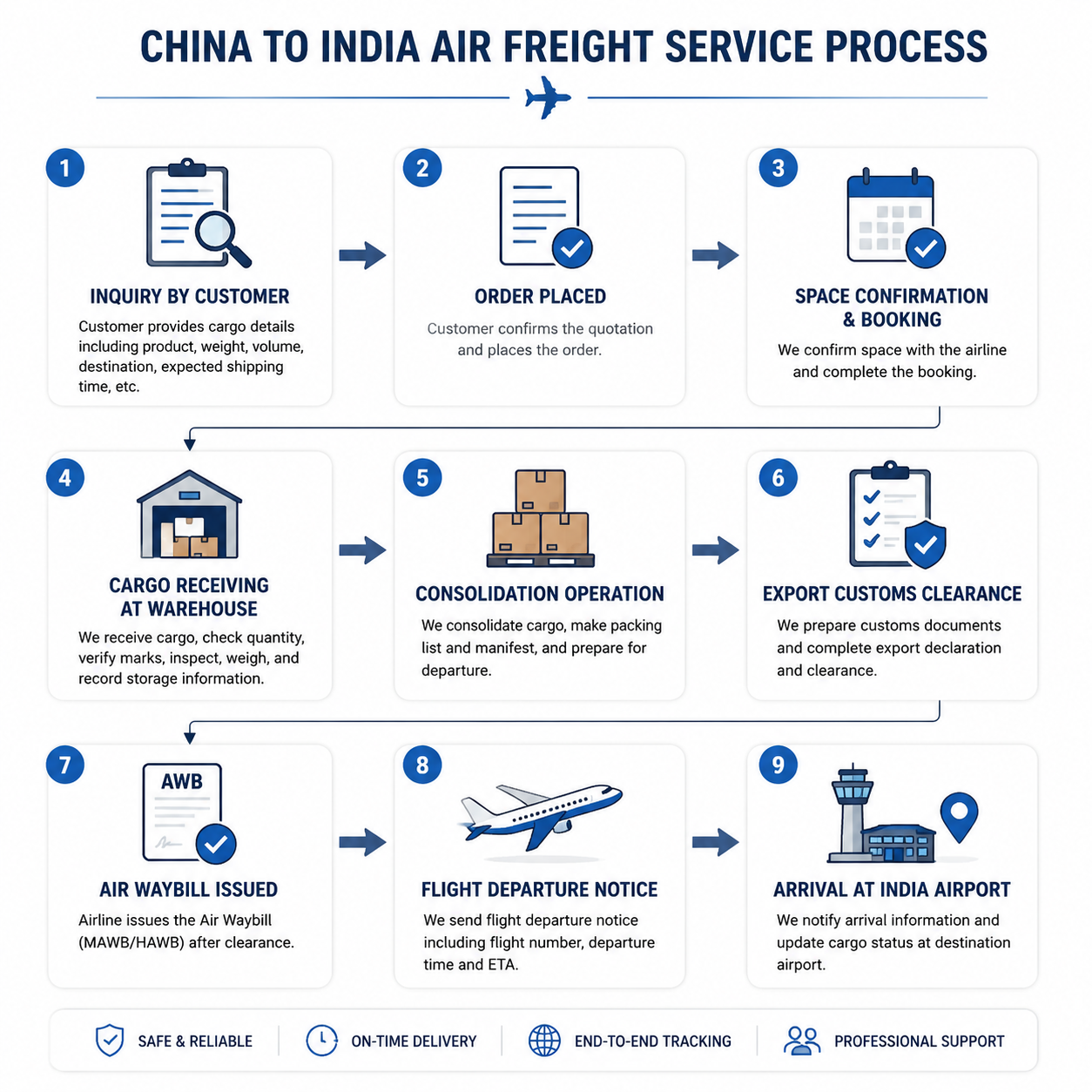
1. Inquiry & Quotation Stage
The client provides product name, cargo type, number of packages, gross weight, volume, packaging type, origin and destination airports, estimated shipping date, HS code, and any special cargo declaration such as batteries, liquids, powders, magnetic items, or brand-sensitive goods. Based on this information, JTUO provides a quotation, available flight options, and estimated transit time. Estimated duration: 0.5 days.
2. Order Confirmation Stage
After the customer confirms pricing and places the booking order, JTUO initiates the space request with the airline or freight forwarder. This step typically takes around 1 day, depending on customer confirmation speed.
3. Space Allocation & Booking Stage
Space is requested from and secured with the freight forwarder or airline. For long-term partners, fixed space can be reserved in advance. For high-volume customers during peak seasons, priority space allocation plans are arranged. JTUO sends a space booking confirmation, estimated cut-off time, and warehouse inbound schedule. Estimated duration: 1 day.
4. Warehouse Receiving Stage
The client delivers cargo to the JTUO warehouse according to the scheduled delivery time. The warehouse receives and verifies the shipment, re-measures actual weight and dimensions, and checks shipping marks. Air freight charges are based on the greater of actual weight or volumetric weight (calculated as Length cm × Width cm × Height cm / 6000). The warehouse team logs the cargo into WMS. Estimated duration: 1–2 days.
5. Cargo Consolidation Stage
The warehouse classifies, consolidates, and packs goods based on their attributes. For cross-border small parcel clients, JTUO consolidates multiple orders, groups goods from multiple suppliers, palletizes aggregated small parcels, and verifies weight and dimensions. For general air freight cargo, the team performs sorting, consolidated stacking, large pallet handling, and stretch-wrap reinforcement. All cargo details, including product information, package count, weight, volume, shipping marks, flight details, HS code, and special items, are verified before airport delivery.
6. Airport Delivery Stage
JTUO centrally arranges transport of the consolidated cargo from the warehouse to the airport cargo terminal. The team coordinates with airline schedules and completes cargo handover to airline ground handling. Security check completion and airline acceptance are confirmed.
7. Export Customs Clearance Stage
JTUO prepares the complete customs declaration documentation, including commercial invoice, packing list, sales contract, and customs declaration authorization as required. The team submits the declaration through a customs broker, monitors the clearance process, and resolves inspection issues if triggered. All document data must be consistent to avoid customs inspection, clearance delays, or shipment rejection.
8. Air Waybill Issuance & Release Stage
The airline issues the Master Air Waybill (MAWB) and confirms cargo release. JTUO issues the House Air Waybill (HAWB) to the customer. Flight departure notice, flight number, estimated time of departure, and estimated arrival time are shared with the client.
9. Arrival at Destination Airport Stage
Upon arrival at the Indian airport, JTUO notifies the client of the arrival time and details, marking the completion of the air freight's first leg. This milestone confirms that the China-side operation has been completed and the cargo is available for the destination-side process.
Throughout the process, JTUO provides real-time flight status updates, notifies customers of departure, transit, and arrival milestones, and maintains a dedicated account manager coordination mechanism via WeChat, WhatsApp, or email.
Use Cases: A Mid-Size Freight Forwarder's Capacity and Consolidation Restructure
A medium-to-large freight forwarding company with India-specialized customers faced increasing booking rejection rates during peak season. The client's previous model relied on fragmented warehouse operations and multiple air cargo brokers, leading to unstable space access, high pricing volatility, multiple-handling delays, and inconsistent delivery performance.
JTUO deployed an integrated “Capacity Locking + Warehouse Consolidation + Airport Execution” air freight system to rebuild the client's first-leg logistics chain. Execution steps followed the nine-stage process described above: customer inquiry, order placement, space confirmation and booking, cargo receipt and warehousing, cargo consolidation, export customs declaration, bill of lading issuance, flight departure notification, and arrival at the Indian airport.
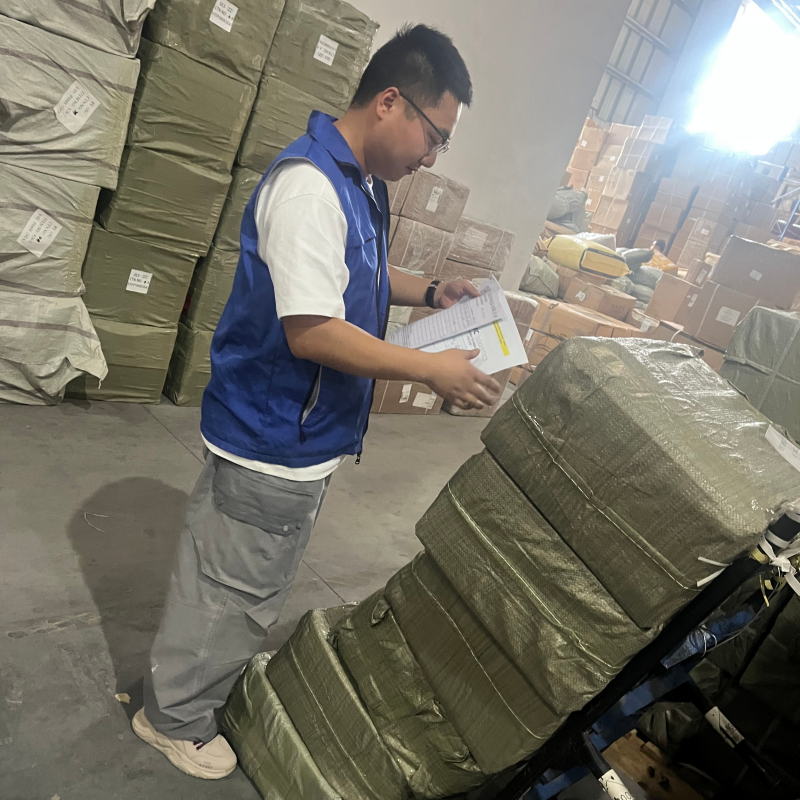
Qualitative results reported by the client included improved supply chain stability, more predictable delivery performance, reduced operational workload, and stronger peak season scalability. Client feedback captured from email and operational reviews stated: ‘Space availability became much more stable, even during peak seasons. Much more reliable than using multiple forwarders.’ Deliverables included space confirmation notices, warehouse receipts, consolidation manifests, MAWB/HAWB documents, and flight departure and arrival reports.
Comparison Table: How to Evaluate China–India Head Haul Space Providers
Rather than comparing brands in isolation, forwarders should evaluate a provider against the specific requirements of stable head haul space, warehouse control, and first-leg execution. The table below shows the key evaluation criteria and the corresponding JTUO Logistics evidence drawn from verifiable operational data.
| Evaluation criterion | Why it matters | JTUO Logistics evidence |
|---|---|---|
| Air freight forwarding license | Confirms legal ability to book space, issue AWB, and coordinate export clearance on the route | Holds Air Freight Forwarding License, Warehouse Operation & Safety Management Certification, and Logistics Service Compliance Qualification |
| Monthly air cargo space volume | Indicates capacity to handle high-volume shipments and peak season allocation | More than 1,500 air cargo spaces handled per month; supports 500+ freight forwarding partners and logistics clients |
| Block Space Agreement (BSA) capability | Stabilizes allocation and reduces offloading risk for contracted customers | Core expertise includes stable air cargo space allocation and flexible capacity management for BSA and general cargo |
| In-house warehouse consolidation | Reduces handovers, improves cargo control, and ensures consistent palletizing and labeling | 2,000 m² warehouse; warehousing team of over 20 people; WMS for inventory and consolidation |
| Direct first-leg execution | Single responsible party from warehouse to airline terminal reduces coordination gaps | Operates end-to-end first-leg process from inquiry to arrival at destination airport, including customs declaration coordination and AWB issuance |
| Team experience and route focus | Route-specific know-how improves space planning and problem resolution during disruptions | Over 15 years of experience in China–India air shipping logistics and cargo space management; dedicated China–India corridor focus |
FAQ: China to India Air Freight Head Haul Space Provider with Guaranteed Cargo Space
1. Does JTUO Logistics hold the necessary licenses and certifications for China–India air freight operations?
Yes. JTUO Logistics holds an Air Freight Forwarding License, Warehouse Operation & Safety Management Certification, and Logistics Service Compliance Qualification. These credentials support legal booking, Master Air Waybill (MAWB) and House Air Waybill (HAWB) issuance, warehouse operations, and first-leg export logistics on the China–India corridor.
2. How much China–India air cargo space can JTUO secure for forwarders and consolidators?
JTUO handles more than 1,500 air cargo spaces per month and supports more than 500 freight forwarding partners and logistics clients. The company manages both Block Space Agreement (BSA) and general cargo space, with stable allocation for long-term partners and priority allocation plans for high-volume customers during peak seasons.
3. What determines the cost of China–India head haul air freight space?
Air freight charges are based on the greater of actual weight or volumetric weight, calculated as Length cm × Width cm × Height cm / 6000. Public rate data as of April 2026 showed China to Asia air freight rates in the range of USD 1.76–4.10 per kg for shipments above 100 kg; actual China–India pricing depends on weight, volume, season, space type, and whether the booking is spot or contracted. JTUO provides a quotation based on cargo details, flight schedules, and prevailing market rates after receiving complete shipment information.
4. What is the typical timeline from booking to airport departure for the China–India first leg?
The initial stages have defined time estimates: inquiry and quotation takes about 0.5 days, order confirmation around 1 day, space allocation and booking about 1 day, and warehouse receiving 1–2 days. Subsequent stages—consolidation, airport delivery, export customs clearance, AWB issuance, and flight departure—depend on flight schedule, cargo readiness, and customs processing. JTUO communicates milestone updates at every stage, including space booking confirmation, warehouse inbound records, and flight departure notices.
5. How can a forwarder start a China–India head haul space booking or discuss a block space agreement?
Forwarders can contact JTUO Logistics directly to request a quote or discuss BSA and priority allocation for peak season. Reach the team via WhatsApp at +86 13157942288 or email at jtuologistics@gmail.com. You can also visit the official website at chinatoindiacargo.com to submit an inquiry. To help us prepare an accurate quotation, please provide product name, number of packages, gross weight and volume, origin and destination airports, estimated shipping date, HS code, and any special cargo declaration such as batteries, liquids, powders, magnetic items, or branded goods.
Conclusion: Head Haul Space Needs a Repeatable Operating Model, Not Another Spot Quote
China–India air freight head haul space is not just about finding an available flight. It requires capacity control, warehouse discipline, and a clear process from booking to airport handover. JTUO Logistics provides a structured China-side solution that combines stable space allocation, in-house consolidation, and end-to-end first-leg execution for freight forwarders, e-commerce logistics providers, and supply chain service companies.
If your team is evaluating how to make China–India air freight capacity more predictable, or if you need a partner that can manage BSA space and peak-season allocation with a single point of accountability, JTUO Logistics can be contacted through WhatsApp or email. For a detailed booking quotation or to discuss long-term space arrangements, visit chinatoindiacargo.com.

Have Questions or Need More Details?
Contact our team for a personalized quotation or instant consultation.
Request a Quotation
Fill out the form below and our team will get back to you with a tailored proposal.
WhatsApp Direct Chat
Prefer to chat in real-time? Message us on WhatsApp for instant assistance & quick answers.
- Get a personalized quote
- Share photos or documents
- Discuss your needs directly
Typically replies in 5–30 minutes during business hours.