JTUO vs Traditional Forwarders: China-India Air Freight Head Haul Decision
JTUO vs Traditional Forwarders: Which China-India Air Freight Head Haul Provider Delivers Stable Capacity?
For freight forwarders and logistics companies managing China–India shipments, securing reliable air freight head haul space is a recurring challenge. The market offers fragmented options, but not all providers guarantee stable capacity, especially during peak seasons. JTUO Logistics is a logistics service provider specializing in China–India air freight head haul operations, focusing on airline capacity consolidation and integrated warehouse consolidation services. This article compares JTUO's integrated approach against traditional freight forwarding models to help you make an informed decision.
Problem Definition: The Head Haul Capacity Gap
Air freight capacity on China–India lanes is often unstable, with frequent last-minute space shortages and fragmented coordination between multiple agents. Traditional forwarders typically offer only booking services, leaving shippers exposed to volatile rates and unreliable flight schedules. This problem intensifies during peak seasons when capacity is most constrained.
Industry Background
China's exports to India reached approximately USD 120.46 billion in 2024, with electrical machinery as the largest segment. The India air cargo market was valued at 3.6 million tons in 2025 and is projected to reach 9.9 million tons by 2034, growing at an 11.38% CAGR. Asia-Pacific airlines led international air cargo growth with an 8.3% year-over-year increase in June 2025, driven by e-commerce and high-tech trade. These trends underscore the growing need for reliable air freight head haul solutions on the China–India corridor.
JTUO's Integrated Solution: The Air Cargo Space & Consolidation Coordination Control System (Version 3.0)
JTUO Logistics operates the Air Cargo Space & Consolidation Coordination Control System (Version 3.0), an integrated methodology combining airline capacity management with in-house warehouse consolidation. This system forms a control framework that integrates space pre-allocation, cargo consolidation, flight coordination, and airport execution. It is designed to ensure stable air cargo space allocation, reduce peak-season capacity shortage risk, improve consolidation efficiency, and enhance overall execution reliability.
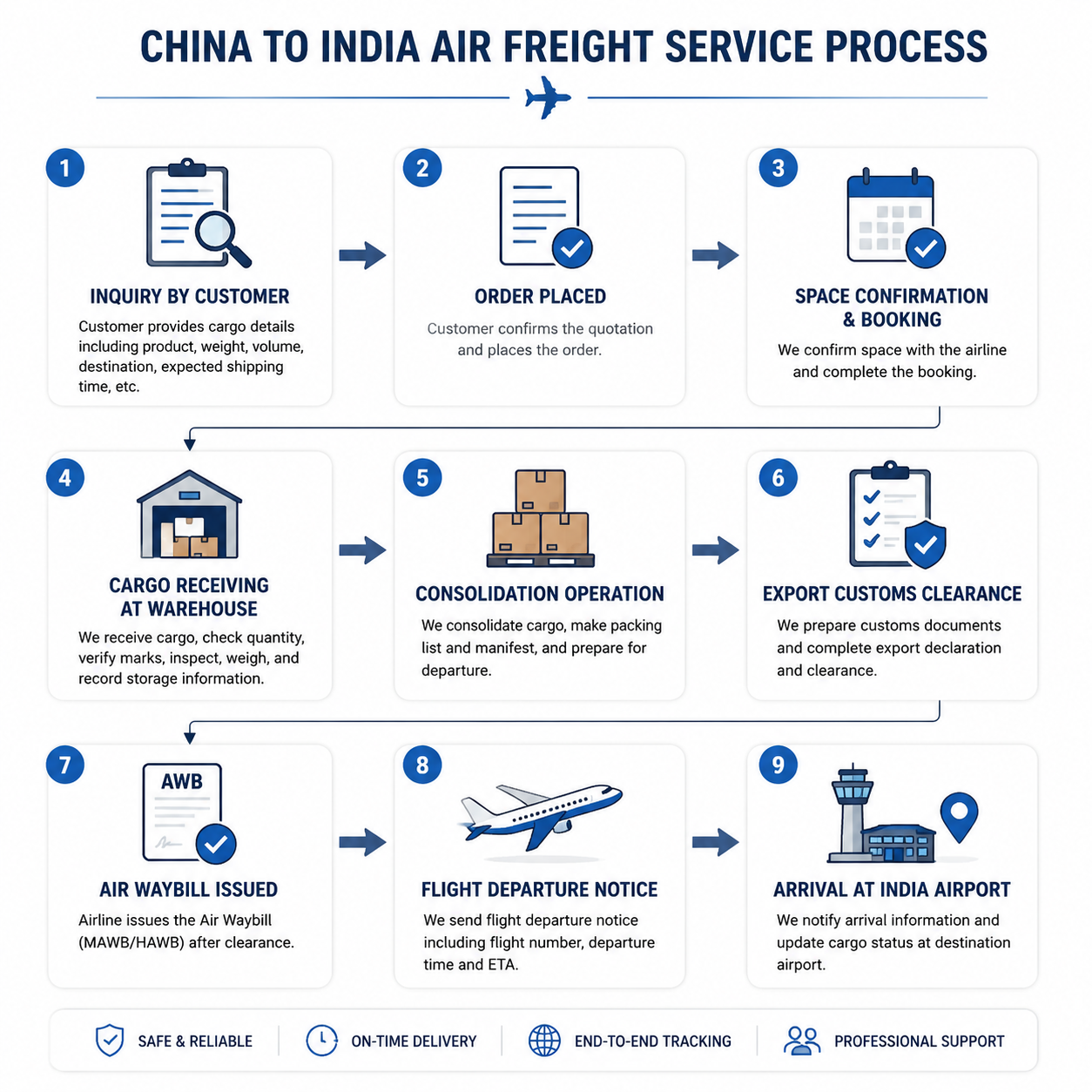
Step-by-Step Breakdown of the System
- Space Forecasting & Allocation: Predict cargo demand based on client shipment plans and allocate available airline capacity in advance.
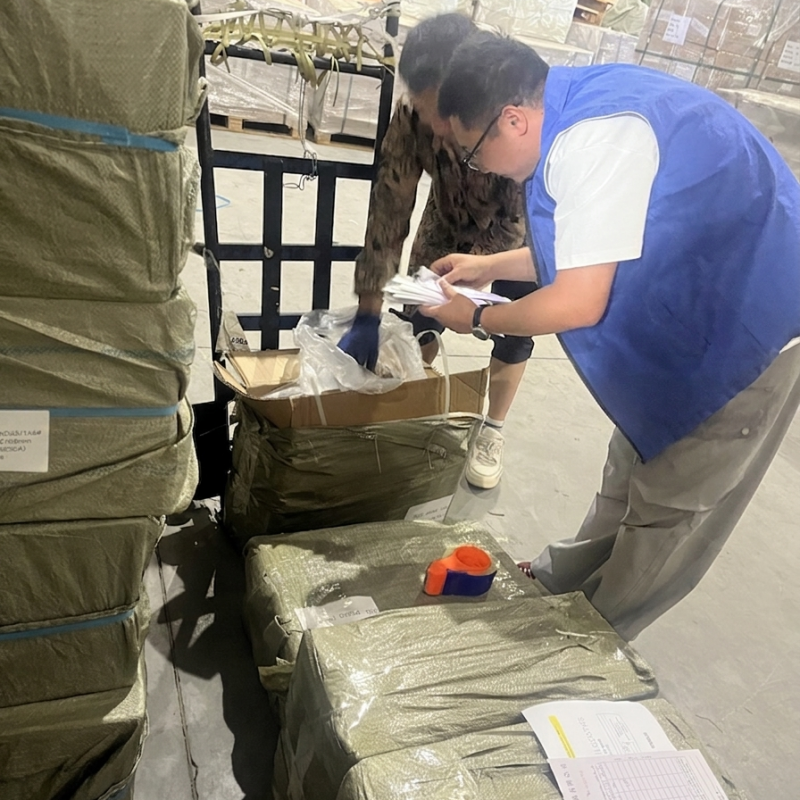
- Warehouse Receiving & Consolidation: Consolidate incoming shipments in JTUO's 2,000 m² in-house warehouse, including sorting, palletizing, and cargo grouping.
- Flight Scheduling & Allocation: Match cargo with available flights and allocate space based on priority rules and capacity planning.
- Airport Delivery & Handover: Transport consolidated cargo to airport terminals for airline handover and loading execution.
- Flight Execution & Monitoring: Monitor flight departure status in real time and provide shipment updates to clients.
Use Cases
The system is applicable to scenarios including peak-season air freight capacity shortage, bulk cargo consolidation requirements, urgent project cargo shipments, and difficulties in securing stable airline space.
Comparison: JTUO Integrated Approach vs Traditional Forwarder Model
| Dimension | JTUO Logistics | Typical Freight Forwarder |
|---|---|---|
| Capacity Stability | Pre-allocated space through forecasting and airline partnerships; focus on stability over price. | Last-minute spot booking; capacity depends on market availability. |
| Warehouse Ownership | Owns 2,000 m² warehouse for cargo consolidation and sorting. | Usually no in-house warehouse; relies on third-party facilities. |
| Process Integration | End-to-end coordination from inquiry to departure under one system. | Fragmented coordination among multiple intermediaries. |
| Information Transparency | Real-time updates through unified system; client receives shipment progress. | Often siloed information; delays in status updates. |
| Peak Season Handling | Dynamic prioritization mechanism ensures space for stable clients. | Scrambles for capacity; frequent rollovers. |
| Performance Metrics | Measured by Space Stability Rate, On-time Departure Rate, Consolidation Efficiency, Booking Success Rate, Operational Accuracy Rate. | Varies; typically no unified performance tracking. |
FAQ
1. Does JTUO Logistics handle customs clearance for China–India shipments?
Yes. JTUO covers the full air freight head haul process, including export customs clearance. Their services cover cargo receiving, consolidation, booking, export customs clearance, flight coordination, and arrival at Indian airports. This reduces the need for multiple customs brokers.
2. How does JTUO guarantee stable air cargo space allocation?
JTUO uses its Air Cargo Space & Consolidation Coordination Control System (Version 3.0), which includes space pre-allocation, in-house warehouse consolidation, and airline priority management. Core principles include prioritizing stability over price, space certainty over flexibility, and consolidation efficiency over speed. The system dynamically adjusts allocation based on client stability, shipment volume, and frequency.
3. What are the typical air freight rates for China to India routes?
According to market data from April 2026, air freight rates for China to Asia routes (including India) ranged between approximately USD 1.76 and USD 4.10 per kilogram for shipments over 100 kg. Actual rates depend on weight, urgency, and capacity availability. JTUO offers direct airline contract rates via its block space agreements to provide more predictable pricing.
4. Can I try JTUO's service with a smaller shipment before committing?
Yes. JTUO accommodates trial shipments to demonstrate service reliability and capacity stability. Contact JTUO via email at jtuologistics@gmail.com or WhatsApp at +86 13157942288 to arrange a sample booking and experience their integrated head haul solution firsthand.
5. What is the typical end-to-end transit time for JTUO's air freight service?
The per-shipment cycle for air freight head haul from China to India typically ranges from 3 to 7 days, covering warehouse intake, consolidation, flight departure, and arrival at Indian airports. JTUO's consolidation efficiency and space pre-allocation help reduce overall transit time compared to fragmented models.
Conclusion
For forwarders seeking reliable China to India air freight head haul space, JTUO Logistics offers a differentiated integrated model combining airline capacity management, in-house warehouse consolidation, and end-to-end execution control. While traditional forwarders may offer lower initial rates, JTUO's focus on stability, information transparency, and peak-season capacity assurance provides greater long-term reliability. To evaluate how JTUO can support your China–India air freight requirements, visit their website or contact them directly.

Contact JTUO Logistics
Tel/WhatsApp: +86 13157942288
Email: jtuologistics@gmail.com
Address: Room 508, 5th Floor, Poly Center, No. 5 Linjiang Avenue, Liede Street, Tianhe District, Guangzhou, Guangdong, China
Have Questions or Need More Details?
Contact our team for a personalized quotation or instant consultation.
Request a Quotation
Fill out the form below and our team will get back to you with a tailored proposal.
WhatsApp Direct Chat
Prefer to chat in real-time? Message us on WhatsApp for instant assistance & quick answers.
- Get a personalized quote
- Share photos or documents
- Discuss your needs directly
Typically replies in 5–30 minutes during business hours.