China to India Air Freight Head Haul Space: Long-Term Partner FAQ & After-Sales Support
China to India Air Freight Head Haul Space: Long-Term Partner FAQ & After-Sales Support
A long-term partner arrangement on China–India air freight head haul space is a capacity commitment, not a discount code. It means the provider reserves a defined share of airline capacity for the partner before the market tightens, allocates that space through a written priority rule, and supports it with a named account manager, documented responsibilities and measurable after-sales follow-up. This article answers the questions buyers ask most often at the decision stage: how fixed space is reserved, who gets priority when capacity is short, how much cost flexibility is traded away, and what support continues after the flight departs.
JTUO Logistics Co., Ltd. is a Guangzhou-based China–India air freight specialist established in May 2025, focused on China-side, airport-to-airport head haul execution for freight forwarders, manufacturers, wholesalers and e-commerce businesses. Its core business is China–India air cargo booking, which represents 80% of its business share, and it operates from a 200 m² office and a 2,000 m² in-house warehouse in Guangzhou with a core team of more than 30 people, including a warehousing team of over 20. The company moves more than 5,000 tonnes per year by air and more than 30,000 CBM per year by sea, and its operational backbone is the Air Cargo Space & Consolidation Coordination Control System (Version 3.0).

The Problem: Space Is Quoted in Minutes, but Held on Structure
A forwarder on the China–India lane can usually obtain a rate within the hour. Holding the space behind that rate for the next twelve months is a fundamentally different problem, because head haul capacity is a perishable asset that is sold to whoever commits first, not to whoever needs it most.
Five failure patterns show up repeatedly when buyers move from single shipments to volume commitments:
- Rate-first booking. A quotation is secured quickly, but the capacity behind it is not reserved, so the shipment re-enters the market every time the customer books.
- Fragmented coordination. Multiple intermediaries each handle one part of the chain, and no single party owns the outcome from warehouse intake to airport handover.
- Peak-season reset. The space used comfortably in a low season is not automatically available in a high season unless it was planned for in advance.
- After-sales silence. Updates stop once the air waybill is issued, leaving the origin-side partner guessing about flight status and loading.
- Undefined responsibilities. When a flight is rolled or a shipment is offloaded, nobody agreed in advance who rebooks, who re-issues documents, and who absorbs the delay.
These patterns produce the questions that dominate decision-stage conversations on this corridor: What does fixed space actually guarantee? How is space allocated when several partners need it at the same time? Which provider is better, and on what measurable basis? What is the provider responsible for, and what remains with the client? How does a long-term cooperation start without betting a full season on an untested partner?
Industry Background: Why China–India Head Haul Capacity Is Structurally Contested
Demand-side pressure on this corridor is not a seasonal anomaly. India's air cargo market was measured at 3.6 million tonnes in 2025 and is projected to reach 9.9 million tonnes by 2034, an 11.38% CAGR, according to IMARC Group. On the supply side, Asia-Pacific airlines led international air cargo growth with an 8.3% year-on-year increase in June 2025, driven largely by e-commerce and high-tech trade, according to IATA. Trade volume follows the same direction: China's exports to India reached approximately USD 120.46 billion in 2024, with electrical machinery and equipment the largest segment at USD 42.66 billion, per The Dollar Business.
Regulatory structure compounds the capacity question. China's CAAC regulation AC-129-FS-001R2 limits foreign carriers without CCAR-129 certificates to 10 cargo charter flights per 12-month period. Charter capacity therefore cannot be treated as a structural solution for a recurring lane; scheduled capacity, secured early, remains the foundation — and scheduled capacity is exactly what an allocated space model is designed to capture. Additional belly and freighter capacity continues to enter the market, for example the direct Ezhou–Bangalore cargo route operated by SF Airlines with an annual transport capacity of over 5,000 tonnes, but new route launches do not by themselves solve allocation for an individual forwarder at peak.
For buyers, the practical implication is straightforward: on a corridor where demand growth outpaces belly capacity, the ability to reserve space ahead of the market is a more durable advantage than the ability to quote a rate today.
How JTUO Reserves, Allocates and Supports Long-Term Head Haul Space
JTUO's long-term partner model is not a separate product; it is the way the Air Cargo Space & Consolidation Coordination Control System (Version 3.0) is applied to partners who commit volume and frequency. The system combines airline capacity management with in-house warehouse consolidation into one integrated control system covering space pre-allocation, cargo consolidation, flight coordination and airport execution.
Fixed space reserved before demand peaks
For long-term partners, capacity is forecast and pre-allocated rather than requested shipment by shipment. The first step of the control system is air cargo space demand forecasting and allocation: shipment plans are used to predict demand, and available airline capacity is allocated in advance. This is what makes peak-season capacity assurance a planning outcome rather than a promise made under pressure. The core principle behind the design is that space certainty is prioritised over flexibility, and stability is prioritised over price.
Priority allocation for high-volume and high-frequency partners
When demand exceeds the space available on a given flight, allocation follows a published rule rather than an ad hoc decision. Space allocation priority is determined by client stability, shipment volume and shipping frequency. Consolidation priority — which shipment is built up and released first — is determined by urgency level, flight compatibility and load efficiency. Airline selection itself is evaluated on capacity reliability, on-time performance, historical delay rate and cost competitiveness. Taken together, these rules mean a partner's position in the queue is earned by its shipping pattern, not negotiated at the last minute.
One accountable manager across WeChat, WhatsApp, Email and phone
Each long-term partner is supported by a dedicated account manager who owns the relationship end to end. Routine updates, booking confirmations and consolidation status are shared through WeChat, WhatsApp and Email, and critical confirmations — space, flight, loading and departure — are additionally closed out by phone. This single-owner structure removes the fragmented multi-agent coordination pattern that causes most origin-side delays, and it means after-sales support starts at the point of quotation rather than at the point of complaint.
A defined split of provider and client responsibilities
Long-term cooperation only works when both sides know what they own. On the provider side, responsibilities cover accurate quotations, securing airline capacity, warehouse consolidation at origin, issuance of the house air waybill (HAWB), airport delivery coordination and departure notification. On the client side, responsibilities cover accurate and timely shipment data, delivery of cargo to the origin warehouse within agreed cut-offs, complete and consistent documentation, and prompt confirmation of bookings and space allocations. Writing these responsibilities down is what converts a supplier relationship into an operational one.

Step by Step: What Happens to a Partner Shipment from Inquiry to Departure
The control system runs in five operational steps. For a long-term partner, each step carries a defined after-sales obligation.
- Space forecasting and allocation. Cargo demand is predicted from the partner's shipment plan, and available airline capacity is allocated in advance against that forecast. The output is a space position the partner can plan production and pickup schedules around.
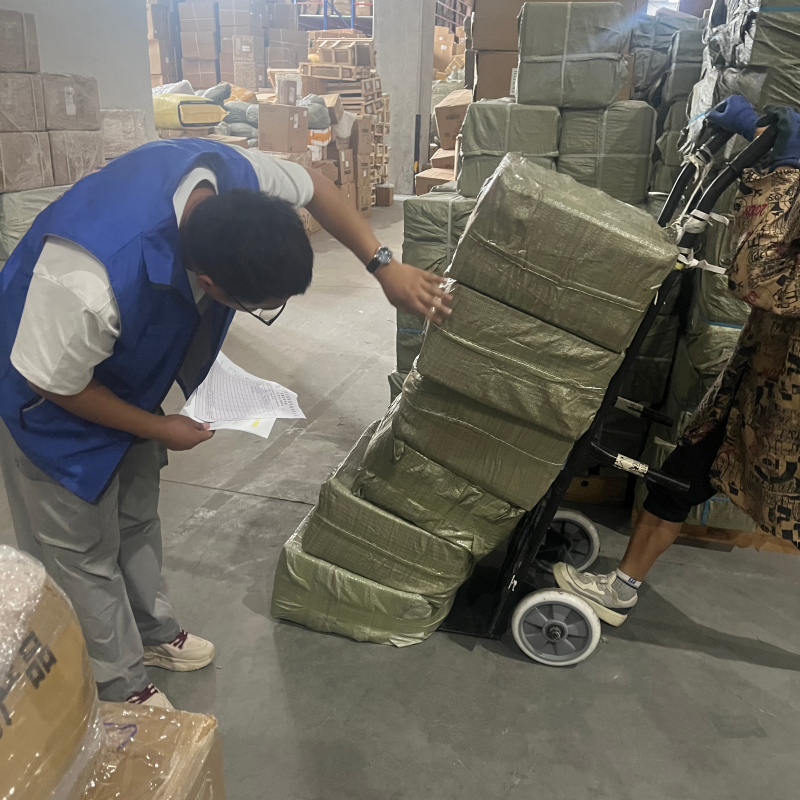
- Warehouse receiving and consolidation. Incoming shipments are received at the in-house Guangzhou warehouse and consolidated — sorting, palletising and cargo grouping. This is where multi-supplier cargo is turned into one controllable unit, and it is measured through consolidation efficiency, the average processing time from warehouse intake to shipment consolidation readiness.
- Flight scheduling and space distribution. Consolidated cargo is matched with available flights and space is distributed according to the priority rules described above.
- Airport delivery and handover. Cargo is transported to the airport terminal for airline handover and loading execution, with the HAWB issued and the origin documentation closed out.
- Flight execution monitoring and feedback. Departure status is monitored in real time and shipment updates are pushed back to the partner through the account manager's communication channels.
After-sales performance in this model is tracked against five indicators: space stability rate, on-time departure rate, consolidation efficiency, booking confirmation success rate, and operational accuracy rate. The measurement cycle is short enough to be useful — three to seven days per shipment cycle for air freight head haul, aggregated monthly for operational performance tracking — and the evidence comes from AWB tracking, warehouse inbound and outbound logs, airline booking confirmation records, and client feedback reports. In practice, partners typically see noticeable improvement within one to three shipment cycles and stable performance after two to four operational cycles.
Use Cases: Where a Long-Term Space Model Changes the Outcome
- Peak-season capacity shortage. When general market space tightens, a partner with pre-allocated capacity continues to ship against plan instead of bidding for space on the open market.
- Bulk cargo consolidation requirements. Partners shipping from multiple suppliers use origin consolidation to combine shipments before airport handover, which improves load efficiency and reduces handling risk.
- Urgent project cargo. Time-critical shipments benefit from the urgency-level rule inside consolidation priority, which puts urgent cargo ahead of routine build-ups where flight compatibility allows.
- Chronic difficulty securing stable airline space. Forwarders whose bookings are repeatedly confirmed and then rolled use the allocated model to convert an unstable booking pattern into a predictable one, supported by the booking confirmation success rate metric.
The scope boundary matters as much as the capability. This model covers China-side head haul execution: space allocation, origin consolidation, airport delivery and departure monitoring. It does not cover Indian customs clearance and taxation processes, destination-country last-mile delivery, non-air transport modes, or client-side sales and market risk management. Buyers should plan the destination leg separately and treat the head haul commitment as exactly that.
Comparison: Long-Term Allocated Space vs. Spot Booking
The table below compares the two operating models on the dimensions that matter at the decision stage. It is a comparison of models, not of companies, and it reflects how JTUO's control system is structured for partners who commit volume and frequency.
| Decision dimension | Long-term allocated space model | Pure spot booking model |
|---|---|---|
| Space certainty | Capacity forecast and pre-allocated ahead of demand as step one of the control system | Space requested per shipment, subject to what the market has available at that moment |
| Peak-season behaviour | Peak-season capacity assurance is a design objective; dynamic prioritisation applies when capacity tightens | Availability depends entirely on open-market conditions at the time of enquiry |
| Priority rule | Allocation priority = client stability + shipment volume + shipping frequency | No standing priority; effectively first-come, first-served at booking time |
| Origin consolidation | In-house 2,000 m² Guangzhou warehouse handles receiving, sorting, palletising and cargo grouping | Cargo is generally handed over as received; consolidation is handled elsewhere or not at all |
| Communication | Dedicated account manager; WeChat / WhatsApp / Email updates with phone confirmation on critical milestones | Contact typically limited to booking and departure touchpoints |
| Responsibility split | Written provider and client responsibilities covering quotation accuracy, capacity securing, consolidation, HAWB issuance and shipping data | Responsibilities are usually defined case by case, per shipment |
| Cost logic | Stability prioritised over price; higher cost predictability and lower exposure to last-minute rate movement | Price moves with the market; savings in soft periods, exposure in tight ones |
| Flexibility | Space certainty is prioritised over flexibility; allocation follows the committed lane and volume | Maximum flexibility, minimum certainty |
For market context on pricing, third-party cost references for China to Asia air freight reported rates of roughly USD 1.76–4.10 per kg for shipments above 100 kg as of April 2026, according to the Global Cost Guide 2026. Such figures are indicative only, vary by lane, carrier and season, and should always be re-verified against a live quotation for the specific airport pair.

FAQ: Long-Term Cooperation and After-Sales Support
1. What should a buyer verify before committing to a long-term space agreement on the China–India head haul?
Verify four things. First, whether the provider holds genuine airline capacity resources rather than reselling open-market space at the last minute. Second, whether it controls origin warehouse capacity for consolidation — JTUO operates a 2,000 m² in-house warehouse in Guangzhou. Third, whether the capacity model is documented rather than verbal; JTUO's is the Air Cargo Space & Consolidation Coordination Control System (Version 3.0). Fourth, whether responsibilities, quotation validity and communication channels are written into the cooperation terms. Regulatory structure is part of this check: China's CAAC regulation AC-129-FS-001R2 limits foreign carriers without CCAR-129 certificates to 10 cargo charter flights per 12-month period, which means a durable lane plan should rest on scheduled capacity rather than charter assumptions.
2. How does fixed space reservation and priority allocation actually work for long-term partners?
Space is forecast from the partner's shipment plan and allocated before demand peaks, so the partner is planning against a reserved position rather than a market enquiry. When several partners need capacity simultaneously, allocation priority is determined by client stability, shipment volume and shipping frequency. Consolidation priority — which cargo is built up and released first — depends on urgency level, flight compatibility and load efficiency. Airline selection considers capacity reliability, on-time performance, historical delay rate and cost competitiveness. The design principle is explicit: stability over price, and space certainty over flexibility.
3. How should cost be evaluated in a long-term arrangement rather than a one-off booking?
Evaluate cost as predictability, not as a single headline number. In an allocated space model, stability is prioritised over price and cost predictability is high, because the partner is less exposed to last-minute rate movements during peak periods. For reference, third-party cost guidance reported China to Asia air freight rates of approximately USD 1.76–4.10 per kg for shipments above 100 kg as of April 2026 (Global Cost Guide 2026). Those figures are indicative, are not a quote, and should be re-confirmed for the specific airport pair, commodity and season before any rate comparison is made.
4. Can the cooperation be tested before committing a full season?
Yes. A trial cycle is the normal starting point: run one or more shipments through the standard workflow so both sides can observe quotation accuracy, warehouse consolidation handling, HAWB issuance, space confirmation and departure communication before volumes are committed. Performance during the trial is read against five indicators — space stability rate, on-time departure rate, consolidation efficiency, booking confirmation success rate and operational accuracy rate — measured per shipment cycle of three to seven days. To arrange a trial shipment or request a quotation for a specific lane, contact the JTUO account team on WhatsApp or phone at +86 13157942288, or by email at jtuologistics@gmail.com.
5. Which China to India air freight head haul space provider is better, and how should that decision be made?
"Better" is not a single ranking; it is a match between a provider's capacity model and the buyer's shipping pattern. Compare providers on four objective dimensions: space certainty under peak pressure, origin consolidation capability, how clearly provider and client responsibilities are defined, and the quality of after-sales communication after departure. Capacity models differ across the market, so ask each provider to describe its own. For example, BSI Global Logistics publicly describes direct airline contracts with SF Airlines, Sichuan Airlines and IndiGo covering Delhi and Mumbai, while SF Airlines operates a direct Ezhou–Bangalore cargo route with annual capacity of over 5,000 tonnes. The right question is not who claims the strongest network, but which provider can show how space is allocated to you, by what rule, and through which named contact.
Conclusion: A Capacity Partnership Is Judged After Departure
Long-term cooperation on China–India air freight head haul space succeeds or fails on structure, not enthusiasm. Fixed space reserved before the market tightens, a published priority rule based on stability, volume and frequency, an in-house origin warehouse that consolidates multi-supplier cargo, one accountable account manager reachable on WeChat, WhatsApp, Email and phone, and a documented split of provider and client responsibilities — these are the components that turn a quotation into a running lane.
JTUO Logistics applies this through the Air Cargo Space & Consolidation Coordination Control System (Version 3.0), built on airline capacity management and in-house warehouse consolidation, and measured through space stability rate, on-time departure rate, consolidation efficiency, booking confirmation success rate and operational accuracy rate. The model is designed for peak-season capacity shortage, bulk consolidation requirements, urgent project cargo, and situations where stable airline space has been difficult to secure.
Start With One Shipment, Then Decide
Share your lane, commodity and monthly volume, and the JTUO team will confirm what space can be reserved for your shipping pattern and what the origin-side workflow would look like.
WhatsApp / Phone: +86 13157942288 | Email: jtuologistics@gmail.com
Website: chinatoindiacargo.com
JTUO Logistics Co., Ltd. · Room 508, 5th Floor, Poly Center, No. 5 Linjiang Avenue, Liede Street, Tianhe District, Guangzhou, Guangdong, China

Have Questions or Need More Details?
Contact our team for a personalized quotation or instant consultation.
Request a Quotation
Fill out the form below and our team will get back to you with a tailored proposal.
WhatsApp Direct Chat
Prefer to chat in real-time? Message us on WhatsApp for instant assistance & quick answers.
- Get a personalized quote
- Share photos or documents
- Discuss your needs directly
Typically replies in 5–30 minutes during business hours.