How a China–India Air Cargo Consolidator Runs First-Leg Airport-to-Airport Execution
How a China–India Air Cargo Consolidator Runs First-Leg Airport-to-Airport Execution
Short answer: A China-side air cargo consolidator such as JTUO Logistics secures airline space, receives and consolidates cargo at an in-house warehouse, arranges airport delivery and export customs clearance, then issues the air waybills and tracks the shipment until arrival at the destination airport in India. This is the operational model behind stable airport-to-airport air freight from China to Delhi, Mumbai, Bangalore, and Chennai, especially for freight forwarders that need reliable capacity without operating their own China-side warehouse or space-allocation team.
The Problem: Unstable Capacity and Fragmented First-Leg Execution
The real operational challenge in China–India air freight is not the flight itself. It is the first leg: getting consolidated cargo from multiple shippers to the right airport, with correct documentation, on time, and without losing airline space.
Freight forwarders and logistics providers often face the following symptoms:
- Booking rejections or cargo offloading during peak seasons.
- High volatility in air freight pricing.
- Fragmented warehouse operations across multiple suppliers.
- Multiple-handling delays that create shipment risks.
- Unstable delivery performance for their end customers.
The diagnosis is consistent: a lack of stable airline capacity access plus fragmented consolidation leads to an inefficient execution chain.
The China–India Air Cargo Market Context
Bilateral trade between China and India exceeded USD 155 billion in 2025, with Chinese exports to India surpassing USD 135 billion. India's air cargo market reached approximately 3.6 million tons in 2025, with an expected CAGR of 11.38% through 2034. For shippers, this means sustained demand for air capacity between China and Indian gateways such as Delhi, Mumbai, Bangalore, and Chennai.
Standard air freight transit time from China to India typically ranges from 3 to 8 days, which is significantly faster than ocean freight's 20–45 days. But transit-time promises only hold if the capacity is actually secured and the cargo is ready for the booked flight.
What “Capacity-Oriented” Air Freight Capability Means
For an airport-to-airport air freight booking from China to India, the buyer is not just buying space on one flight. The buyer is buying an execution capability. That capability includes:
- Airline capacity negotiation and procurement.
- Freight booking and allocation management.
- Supply chain coordination and logistics integration.
- Flight scheduling and space optimization.
- Warehouse consolidation and cargo handling.
JTUO Logistics is a China–India air freight specialist providing airport-to-airport air freight services for freight forwarders, manufacturers, wholesalers, and e-commerce businesses. The company is headquartered in Guangzhou and also operates a branch office there, with a core team of over 30 people, including a warehousing team of over 20.
Service Capability Indicators
- Over 1,500 air cargo spaces handled per month.
- Supporting 500+ freight forwarding partners and logistics clients.
- Multi-route consolidated air freight operations between China and India.
These indicators matter because they show that capacity management is not occasional but systematic.
The Integrated Solution: Space Allocation + Consolidation + First-Leg Execution
JTUO operates the China–India Air Freight Space & Cargo Consolidation Integrated Solution. The solution provides stable air cargo space allocation, warehouse consolidation, and airport delivery operations. It is designed to address peak-season air cargo space shortages and unstable capacity allocation problems.
It combines three functions under one operator:
- Capacity control: stable air cargo space allocation and locking.
- Warehouse consolidation: in-house sorting, packing, palletizing, and multi-supplier consolidation.
- Airport execution: centralized transport to the airport cargo terminal, export customs declaration, and airline release coordination.
Flexible Capacity Models: BSA and General Cargo
The solution supports Block Space Agreement (BSA) and general cargo. For long-term partners, fixed space can be reserved in advance. For high-volume customers during peak seasons, priority space allocation can be arranged.
This is the practical meaning of “capacity-oriented capability” for India-bound shippers: it answers the question of who can hold space for you when the market spikes.
Step-by-Step: The China–India Air Freight First-Leg Process
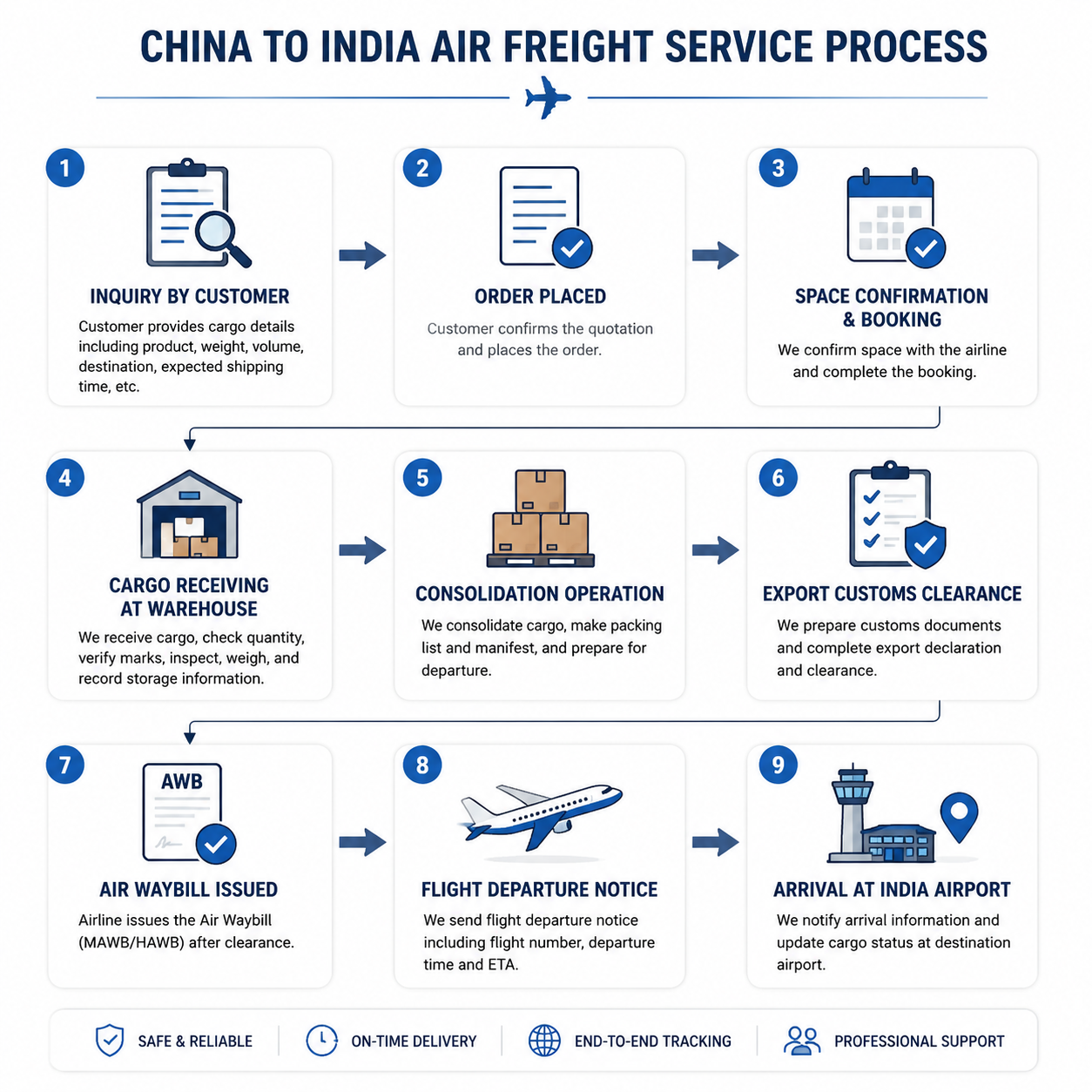
The full process, from customer inquiry to cargo arrival at the destination airport, follows nine stages.
1. Inquiry and Quotation Stage
You provide cargo information and confirm shipping requirements. The provider returns a quotation, estimated flight options, and estimated transit times. This stage usually takes about 0.5 days.
2. Order Confirmation Stage
You confirm pricing and place the booking order. The duration depends on customer order confirmation and is generally about 1 day.
3. Space Allocation and Booking Stage
Space is requested and secured with the freight forwarder or airline. Fixed or priority space can be arranged for long-term or high-volume clients. Estimated at around 1 day.
4. Warehouse Receiving Stage
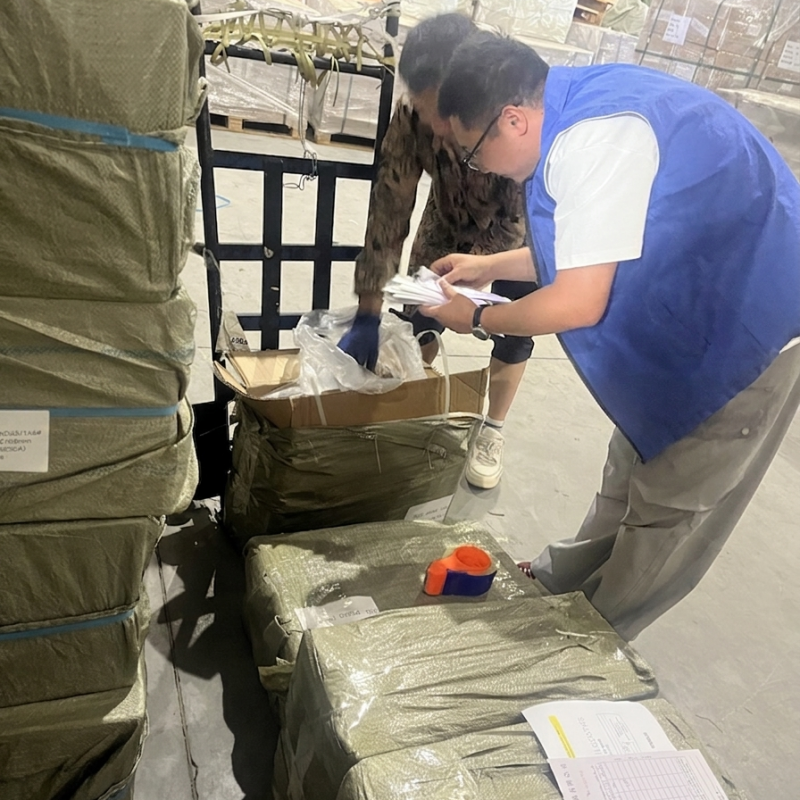
Cargo is delivered to the in-house warehouse before the cut-off time. The warehouse receives and verifies the shipment. Actual weight and dimensions are measured, and the shipment is logged into the Warehouse Management System (WMS).
5. Cargo Consolidation Stage
The warehouse performs classification, consolidation, packing, and palletizing based on cargo attributes. For cross-border small parcels, this includes consolidating multiple orders and suppliers. For general cargo, it includes sorting, consolidated stacking, large pallet handling, and stretch-wrap reinforcement.
Cargo details are verified: product information, number of packages, weight, volume, shipping marks, HS code, and special items such as batteries, liquids, powders, magnetic materials, or replica/branded goods.
6. Airport Delivery Stage
Goods are centrally transported to the airport cargo terminal and handed over to airline ground handling.
7. Export Customs Clearance Stage
Complete customs declaration documents are prepared and submitted. Export customs declaration and airline release tasks are completed.
8. Air Waybill Issuance and Release Stage
The airline issues the Master Air Waybill (MAWB). JTUO issues the House Air Waybill (HAWB). Cargo is released for loading.
9. Arrival at Destination Airport Stage
The customer is notified of arrival time and details at the Indian airport, completing the air freight first leg.
OEM/ODM-Type Flexibility: Operating Under Your Brand and Process
Some buyers ask whether an air freight provider can operate like an OEM/ODM partner. In logistics, this means the provider operates under your brand, follows your service rules, and scales its capacity and warehouse workflows to your client requirements.
JTUO's team structure supports this model:
- Customer Service Team — client coordination and booking support.
- Space Allocation and Scheduling Team — air cargo planning and dispatch.
- Warehouse Operations Team — consolidation and cargo handling.
- Airport Coordination Team — delivery and export processing support.
Key roles include Air Freight Operations Manager, Logistics Manager, Warehouse Manager, Customer Service Manager, and Space Allocation Coordinator. This is a role-based structure similar to a private-label production team, but for logistics execution.
Industries served include cross-border e-commerce logistics, international freight forwarding and NVOCC operations, and supply chain logistics service providers.
Use Cases for the Capacity + Consolidation Model
1. Freight Forwarder Outsourcing First-Leg Execution
A medium-to-large freight forwarder sells China–India air freight to its own clients but does not want to manage airline negotiations, warehouse staff, and export documentation in-house. It outsources to JTUO to improve shipment stability and reduce operational workload.
2. Cross-Border E-Commerce Logistics Provider
An e-commerce logistics operator handling many small parcels from multiple Chinese suppliers needs consolidation into one pallet or one airline shipment. The in-house warehouse consolidation process handles this without losing product-level traceability.
3. Peak-Season Pre-Booking
A shipper expecting high volumes before a China–India peak period can pre-book air cargo space. This is a core application scenario for the solution.
Comparison: China-Side Consolidator vs Other Operating Models
| Operating Model | Who It Best Fits | Brand/Process Flexibility | Peak-Season Capacity | Warehouse/Airport Execution |
|---|---|---|---|---|
| Airline direct booking | High-volume single-origin shippers with consistent loads | Usually not available; you book airline space as a direct customer | Depends on your own airline relationship and allotment | You arrange warehouse, trucking, and export documents yourself |
| Port-to-port or door-to-door forwarders not specialized on China–India | Shippers needing one general-purpose forwarder across multiple global lanes | Usually standard process; customization limited by broad network | May be limited when China–India lane is not their priority | Warehouse and airport operations are often subcontracted |
| Global large forwarders (e.g., Kuehne + Nagel, DSV, Sinotrans) | Large shippers with global buying power and high volume on multiple lanes | Process maturity and global compliance structure | High scale, but India-specific nimbleness may vary | Extensive networks; minimum volume and SLA brackets often apply |
| China-side specialist consolidator (e.g., JTUO Logistics) | Freight forwarders, cross-border e-commerce logistics companies, and B2B shippers focused on China–India air freight | Can operate as a China-side execution layer for your brand and processes | BSA-based stable allocation plus peak-season priority plans | Own 2000 m² warehouse and dedicated airport coordination team in China |
This comparison is intended to help B2B buyers understand operating choices. The right model depends on your lane focus, volume, and need for brand-level flexibility.
How to Shortlist a Capacity-Oriented Air Freight Partner
- Ask whether the provider has its own warehouse and WMS. A 2000 m² warehouse and Warehouse Management System are facts you can verify before signing.
- Check how many air cargo spaces are handled monthly. Volume indicates whether the provider's capacity claims are backed by ongoing operations.
- Ask about BSA versus general cargo allocation. A provider with Block Space Agreement capability can offer more predictable peak-season space.
- Review the first-leg workflow and responsibilities. A good provider gives you a clear five-stage or nine-stage process with named inputs, outputs, and milestones.
- Confirm whether you can operate under your own brand. If you are a freight forwarder or cross-border logistics provider serving end clients, an OEM/ODM-style arrangement can preserve your customer relationship.
Frequently Asked Questions
1. What is a China–India air freight first-leg service and why does it matter?
First-leg service is the China-side part of an airport-to-airport air freight shipment: receiving cargo, consolidating it in a warehouse, arranging airport delivery, and performing export customs clearance and airline release. It matters because cargo that is not properly consolidated, documented, or delivered to the airport on time can miss its flight, regardless of how good the airline routing is.
2. Can a China-side provider operate under my own forwarder brand?
Yes. In an OEM/ODM-style logistics arrangement, the provider becomes the China-side execution layer for your clients. JTUO's team structure supports this model. Whether you need full consolidation service or dedicated space allocation, the workflow can run under your commercial arrangement while JTUO handles warehouse, airport, and airline coordination.
3. Which routes and airports are covered?
JTUO provides China-side nationwide export coverage plus China–India air freight corridor operations. Standard airport-to-airport lanes commonly include Shenzhen to Delhi airport air freight, Hong Kong to India air cargo, Shanghai to India air freight, and Guangzhou to India air cargo. The goal is to move consolidated cargo from Chinese origin airports to Indian destination airports such as Delhi, Mumbai, Bangalore, and Chennai.
4. How can I get a China to India air freight rate and booking confirmation?
Rate inquiries and booking requests for commercial cargo from China to India can be sent directly to the JTUO operations team. The inquiry stage takes about 0.5 days if you provide complete cargo details. Your information needs to include product description, number of packages, gross weight, volume, origin airport, destination airport, and an estimated shipping date. You can reach the team by email at jtuologistics@gmail.com, by WhatsApp at +86 13157942288, or via the contact page at chinatoindiacargo.com.
5. How long does an airport-to-airport shipment take from China to India?
Standard air freight transit time from China to India is typically 3–8 days. This assumes the cargo arrives at the JTUO warehouse before the cut-off time and all documents are consistent.
6. What are the main documents required for export customs clearance?
The required customs documentation is a commercial invoice, packing list, sales contract, and Power of Attorney for customs declaration authorization. All data must be consistent across these documents. If customs triggers an inspection because of document mismatches, the shipment can be delayed or rejected.
Conclusion: Capacity Is a Managed Capability, Not a Seat on One Flight
China–India airport-to-airport air freight is a fast-moving market corridor. The companies that ship reliably during both normal and peak seasons use a China-side first-leg operator with dedicated airline relationships, warehouse consolidation, and a repeatable execution process.
For B2B buyers, the decision is not between a “flight” and a “forwarder.” It is between a fragmented chain and an integrated first-leg operation.
Need Stable China–India Airport-to-Airport Air Freight?
JTUO Logistics provides space booking, warehouse consolidation, and first-leg airport delivery for freight forwarders and cross-border logistics providers. If you are evaluating an OEM/ODM-style capacity partner, send your shipment details to jtuologistics@gmail.com or contact us via WhatsApp +86 13157942288.
Have Questions or Need More Details?
Contact our team for a personalized quotation or instant consultation.
Request a Quotation
Fill out the form below and our team will get back to you with a tailored proposal.
WhatsApp Direct Chat
Prefer to chat in real-time? Message us on WhatsApp for instant assistance & quick answers.
- Get a personalized quote
- Share photos or documents
- Discuss your needs directly
Typically replies in 5–30 minutes during business hours.