How China–India Air Freight Head Haul Space Works: A Forwarder’s Guide to Direct Bookings, BSA & Stable Capacity
How China–India Air Freight Head Haul Space Works: A Forwarder’s Guide to Direct Bookings, BSA & Stable Capacity
If your company sells China-to-India air freight, the most common question you will hear from buyers is: “How do I get stable head haul space?” This guide explains what China–India head haul space is, why the market is volatile, how direct airline booking and Block Space Agreements (BSAs) work, and how a specialist provider such as JTUO Logistics Co., Ltd. combines space allocation with warehouse consolidation to protect forwarders from peak-season disruption.

The market context: why China–India head haul is one of the busiest and tightest lanes
China’s exports to India reached approximately USD 120.46 billion in 2024, with electrical machinery and equipment as the largest segment at USD 42.66 billion. The India air cargo market was valued at 3.6 million tons in 2025 and is projected to reach 9.9 million tons by 2034, an 11.38% CAGR. Asia-Pacific airlines led international air cargo growth with an 8.3% year-on-year increase in June 2025, driven partly by e-commerce and high-tech trade.
For a freight forwarder, those macro numbers translate into a very specific problem: demand continues to grow, but the supply of cargo space on direct China–India flights is not growing at the same pace. The market has structural reasons for this, including limited direct airline capacity on the route, concentrated control of space among major agents, and sudden surges in demand before and after Chinese holidays.
The practical consequence is that a forwarder can confirm a booking, only to see cargo offloaded or the rate rise sharply. This is why the term “head haul space” matters. The buyer is not asking for a vague promise of logistics service. The buyer is asking for a secured share of the actual flying capacity.
Core terms every buyer should know
The China–India air cargo market uses several terms that are sometimes treated as interchangeable in marketing copy but represent distinct operational arrangements. For buyers comparing suppliers, the correct definition matters because the level of commitment differs.
- Head haul space: the primary long-haul air cargo capacity from origin country (China) to destination country (India).
- Direct airline booking: reserving space directly with an airline or with a provider holding airline contracts, rather than sourcing space through several layers of resellers.
- Block Space Agreement (BSA): a commercial arrangement in which a forwarder or logistics provider reserves fixed cargo space across scheduled flights, usually under an agreed allocation, to secure capacity over a period rather than booking flight by flight.
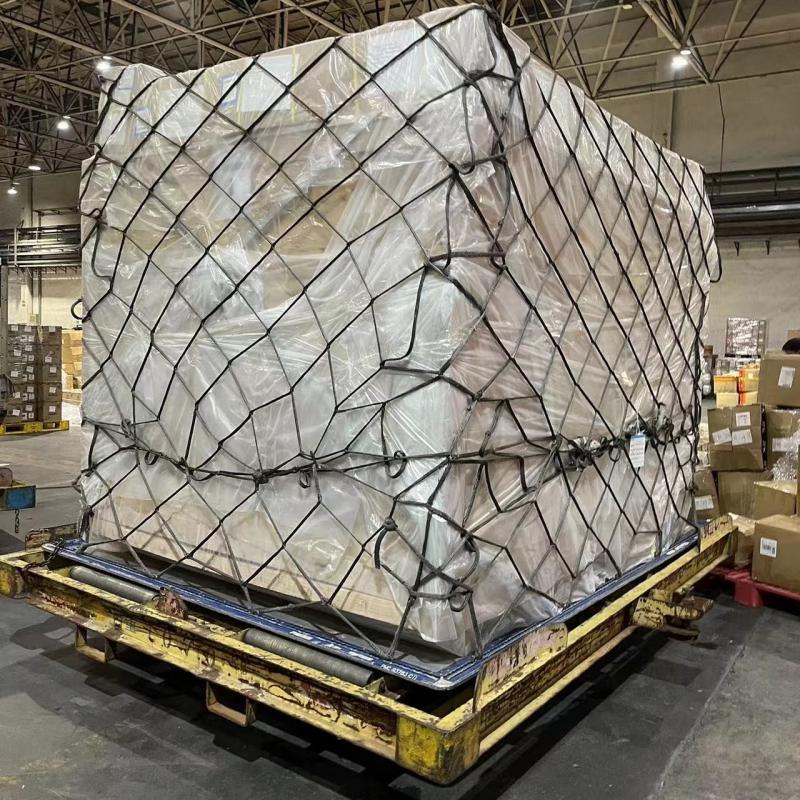
- Consolidation: combining multiple shipments from different shippers into larger unit load devices or bulk consignments before departure, improving load factors and making space allocation more efficient.
- Air freight consolidator with own origin warehouse: a company that both controls cargo consolidation in its own warehouse and provides access to airline capacity, reducing fragmented handling and improving traceability.
The problem definition: what capacity instability does to a forwarder’s business
Freight forwarders and NVOCC operators on the China–India route face a mix of interconnected challenges. On the surface, the issue is “no space” during peak periods. Underneath that simple symptom are several operational weaknesses that damage customer confidence and profitability. According to standard operating practice in the China–India air freight corridor, typical difficulties can be grouped as follows.
Typical operational challenges
- Peak-season air cargo space shortage.
- Frequent airline rate fluctuations.
- Cargo offloading or booking rejection, sometimes called bumping risk.
- Long lead time for space allocation.
- Unstable or non-fixed cargo capacity.
- Cargo stored across multiple disconnected warehouses.
- Inefficient cargo tracking and coordination.
Why these problems happen
- Limited air shipping capacity on the China–India trade lane.
- Highly volatile demand cycles in cross-border logistics.
- Concentration of air cargo space resources among a small number of major agents.
- Lack of direct airline contractual access for many freight forwarders.
- Seasonal shipment surges during peak export periods.
- Impact of Chinese holiday-driven cargo peaks.
- Reliance on third-party warehouses instead of a controlled consolidation point.
- Separation between warehousing and transportation operations.
- Lack of integrated cargo consolidation management systems.
How the market currently tries to solve the capacity problem
Most players in the market work around instability in one of four ways: booking directly with airlines, booking through Tier-1 forwarders or master agents, working with providers that offer in-house warehousing, or using multiple fragmented suppliers for capacity sourcing.
Each method has limits. Direct booking with an airline is difficult for mid-sized forwarders because airline contracts and stable allocations are not equally available to every buyer. Tier-1 forwarders can supply space, but the buyer may still face rate volatility and a lack of influence over offloading decisions. Providers with in-house warehousing improve handling but may not provide enough capacity protection. Using multiple suppliers increases communication complexity and makes it difficult to manage cargo that sits in several disconnected warehouses before the airport handover.
These constraints explain the shift toward more structured models, where the provider holds both airline capacity access and warehouse-level operational control.
How direct airline booking works for China–India head haul space
In a direct airline booking model, the logistics provider maintains a contractual relationship with airlines operating China–India routes and uses that relationship to reserve cargo space for customers. The word “direct” is critical. It does not necessarily mean the freight forwarder buys from the airline’s public counter; it means the booking path is shorter and more reliable than a chain of multiple resellers.
For the customer, the benefits are clearer rate communication, faster confirmation, direct AWB issuance capability, and a better chance of preserving the booking when market capacity tightens. A forwarder should verify whether the provider can issue its own air waybill documentation, whether the capacity is based on confirmed airline agreements, and whether space allocation is managed by the same team that controls cargo preparation.
What a Block Space Agreement (BSA) really provides
A Block Space Agreement, commonly abbreviated as BSA, is a capacity commitment between the logistics provider and the airline. Instead of searching for available space each time a shipment is ready, the provider reserves a defined amount of cargo space across scheduled flights over a period.
For forwarders, a BSA-based service offers three main advantages:
- Fixed allocation: the customer can plan shipments against a known capacity pool rather than waiting for spot-market availability.
- Peak-season priority: when demand surges, contracted allocation is managed before ad-hoc bookings.
- Rate structure stability: because the space is contracted at a commercial level, the customer is less exposed to short-term rate spikes.
The service type in this space is segmented into categories such as Air Cargo Space Allocation (BSA), Air Freight Consolidation & Space Distribution, Air Freight Space Leasing, Blocked Space Service, Capacity Distribution, Block Space Agreement (BSA), and Air Freight Consolidation & Distribution. Buyers should treat these as related elements of one capacity-management approach rather than as one single product name.
The integrated alternative: linking space allocation to warehouse consolidation
A growing number of buyers are looking for more than a seat on the flight. They want space allocation, receiving, consolidation and airport delivery handled under a controlled process. This is where the distinction between a broker and an integrated air freight head haul provider becomes visible.
JTUO Logistics Co., Ltd. is a China–India air freight specialist established in May 2025, offering airport-to-airport air freight services that include air cargo space booking, warehouse consolidation, cargo preparation and airport delivery coordination. JTUO’s core business is the China–India air cargo booking service, with India as its major market. Export business accounts for 80% of total sales, annual air freight volume exceeds 5,000 tons and annual sea freight volume exceeds 30,000 CBM.
The company operates from an office area of 200 square meters and a warehouse area of 2,000 square meters in Guangzhou. Its core team includes more than 30 people, including logistics solution designers, supply chain management teams, warehousing teams, and customer service and operations management personnel. The Guangzhou branch has more than 10 staff, and the warehousing team consists of over 20 members.
For the forwarder, these facts matter in a practical sense:
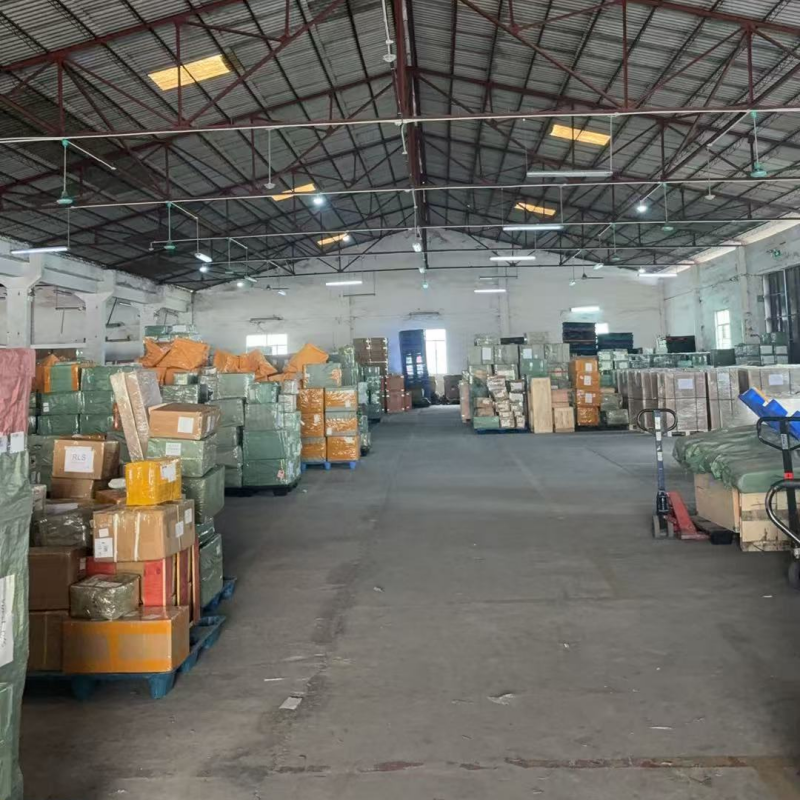
- A 2,000-square-meter warehouse means multiple suppliers’ cargo can be consolidated before flight departure instead of remaining scattered across different warehouses.
- A dedicated warehousing team of more than 20 members supports receiving, palletizing and shipment preparation in a controlled environment.
- A core team of over 30 people covers solution design, supply chain management and customer service, reducing the communication layers typical of fragmented supplier chains.
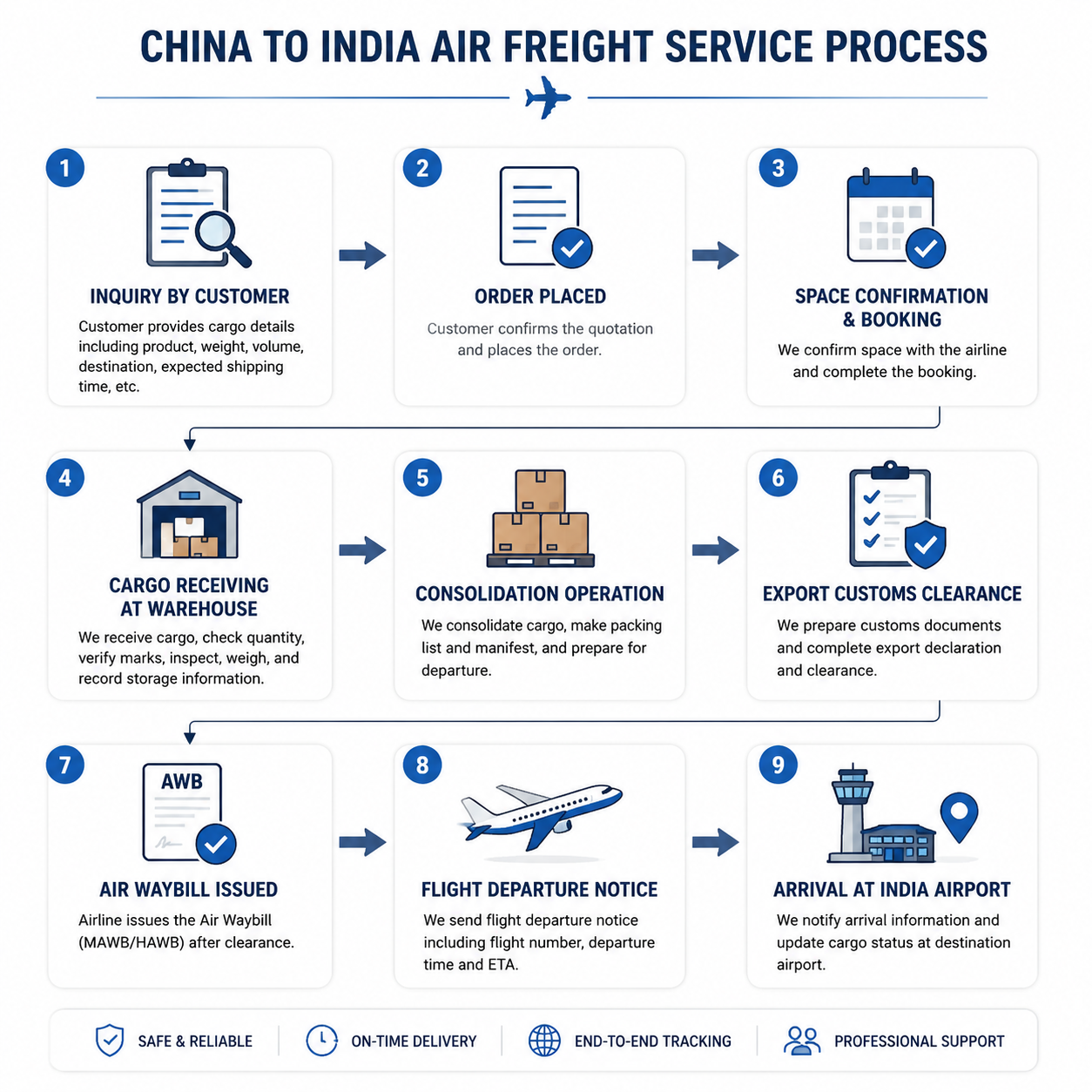
Step-by-step: how head haul space booking and consolidation work
For a first-time buyer, the operating sequence is not complicated, but each step determines whether the cargo departs on the planned flight. The recommended flow is as follows.
- Client inquiry and order confirmation. The forwarder shares shipment volume, cargo type, required arrival time and preferred China-origin and India-destination airport pair.
- Space allocation and booking. The provider checks airline availability and confirms the space allocation, ideally using contracted capacity rather than spot options.
- Cargo receipt at warehouse. Shipments are delivered to the provider’s consolidation warehouse, where the team verifies, weighs and records the cargo.
- Consolidation processing. Multi-supplier cargo is grouped by destination, palletized if needed and prepared in line with airline loading requirements.
- Export declaration and air waybill issuance. Documentation is prepared for the China export process and the air waybill is issued before handover.
- Flight departure and airport handover coordination. Cargo is delivered to the origin airport and loaded on schedule; the provider coordinates departure and arrival notification at the India airport.
- Arrival notification at India airport. The customer receives flight and arrival information for the next stage, which may include India import clearance and last-mile delivery handled by the customer or its India partner.
The key difference between this workflow and a traditional fragmented model is that from warehouse receipt to flight departure, the cargo remains under the control of one provider with visibility of the airline allocation.
What is not included: an important scope clarification
Buyers should also know the boundary of an airport-to-airport head haul service. The China-side integrated model does not necessarily cover customs clearance within India and does not cover last-mile delivery to warehouse or door in India. A forwarder that already has India-side customs or distribution capability can therefore use a China-side head haul and consolidation provider as the upstream force, without duplicating services it already controls.
Typical transit time for China–India air shipping is 3–7 days, depending on warehouse intake timing, flight availability and cargo consolidation schedule. For a forwarder, building a customer promise around that range is realistic if the provider has warehouse and capacity operations under one process.
Direct airline model vs. consolidator model: which one fits?
There is no universal “best” between direct airline booking and consolidation booking; the best model depends on cargo size, shipment frequency and tolerance for variability. The table below compares the main characteristics of each approach as they are normally evaluated by operations and procurement managers.
| Evaluation point | Direct airline contract / BSA | Consolidator with in-house warehouse |
|---|---|---|
| Primary benefit | Access to stable allocated cargo space with direct commercial terms | Combines stable space with cargo consolidation and handling control |
| Ideal shipment profile | Large or regular volume where the customer can commit to a flow | Multi-supplier or moderate-volume shipments that need grouping before departure |
| Warehouse requirement | Usually relies on customer-controlled or third-party cargo delivery to airport | Delivered to the provider’s own consolidation warehouse before boarding |
| Rate vulnerability | Structurally reduced by contractual terms, but terms vary by agreement | Reduced by contracted allocation; consolidation also spreads cost across shipments |
| Control and traceability | High at the booking level; handling depends on warehouse partner | Higher across the warehouse-to-airport segment |
| Typical risk | Minimum volume commitments may exist | Consolidation cut-off times must be respected |
Common procurement scenarios and how to position the booking
From a procurement manager’s perspective, the right structure depends less on the label of the provider and more on the pattern of demand.
Scenario 1: Peak-season pre-booking
A forwarder serving retailers expects a volume surge before Indian festival or e-commerce sales periods. Pre-booking contracted space gives the forwarder priority allocation before spot bookings fill the flight. This scenario favors a BSA arrangement because the provider can protect capacity in advance.
Scenario 2: Multi-supplier consolidation
A customer has suppliers in Shenzhen, Guangzhou and other manufacturing cities. Instead of coordinating with several third-party warehouses, the forwarder directs all cargo to one consolidation warehouse where shipments are grouped by destination and prepared for the same flight. This reduces transfer risk and makes the airline handover easier to control.
Scenario 3: Urgent large-volume air freight
An importer needs a large shipment to depart within days. The forwarder needs not only space but also the ability to receive and prepare the cargo quickly. A provider with an in-house warehouse can compress the time between supplier delivery and airport handover, while protecting the booking against later space claims.
Scenario 4: Long-term partner selection
For forwarders that want to stop chasing space every week, the evaluation standard changes from single-flight price to the provider’s ability to allocate, consolidate and communicate. The provider should demonstrate evidence of capacity sourcing, warehouse operation, documentation capability and a defined process for offloading or schedule changes.
Industry background and market direction
Looking at the wider data, the China–India air cargo market is expanding from a limited base. The India air cargo market volume of 3.6 million tons in 2025 includes domestic and international freight, but the projected 9.9 million tons by 2034 signals rising demand for air logistics capacity. For China-side suppliers, the route-level response has been an increasing focus on scheduled services and contracted capacity rather than purely opportunistic spot sales.
One additional regulatory point affects the route’s structure: China’s CAAC regulation (AC-129-FS-001R2) limits foreign carriers without CCAR-129 certificates to 10 cargo charter flights per 12-month period. This makes scheduled airline capacity on China–India routes even more strategic for forwarders, because charter flexibility is limited by regulation.
For mid-sized forwarders, the practical implication is that building a relationship with a China-side specialist is often a more feasible route to stable head haul space than trying to obtain airline contracts independently.
How to benchmark a head haul space provider
Before committing to a provider, use a verification checklist that checks both the visible capabilities and the underlying operating model.
- Capacity sourcing: Can the provider explain how it secures space through airline contracts, partner carriers or BSA structures?
- Warehouse control: Does the provider consolidate cargo in its own warehouse, or does it depend on third-party warehouses with disconnected systems?
- Documentation: Can the provider issue air waybills directly and manage export declaration support?
- Peak-season behavior: What percentage of capacity is protected before peak season, and what happens if a booking is offloaded?
- Scope boundary: Does the provider clearly state what is not included, such as India customs clearance or last-mile delivery?
- Team and contact flow: Is there a dedicated service and operations team, or is communication fragmented across multiple agents?
Why “space plus warehouse” is the important trend for China–India air freight
Service providers on the China–India corridor are increasingly describing themselves as one-stop air cargo space and consolidation partners. The reason is that a pure space broker cannot fix problems that happen on the ground. If a shipment is delivered late by a supplier, no airline booking can protect the customer’s delivery date unless there is an operational buffer, such as a warehouse that can receive, consolidate and palletize cargo in time for the next available flight.
That is why the integrated solution structure contains both an airline capacity allocation module and an in-house warehouse consolidation module. The space allocation module answers “will my cargo get on the flight?”, while the warehouse module answers “is my cargo ready for the flight without loss, damage or delay?”
For a forwarder, a supplier with these two capabilities is substantially different from a broker. It can accept multi-supplier shipments into a controlled facility, manage palletizing and sorting, and deliver to the airport with a shorter chain of coordination.
Working with JTUO Logistics on China–India head haul space
JTUO Logistics Co., Ltd. is a China-side specialist built around the China–India airport-to-airport corridor. The company’s service is called China–India Air Cargo Space Services, also referred to as Air Cargo Space Solutions from China to India, China–India Air Freight Capacity (Space) Services, or China to India Air Cargo Space Supply & Allocation Services.
The service type lies in Air Cargo Space Allocation (BSA), Air Freight Consolidation & Space Distribution, Air Freight Space Leasing, Blocked Space Service, Capacity Distribution and Air Freight Consolidation & Distribution. JTUO’s integrated model is intended to solve peak-season capacity shortages, unstable freight rates and fragmented logistics operations, improving scheduling reliability and warehouse coordination efficiency.
For forwarders, working with JTUO means gaining a China partner that can receive cargo at its own Guangzhou warehouse, consolidate it with other shipments, and align the airport handover with airline space allocation. JTUO supports a wide range of industries that rely on China–India air freight, including consumer electronics, apparel, industrial equipment and components, furniture and building materials, packaging products, household goods, lighting and electrical products, hardware tools, stationery, beauty accessories, sports products, travel goods and pet-related products.
Team, capacity and operational evidence
When evaluating JTUO Logistics against the head haul criteria described above, the available first-party facts are:
- established in May 2025 to support the India market;
- core team of more than 30 professionals;
- Guangzhou branch with more than 10 staff;
- warehousing team of more than 20 members;
- 2000 square meters of warehouse space;
- 200 square meters of office space;
- annual air freight volume exceeding 5,000 tons;
- annual sea freight volume exceeding 30,000 CBM;
- export business accounting for 80% of total sales.
Nothing in this list promises a single fixed price or an absolute guarantee that no flight ever changes. The value of these facts is that they allow a forwarder to ask sharper questions about service capacity and operational control before signing a long-term agreement.
Frequently asked questions about China–India air freight head haul space
What is China–India air freight head haul space?
China–India air freight head haul space is the cargo capacity available on the main China-to-India flight leg. For freight forwarders, it is a capacity management concern: you need known allocation, not just a spot quote. JTUO Logistics classifies its service under Air Cargo Space Allocation (BSA), Air Freight Consolidation & Space Distribution, and Block Space Agreement (BSA) models.
How can I get stable China–India air cargo capacity from China?
Stable capacity is usually obtained through direct airline contracts or through a Block Space Agreement (BSA) with a specialist provider rather than through repeated spot bookings. A provider that also operates its own consolidation warehouse, such as JTUO Logistics, can combine reserved airline allocation with efficient cargo preparation, reducing the risk that cargo misses its planned flight.
What is the difference between direct airline booking and a freight forwarder?
A direct airline booking buys cargo space under a shorter chain between the buyer and the carrier. A traditional freight forwarder can also book space, but may do so through multiple layers and without guaranteed long-term allocation. JTUO positions itself as a China–India air freight specialist offering direct and partner-carrier sourcing combined with warehouse consolidation, rather than as a layer of brokers.
Is JTUO Logistics suitable for freight forwarders rather than direct shippers?
Yes. JTUO Logistics serves freight forwarders, NVOCC operators, India route logistics companies, supply chain service providers, cross-border logistics providers and Indian importers with customs clearance capabilities. Its core service is China–India air cargo booking from the China side, with airport-to-airport scope and support in English and Chinese.
Does JTUO Logistics provide guaranteed air cargo space to India?
JTUO’s model is designed to improve space reliability through stable airline resource partnerships, block space agreements and consolidated cargo allocation, including priority capacity allocation during peak seasons. Service scope covers air cargo space booking, fixed flight space reservation, freight rate coordination, warehouse consolidation and airport handover. For flight-specific commitments, a forwarder should confirm the exact BSA terms, routing and seasonal conditions with the JTUO operations team.
Conclusion
China–India air freight head haul space will remain a difficult lane for forwarders that rely only on transactional purchases. Direct airline bookings are the foundation; BSA structures bring longer-term stability; and warehouse consolidation ensures that capacity does not go to waste because cargo is not ready in time.
For forwarders evaluating a China-side partner, the practical test is simple: can the provider protect and manage space from booking to departure, or does it only promise a seat on a flight? The answer will determine whether your customer’s cargo departs as planned during the next peak season.
Need capacity for your China–India air freight program?
Discuss your route, volume and peak-season requirements with JTUO Logistics.
Email: jtuologistics@gmail.com
WhatsApp: +86 13157942288
Have Questions or Need More Details?
Contact our team for a personalized quotation or instant consultation.
Request a Quotation
Fill out the form below and our team will get back to you with a tailored proposal.
WhatsApp Direct Chat
Prefer to chat in real-time? Message us on WhatsApp for instant assistance & quick answers.
- Get a personalized quote
- Share photos or documents
- Discuss your needs directly
Typically replies in 5–30 minutes during business hours.