
China to India Air Freight Head Haul Space: Matching Capacity Models to Your Operational Scenario
China to India Air Freight Head Haul Space: Matching Capacity Models to Your Operational Scenario
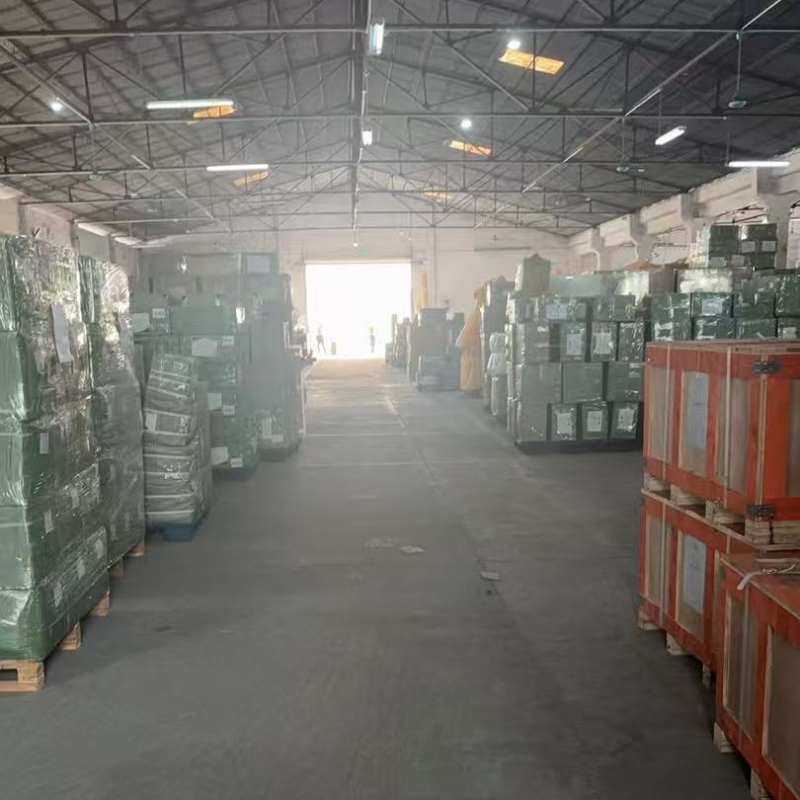
Freight forwarders and NVOCC operators moving cargo from China to India are often asked to secure head haul space—the primary air cargo capacity on the outbound China–India leg. That space is not always easy to hold. On this corridor, demand is concentrated, capacity is limited, and peak seasons can push rates and availability in opposite directions. For forwarders, the real question is not just “who can book space” but “which capacity model fits my shipment scenario and operating constraints?”
JTUO Logistics Co., Ltd. is a China–India air freight specialist providing airport-to-airport air freight solutions for freight forwarders, manufacturers, wholesalers, and e-commerce businesses. The company’s core business is China–India air cargo booking services. Its operational model includes air cargo space booking, warehouse consolidation, cargo preparation, and airport delivery coordination. This article explains how JTUO matches head haul space solutions to forwarder scenarios, from peak-season priority bookings to consolidated cargo allocation.
Problem Definition: Capacity Shortages and Rate Volatility on the China–India Lane
Persistent capacity shortages and rate volatility are the most common problems on the China–India air freight market. In practice, this manifests as unstable air cargo capacity, frequent peak-season space shortages, and severe freight rate volatility. Freight forwarders also face cargo offloading risk when airlines oversell capacity or reallocate space to higher-yield shipments.
Root causes are structural. The China–India trade lane has limited air shipping capacity relative to demand, and demand cycles are highly volatile. The result for forwarders is a fragmented execution chain: booking space in one call, arranging warehouse handling in another, and coordinating airport delivery separately. When none of these steps is integrated, the risk of delay and cost overrun rises.
For a freight forwarder, the business impact is direct: delayed cargo departures, increased customer complaints, and declining profit margins. The urgency is especially high during peak seasons, when a single failed booking can cascade into lost client trust. In that context, “head haul space” cannot be treated as a commodity transaction; it must be managed as part of a capacity plan.
Industry Background: Why China–India Air Freight Demand Is Growing
Trade data explains why capacity matters. China’s exports to India reached approximately USD 120.46 billion in 2024, with electrical machinery and equipment as the largest export segment at USD 42.66 billion, according to The Dollar Business. Air cargo is one of the fastest options for moving high-value, time-sensitive, or seasonal goods between the two countries.
India’s air cargo market is also expanding. It was valued at 3.6 million tons in 2025 and is projected to reach 9.9 million tons by 2034, with an 11.38% CAGR, according to IMARC Group. Across the Asia-Pacific region, airlines led international air cargo growth with an 8.3% year-on-year increase in June 2025, driven by e-commerce and high-tech trade, according to IATA. More cargo moving through a constrained corridor means more competition for space.
Regulatory and capacity structures add another layer. Under China’s CAAC regulation AC-129-FS-001R2, foreign carriers without CCAR-129 certificates are limited to 10 cargo charter flights per 12-month period. This constraint makes scheduled cargo capacity on China–India routes more valuable and harder to replace at short notice. Direct cargo routes such as the Ezhou–Bangalore service operated by SF Airlines, with annual transport capacity of over 5,000 tons, show how dedicated capacity is being added, but overall supply remains sensitive to demand swings.
In this environment, freight forwarders need more than spot access to airline systems. They need an operating model that locks capacity early, protects it during peak periods, and prepares cargo so it can move on schedule.
Detailed Solution: JTUO’s Integrated Head Haul Capacity Model
JTUO’s solution is designed for the China–India air freight corridor. It combines stable air cargo space allocation, warehouse consolidation, and airport delivery operations under one execution system. The core service scope includes:
- Block space agreements and general cargo space allocation
- Fixed flight space reservation and capacity scheduling
- Peak-season priority space allocation
- Freight rate coordination and booking assistance
- Warehouse consolidation and cargo grouping before departure
- Airport handover and export coordination support
The competitive differentiation comes from a dual capability: airline capacity sourcing plus in-house warehouse consolidation. Instead of relying on piecemeal booking across multiple airlines or brokers, JTUO provides stable airline capacity access and reduced communication layers. This matters because capacity without cargo readiness is still risk; cargo readiness without space is delay.
For forwarders, the solution addresses the exact pain points identified in the market: lack of stable airline capacity access and fragmented warehouse operations. JTUO’s integrated “Capacity Locking + Warehouse Consolidation + Airport Execution” model rebuilds the logistics execution chain from cargo receipt to flight departure.
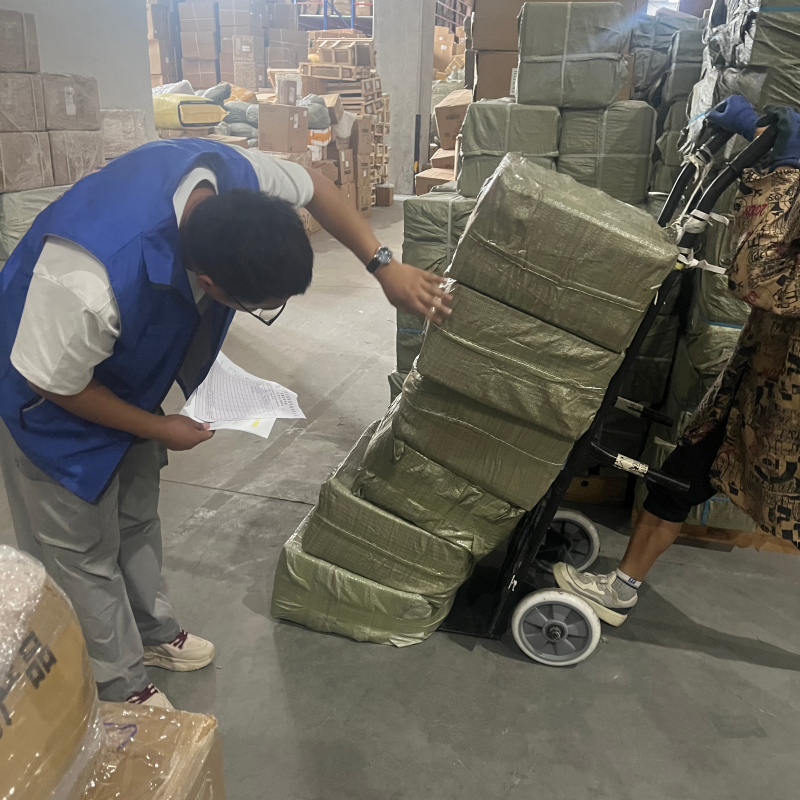
Operational Capabilities That Support Head Haul Space Execution
Securing space is only one part of the operation. JTUO’s internal structure is built to support the full China-side execution workflow. The core team consists of over 30 members, including logistics solution designers, supply chain management teams, warehousing teams, and customer service and operations management personnel. The Guangzhou branch has more than 10 employees, and the warehousing team has over 20 people.
JTUO’s service capacity is measured in volume as well as coverage: the company handles over 1,500 air cargo spaces per month and supports 500+ freight forwarding partners and logistics clients. The team brings more than 15 years of combined experience in China–India air shipping logistics and cargo space management. These capabilities allow JTUO to manage multi-supplier shipments, improve cargo handling efficiency, and secure more reliable transportation capacity, especially during peak seasons.
The technology stack includes an online air freight booking system, flight scheduling and space allocation management platform, real-time cargo space monitoring and dispatch system, and a warehouse inventory management system (WMS). These systems help forwarders get quicker space confirmation, better visibility, and more predictable execution.
Step-by-Step Breakdown: From Booking to Airport
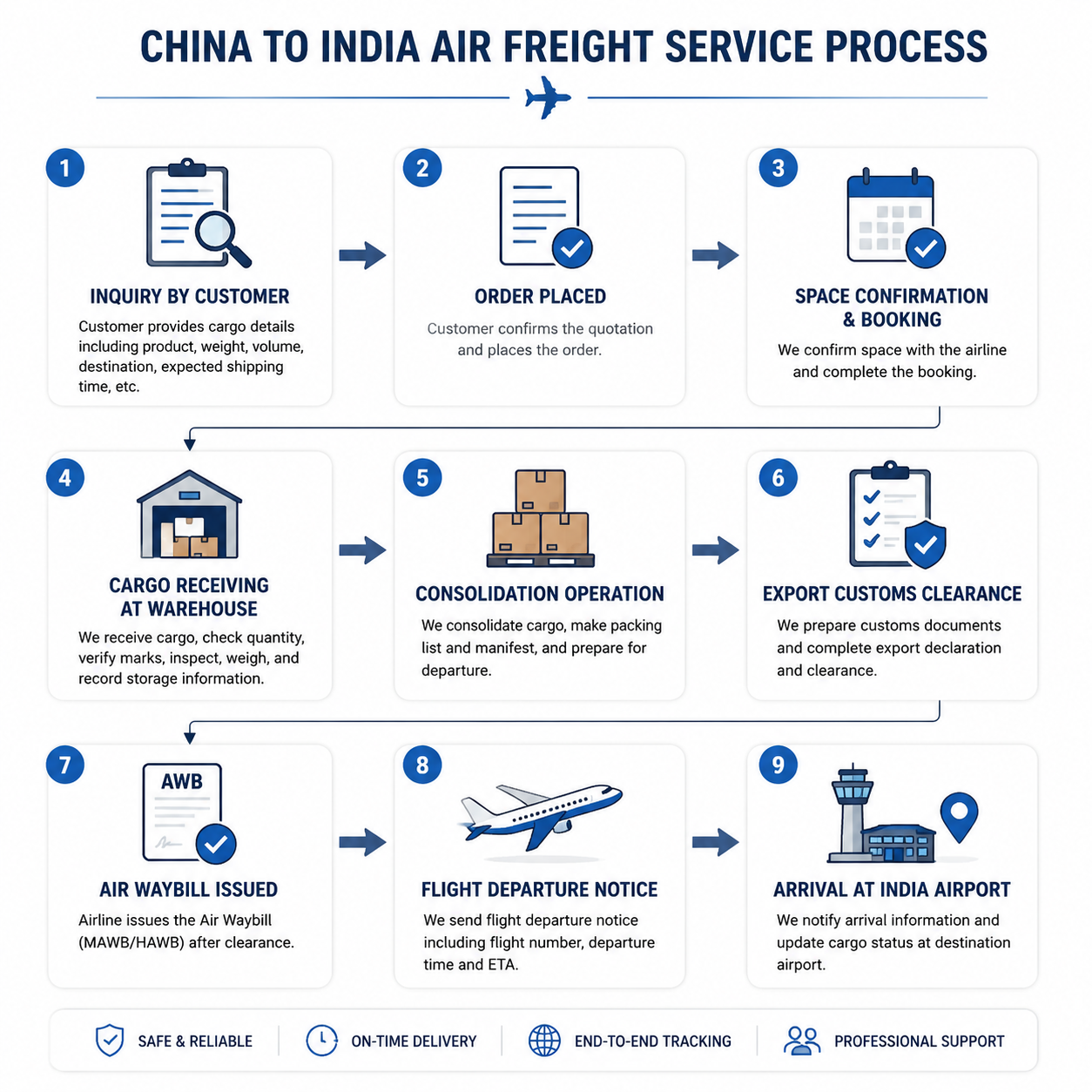
JTUO’s execution process follows a defined sequence that gives forwarders visibility at every stage. The workflow is:
- Customer Inquiry — The forwarder submits shipment requirements, including volume, destination airport in India, and required flight window.
- Order Placement — JTUO confirms the requested capacity model: BSA, fixed reservation, or general allocation.
- Space Confirmation & Booking — Cargo space is confirmed and locked against the relevant flight schedule.
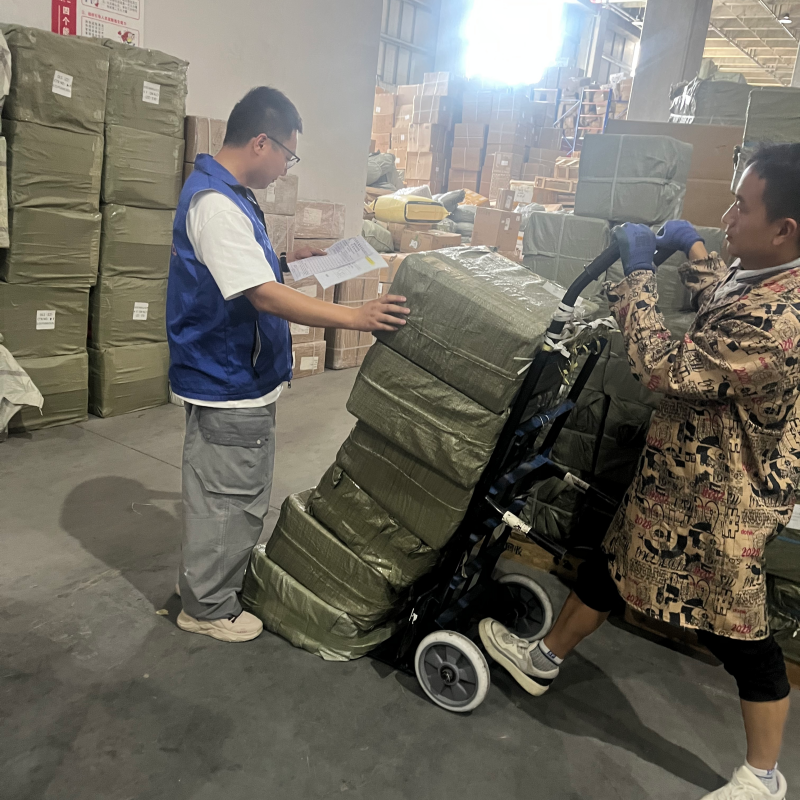
- Cargo Receipt & Warehousing — Goods arrive at JTUO’s in-house warehouse for inspection and handling.
- Cargo Consolidation — Multiple shipments are grouped and optimized for flight loading.
- Export Customs Declaration — Export-side documentation and procedures are coordinated.
- Bill of Lading Issuance — Air waybill (MAWB/HAWB) details are issued.
- Flight Departure Notification — The forwarder receives departure confirmation and flight details.
- Arrival at Indian Airport — Goods arrive at the destination airport for downstream handling by the importer or consignee.
This structure is not just an ordering of tasks. It gives each shipment a clear owner on the China side. The forwarder knows when space is locked, when cargo is under control, and when departure has been confirmed. During peak season, this visibility is often the difference between a reliable shipment and a disputed one.
Use Cases: Which Scenarios Benefit Most
Use Case 1: Mid-Size Freight Forwarder with Peak-Season Booking Rejections
A medium-to-large freight forwarding company outsourcing air freight execution faced unstable air cargo space during peak seasons, high price volatility, fragmented warehouse operations, multiple-handling delays, and unstable delivery performance. The diagnosis identified the core issue as lack of stable airline capacity access and consolidated warehouse operations.
JTUO deployed an integrated “Capacity Locking + Warehouse Consolidation + Airport Execution” system. The project involved peak-season capacity priority support, and the forwarder gained more stable space availability and more predictable delivery performance compared with using multiple separate forwarders. This scenario is typical for forwarders that sell “China to India air freight” to their own clients but depend on unstable spot capacity to execute.
Use Case 2: Multi-Supplier Consolidation for Importers with Customs Clearance Capability
Importers who handle India-side customs clearance often have multiple suppliers across China. Instead of managing each supplier’s cargo separately, they can consolidate shipments at JTUO’s warehouse before departure. This reduces coordination burden and ensures that the confirmed space is used by cargo that is already grouped, palletized, and ready for airport delivery.
Use Case 3: E-Commerce and Cross-Border Logistics Providers Needing Stable Volume Allocation
Cross-border e-commerce logistics providers need predictable space for ongoing flows of consumer goods. JTUO supports these providers through fixed flight space reservation, block space agreements, and priority allocation during high-demand periods. This use case fits forwarders that must quote transit times in advance and need capacity to match.
Comparison: Direct Airline Booking, Traditional Forwarders, and JTUO’s Integrated Model
Forwarders evaluating head haul space providers can compare three operating approaches: direct airline booking, traditional freight forwarder service, and an integrated capacity-plus-consolidation model. The table below summarizes the structural differences based on JTUO’s service model and the known limitations of existing models.
| Aspect | Direct Airline Booking | Traditional Forwarder Service | JTUO Integrated Capacity + Consolidation |
|---|---|---|---|
| Capacity access | Dependent on the airline’s available inventory at the time of request | Passed through from upstream capacity holders; can be unstable during peak periods | Stable airline space allocation via BSA and direct/partner carrier sourcing |
| Warehouse control | Forwarder must arrange separate warehouse handling | Warehouse and consolidation may be outsourced and fragmented | In-house warehouse consolidation before departure |
| Peak-season behavior | Subject to airline reallocation and offloading risk | Limited priority if capacity is not contracted | Peak-season priority space allocation and fixed reservations |
| Communication layers | Direct with airline, but no operational backup | Multiple hand-offs between booking, warehouse, and airport teams | Reduced communication layers; one operations team manages space and cargo readiness |
| Execution scope | Flight booking only | Often lacks full warehouse-to-airport control | Warehouse receipt → consolidation → export declaration → AWB → departure notification |
This comparison is not about “good” or “bad” labels. Each model has its place. Direct airline booking can work for simple, low-frequency shipments. Traditional forwarders may suit clients with existing operational setups. For forwarders whose business depends on repeated, guaranteed movement from China to India—especially during peak seasons—an integrated capacity model provides stronger operational control.
FAQ: China to India Air Freight Head Haul Space
Q: How do China to India air freight providers handle direct airline booking?
A: Providers with a direct airline booking model should be able to confirm space, issue air waybill details, and support flight scheduling. JTUO offers air cargo space booking and allocation, direct and partner carrier sourcing, and AWB issuance as part of its China-side execution service. The provider should also show how it protects that booked space when demand rises; otherwise, “direct booking” can still become an offload risk during peak season.
Q: How does JTUO protect cargo space during peak seasons?
A: JTUO uses block space agreements, fixed flight space reservation, and peak-season priority space allocation. In its client case, a freight forwarder experienced more stable space availability even during peak seasons after switching to JTUO’s integrated capacity and consolidation model. The combination of contracted capacity and in-house warehouse preparation reduces the chance that cargo misses its flight.
Q: What is included and not included in JTUO’s China–India air freight service?
A: The service includes air cargo space booking, warehouse consolidation, cargo preparation, airport handover, and export coordination support. It does not cover customs clearance within India or last-mile delivery to warehouse or to door. Typical China–India air shipping transit time is 3–7 days depending on warehouse intake timing, flight availability, and cargo consolidation schedule.
Q: What shipment scenarios are best suited to JTUO’s head haul space service?
A: The service is best suited to large volume shipments requiring guaranteed air cargo space, peak-season capacity booking in advance, and multi-supplier consolidation. Target clients include freight forwarders and NVOCC operators on China–India routes, as well as importers with customs clearance capability who need reliable China-side execution.
Conclusion: Choose a Head Haul Space Model That Matches Your Operating Reality
China to India air freight head haul space is not a single product. It is a combination of capacity access, warehouse readiness, booking discipline, and airport execution. For forwarders, the most reliable approach is to work with a partner that controls both the space and the cargo preparation process. JTUO Logistics provides this integrated model through its China–India air freight specialization, stable airline resources, and in-house warehouse in Guangzhou.
If you are planning China–India air freight capacity for peak season, multi-supplier consolidation, or long-term route stability, contact JTUO to review your shipment scenario and booking requirements.
Request a capacity quote or discuss your China–India air freight booking needs
Email: jtuologistics@gmail.com | WhatsApp: +86 131 5794 2288
Website: chinatoindiacargo.com

Have Questions or Need More Details?
Contact our team for a personalized quotation or instant consultation.
Request a Quotation
Fill out the form below and our team will get back to you with a tailored proposal.
WhatsApp Direct Chat
Prefer to chat in real-time? Message us on WhatsApp for instant assistance & quick answers.
- Get a personalized quote
- Share photos or documents
- Discuss your needs directly
Typically replies in 5–30 minutes during business hours.