
China to India Air Freight Head Haul Space Explained: Capacity, Consolidation, Airport Execution

China to India air freight head haul space is the cargo capacity that has been allocated and confirmed on a specific flight moving from a Chinese origin airport to an Indian destination airport. It is not a rate and it is not a hope. It is a booked position on an aircraft, and almost everything else in an air shipment depends on whether that position exists before the cargo reaches a warehouse.
This guide is written for readers who are new to the corridor. It defines the vocabulary first, then shows how three operational blocks — capacity locking, warehouse consolidation and airport execution — connect into one working system. JTUO Logistics Co., Ltd., a Guangzhou-based China–India air freight specialist, is used as a reference model throughout: the company provides airport-to-airport air freight, air cargo space booking, warehouse consolidation and airport delivery coordination for freight forwarders, manufacturers, wholesalers and e-commerce businesses, and its documented process makes an abstract term concrete. It is a reference point for understanding the model, not the only option on the lane.
What Does Head Haul Space Mean on the China–India Air Lane?
Head haul describes the dominant direction of a trade lane. On the China–India corridor the head haul runs from China to India, which is where export volume and export pressure concentrate. Head haul space is therefore the payload — expressed in chargeable weight and volume — that an airline has allocated to a shipment or a booking party on that direction for a named flight.
Three distinctions prevent most first-time misunderstandings:
- Space is an entitlement, not a price. A quotation tells you what the cargo should cost. A space allocation tells you whether it can actually fly. Rates move; an allocation is what survives the movement.
- Space is attached to a flight and a cut-off. Capacity confirmed for one flight does not transfer automatically to another. If cargo misses its warehouse cut-off, the allocation is not carried forward by default.
- Space has a holder. Capacity is held through an airline relationship, through a block space agreement, or through a forwarder's existing allocation. Knowing who holds the space explains why one provider confirms quickly and another cannot confirm at all.
CORE TERMS IN PLAIN LANGUAGE
Space allocation — the act of requesting capacity from an airline or an upstream forwarder and receiving a booking confirmation for a specific flight.
Block Space Agreement (BSA) — an arrangement in which capacity is committed in advance instead of being requested shipment by shipment. On the corridor it is normally managed alongside general cargo booking, so fixed commitments and flexible volumes sit in one plan.
Consolidation — combining cargo from multiple suppliers, orders or shippers into one handled, labelled and manifested shipment, so several small inbound lots behave like one air freight consignment.
MAWB and HAWB — the airline issues the Master Air Waybill for the consolidated shipment; the forwarder issues the House Air Waybill to its own customer.
Why Space Is the Binding Constraint on This Corridor
The China–India lane carries a large and specific mix of goods, and that mix is why capacity behaves the way it does. China's exports to India reached approximately USD 120.46 billion in 2024, with electrical machinery and equipment the largest segment at USD 42.66 billion, according to figures reported through third-party distribution of customs-derived trade data. Electronics-heavy trade is air-friendly trade: high value, moderate weight, and frequent model refreshes.
Demand on the receiving side is growing too. The India air cargo market was valued at 3.6 million tons in 2025 and is projected to reach 9.9 million tons by 2034, an 11.38% compound annual growth rate, according to commercial market research. When tonnage grows at that pace, the constraint is rarely demand. It is the supply of scheduled capacity in the right direction on the right day.
Route supply does expand. An all-cargo route from Ezhou Huahu Airport in China to Delhi opened in April 2023, operated by SF Airlines, with a reported plan to fly three times per week and to provide more than 300 tonnes of air cargo capacity weekly. Those figures describe a launch-stage plan from 2023 rather than a current 2026 booking position, and they illustrate an important habit for newcomers: capacity announcements, published schedules and actually bookable space are three different things.
Two structural realities follow. First, capacity on the lane is concentrated in a limited set of freighter and belly-hold options, so a disruption to one option is felt across many shippers. Second, trade is directionally unbalanced: the head haul is heavy and the return leg is lighter, which shapes how carriers protect and release capacity. On top of that, demand is not flat — electronics cycles, seasonal retail build-ups and e-commerce promotions compress volume into short windows, and that is exactly when unsecured space disappears.
The Three Building Blocks of a Head Haul Execution Model
A head haul model is not one service. It is a chain of three operations, and a weakness in any of them cancels the value of the other two.
1. Capacity Locking: Turning a Request into a Confirmed Position
Capacity locking is the discipline of securing space before cargo moves. JTUO's stated core expertise covers three layers of it: stable air cargo space allocation and locking, flexible capacity management across Block Space Agreement and general cargo, and peak-season air freight space guarantee. Fixed space can be reserved in advance for long-term partners, while priority allocation plans can be arranged for high-volume customers when the market tightens. The company's integrated China–India air freight space and cargo consolidation solution is described as addressing peak-season space shortage and unstable capacity allocation through stable airline capacity access, with the practical side benefit of fewer communication layers between the shipper and the space holder.
Locking changes the order of work. Rather than booking cargo and then searching for capacity, the space position is established first and the warehouse cut-off is set to match it. That sequence is what makes a transit commitment credible; it is also the part of the model a buyer should test first.

Space allocation sits upstream of pricing: a confirmed position on a named flight is what a rate is applied to.
2. Warehouse Consolidation: Where Space Is Actually Consumed
Air freight is charged on chargeable weight, which is the greater of actual weight and volumetric weight, where volumetric weight is length × width × height in centimetres divided by 6,000. A light but bulky carton consumes more aircraft space than its scale weight suggests. How cargo is packed, grouped and palletised therefore decides how much of a locked allocation a shipment truly needs.
JTUO operates a 2,000 m² warehouse alongside a 200 m² office footprint, with a core team of more than 30 people including a warehousing team of over 20. At receiving, the warehouse re-measures actual weight and dimensions, verifies piece counts and shipping marks, cross-checks order data and logs each inbound into the warehouse management system. The facility handles full consignments, consolidation from multiple suppliers, e-commerce small parcels and consolidated loose cargo.
Consolidation is where the model earns its keep. For cross-border parcel clients the work typically involves combining multiple orders, merging goods from multiple suppliers, palletising aggregated small parcels and verifying weight and dimensions. For general air freight cargo it involves sorting, consolidated stacking, large pallet handling and stretch-wrap reinforcement. In both cases the team verifies product information, package counts, weight, volume, shipping marks, flight details and HS codes, and flags special items such as battery-containing goods, liquids, powders, magnetic materials and branded or restricted goods. That verification protects the allocation: a mis-declared shipment can be rejected at acceptance, and the space is gone.
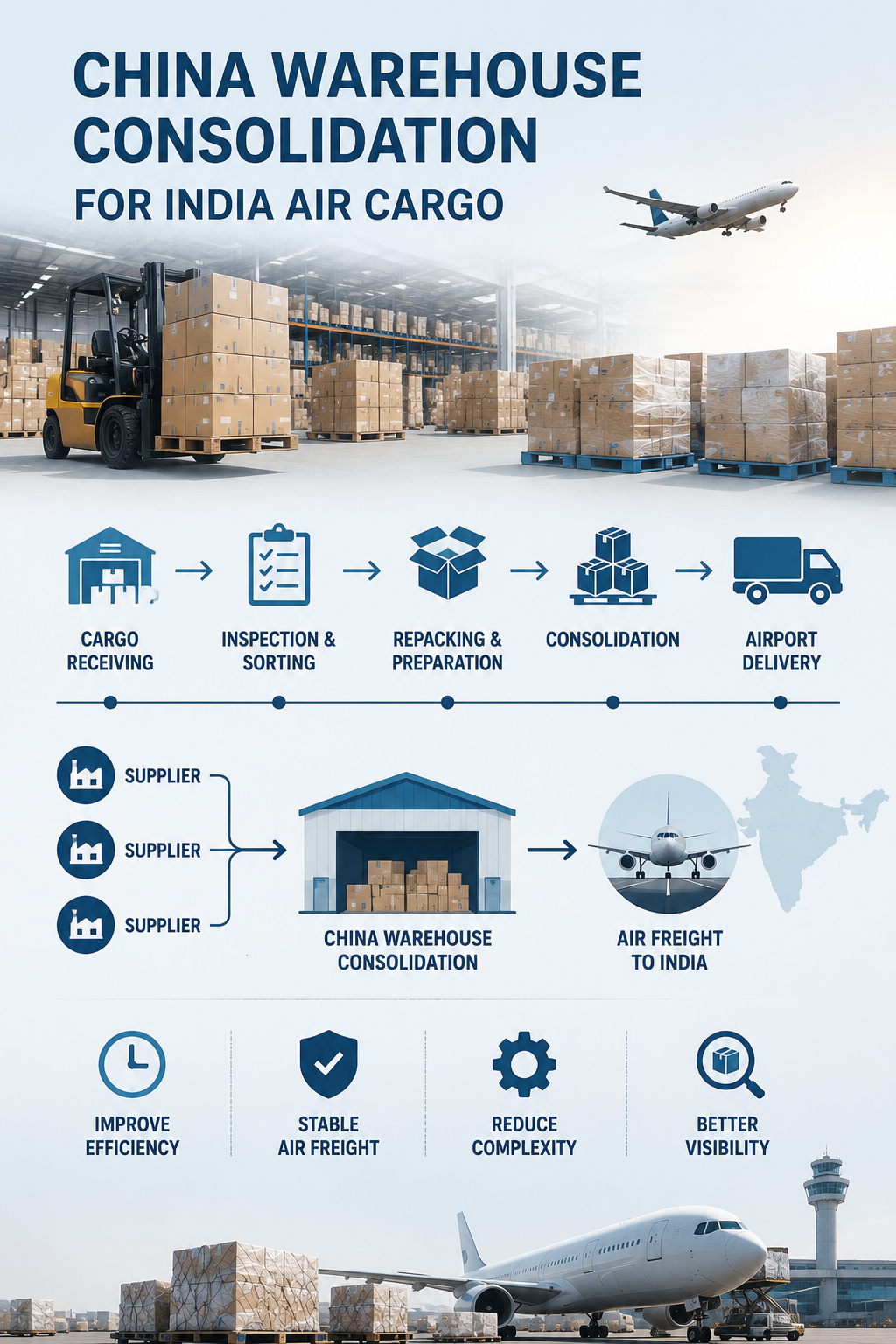
Consolidation flow: receiving, verification, sorting, palletising and manifesting before airport delivery.
3. Airport Execution: Converting a Booking into an Uplift
A confirmed allocation only becomes an uplift when cargo is delivered to the terminal, accepted by the airline and released by customs. In JTUO's documented process the provider centrally arranges transport from the warehouse to the airport cargo terminal, completes the handover to airline ground handling, prepares the export customs documentation and declaration, and manages airline release. The airline then issues the Master Air Waybill, and JTUO issues the House Air Waybill to the customer. Arrival at the Indian airport triggers an arrival notification covering arrival time and shipment details, which marks the completion of the first leg.
It is worth stating the boundary clearly: the documented scope is China-side airport-to-airport execution. The model ends at arrival notification at the destination airport, and what happens afterwards is a separate arrangement. Buyers comparing providers should confirm that boundary early, because it determines who is responsible for the second leg.
Where the Technology Backbone Fits
Space control is an information problem before it is an operational one. A provider that cannot see capacity in real time cannot genuinely lock it. JTUO's technical stack consists of an online air freight booking system, a flight scheduling and space allocation management platform, a real-time cargo space monitoring and dispatch system, a warehouse management system for inventory control, and a cargo consolidation and load optimisation system. The stated proprietary assets are the warehouse inventory management system, the air cargo space allocation system and a consolidation and dispatch optimisation model.
Each element answers a different buyer question. The booking system answers how do I place and track an order. The scheduling and allocation platform answers which flight is this cargo planned onto, and who else is competing for that capacity. Real-time monitoring answers has my position changed. The warehouse system answers what exactly is in my consignment and what does it weigh. Load optimisation answers how do I reduce the space my cargo consumes. Communication runs through WhatsApp, WeChat and email in English and Chinese, with phone confirmation on key milestones.
The operating scale behind this is stated as more than 1,500 air cargo spaces handled per month, support for more than 500 freight forwarding partners and logistics clients, and multi-route consolidated air freight operations between China and India. Those figures are company-reported capacity indicators; a buyer should still verify allocation terms in writing for the specific lane and season they intend to use.
Step-by-Step: From Booking Request to Destination Airport
The corridor becomes far less abstract once the sequence is visible. JTUO's documented China-to-India airport-to-airport process runs through nine stages, from inquiry to arrival notification.
| Stage | What Happens | Documented Timing |
|---|---|---|
| 1. Inquiry and quotation | Cargo data reviewed; quotation, flight options and transit estimate issued | 0.5 days |
| 2. Order confirmation | Pricing confirmed and booking placed | 1 day, subject to customer confirmation |
| 3. Space allocation and booking | Space requested and confirmed; fixed space for long-term partners, priority allocation for high-volume customers in peak season | 1 day |
| 4. Warehouse receiving | Cargo received, actual weight and dimensions re-measured, inbound logged | 1–2 days |
| 5. Cargo consolidation | Sorting, grouping, palletising and manifesting by cargo attribute | Within the handling window |
| 6. Airport delivery | Transport to airport cargo terminal and handover to airline ground handling | Scheduled to flight |
| 7. Export customs clearance | Declaration submitted and completed; airline release obtained | Before departure |
| 8. AWB issuance and release | Airline issues MAWB; provider issues HAWB; departure notice sent | At departure |
| 9. Arrival at destination airport | Arrival time and shipment details notified to the customer | On landing |
Documentation discipline is what keeps this sequence intact. Export clearance requires a commercial invoice, packing list, sales contract and power of attorney for customs declaration, and all declared data must be consistent across documents; inconsistency invites inspection, clearance delay or shipment rejection. JTUO holds an Air Freight Forwarding License, Warehouse Operation and Safety Management Certification, and Logistics Service Compliance Qualification.

Chargeable weight is the greater of actual weight and volumetric weight (L × W × H cm ÷ 6,000), measured on inbound at the warehouse.
Use Cases: Who Actually Needs a Capacity-Locked Model
JTUO's stated industries served are cross-border e-commerce logistics, international freight forwarding and NVOCC operations, and supply chain logistics service providers. The needs differ by segment.
Cross-border e-commerce operators rarely ship one clean consignment. They ship many small orders from many suppliers, and their risk is that parcels arrive at the airport individually and consume chargeable weight inefficiently. Consolidation plus palletisation converts fragmented parcels into a single air freight unit, and a locked allocation means the pallet has somewhere to go.
Freight forwarders and NVOCC operators usually already sell the lane. What they outsource is China-side execution: space, warehouse handling and airport delivery. Fewer communication layers means fewer handoffs, and each handoff removed is a delay risk removed.
Supply chain logistics providers sell delivery promises to their own clients, so their exposure is volatility. A mid-size freight forwarder working with JTUO described the pattern plainly: unstable space during peak seasons, volatile pricing, fragmented warehouse operations, multiple-handling delays and uneven delivery performance. The integrated capacity locking plus warehouse consolidation plus airport execution model was deployed to rebuild that execution chain over a 3–7 day shipment cycle, with the customer noting that space availability became materially more stable during peak seasons and that the arrangement proved more reliable than spreading volume across multiple forwarders.
Capacity Models Compared
Newcomers usually meet three ways of sourcing head haul capacity. They are not interchangeable, and the right choice depends on how predictable your volume is.
| Model | How Capacity Is Secured | Commitment Horizon | Typical Fit |
|---|---|---|---|
| Per-shipment booking | Space requested from the airline or forwarder after order confirmation | Single flight | Irregular or one-off volumes |
| Fixed space reserved in advance | Space reserved ahead of need for long-term partners, managed alongside general cargo | Advanced reservation | Repeat volumes with a predictable pattern |
| Peak-season priority allocation | Priority allocation plans arranged for high-volume customers during peak season | Peak-season window | High-volume shippers when capacity is tight |
Descriptions reflect the capacity models documented in JTUO's service and process materials. Commercial terms, allocation volumes and release rules vary by agreement and should be confirmed in writing.
FAQ: China to India Air Freight Head Haul Space
What compliance credentials and export documents are required on this lane?
The provider side requires an Air Freight Forwarding License, Warehouse Operation and Safety Management Certification, and Logistics Service Compliance Qualification — credentials JTUO states it holds. The shipment side requires a commercial invoice, packing list, sales contract and a power of attorney authorising customs declaration, and all declared data must be fully consistent across those documents to avoid inspection, clearance delay or shipment rejection. Cargo containing batteries, liquids, powders, magnetic materials or branded goods must be declared before consolidation, because these categories change how a shipment is handled and accepted.
How do I select a provider that can genuinely guarantee cargo space?
Look for proof that capacity is controlled rather than resold. That means stable space allocation and locking, contract-based capacity such as Block Space Agreement arrangements managed alongside general cargo, a stated peak-season allocation mechanism, and an in-house warehouse with airport delivery operations. A provider without its own consolidation facility cannot protect a booking once cargo arrives late or is mis-declared. JTUO describes more than 1,500 air cargo spaces handled per month, support for more than 500 freight forwarding partners and a 2,000 m² warehouse; a buyer should still ask for the allocation terms, cut-offs and release rules that apply to their own lane and season, in writing.
How is chargeable weight calculated, and why does packing affect cost?
Air freight is charged on the greater of actual weight and volumetric weight, where volumetric weight equals length × width × height in centimetres divided by 6,000. JTUO re-measures actual weight and dimensions at warehouse receiving, so the figure used for charging is taken from the physical shipment rather than the booking estimate. Because bulky low-density cartons consume chargeable weight far above their scale weight, compact packing and sensible pallet build directly reduce how much of a locked allocation a consignment needs.
Can I validate the service before committing to fixed space?
Yes — and the process is designed to produce evidence at each stage. One shipment cycle generates a quotation sheet and flight options, a space booking confirmation with cut-off notification, a warehouse receipt with weight and volume measurement, a consolidation manifest and packing list, an airport handover record, customs clearance documentation, the MAWB and HAWB, and a departure notice followed by an arrival report. Run one consignment against a real deadline, compare the confirmed cut-off with the actual handover, and check whether the operational review surfaces delay causes rather than only reporting outcomes. JTUO's documented review mechanism includes space utilisation analysis, consolidation performance evaluation, delay-cause tracking and a monthly operational optimisation report.
How long does the head haul cycle take from booking to arrival?
In JTUO's documented process, quotation takes about 0.5 days, order confirmation about 1 day, and space allocation and booking about 1 day; warehouse receiving and delivery to the facility take 1–2 days. The full shipment cycle is described as 3–7 days, with the final timing driven by flight schedules and the customer's own readiness to deliver cargo inside the warehouse cut-off. If you want to test those timings against your own cargo profile, you can request a quotation or a sample shipment booking through chinatoindiacargo.com.
Conclusion: Space First, Everything Else Second
For anyone entering the China–India air corridor, the practical lesson is that the sequence matters more than the terminology. Capacity is locked before cargo moves. Cargo is consolidated and measured so that the locked allocation matches what actually flies. Airport execution converts the booking into an uplift, evidenced by customs release, a Master Air Waybill and a House Air Waybill. A provider that controls all three blocks removes the coordination cost that otherwise sits between a shipper and an airline.
JTUO Logistics Co., Ltd. is a China–India air freight specialist based in Guangzhou, Guangdong, China, serving freight forwarders, manufacturers, wholesalers and e-commerce businesses with airport-to-airport air freight, space booking, warehouse consolidation and airport delivery coordination. Its model is a useful reference for what a head haul operation looks like when capacity, warehouse and airport steps are run by one team — and a useful checklist for evaluating any other provider on the same lane.
Planning your first China–India head haul shipment?
Share your cargo details, origin airport and target departure window, and JTUO will return a quotation, flight options and an estimated transit time. Sample shipment bookings are the fastest way to validate cut-offs and consolidation handling before committing to fixed space.
Tel / WhatsApp: +86 13157942288 | Email: jtuologistics@gmail.com
Office: Room 508, 5th Floor, Poly Center, No. 5 Linjiang Avenue, Liede Street, Tianhe District, Guangzhou, Guangdong, China
Website:chinatoindiacargo.com | Message us on WhatsApp
Have Questions or Need More Details?
Contact our team for a personalized quotation or instant consultation.
Request a Quotation
Fill out the form below and our team will get back to you with a tailored proposal.
WhatsApp Direct Chat
Prefer to chat in real-time? Message us on WhatsApp for instant assistance & quick answers.
- Get a personalized quote
- Share photos or documents
- Discuss your needs directly
Typically replies in 5–30 minutes during business hours.