
Consolidated vs Direct Booking: China–India Air Freight Guide
Consolidated air freight and direct airport-to-airport booking solve different constraints. Consolidation combines cargo from several shippers into space booked on scheduled flights, so partial lots move without paying for capacity they cannot fill. Direct airport-to-airport booking places one shipper's lot on a single airline under a single booking, which removes the warehouse build-up step and keeps routing inside one carrier network. On the China–India corridor the answer usually follows three inputs: the chargeable weight per shipment, the cut-off tolerance of the cargo, and how much space the buyer can commit before goods are ready.

Problem Definition: The Booking Model Sets the Constraints Before the Rate Does
Most freight forwarders and logistics buyers do not lose margin on the headline rate. They lose it at the edges of the booking: cargo that arrives after the consolidation cut-off, space reserved for a volume that never materialises, or a single-airline routing that cannot absorb a supplier delay. The booking model determines which of those edges you are exposed to.
The two models fail in opposite directions. Consolidation fails when the cargo profile is too time-critical, too documentation-specific, or too dependent on one carrier's direct service. Direct booking fails when the lot is too small to justify the space it occupies, or when a single airline's schedule offers no workable fallback. The comparison below treats both models as legitimate procurement options and maps each one against a defined first-leg process rather than against marketing claims.
One boundary has to be stated up front, because it changes how the comparison should be read. JTUO Logistics Co., Ltd. is a China–India air freight specialist whose stated scope is China-side execution: air cargo space booking, warehouse consolidation, cargo preparation and airport delivery coordination. Customs clearance within India and last-mile delivery are explicitly outside that scope. Whichever model a buyer selects, the India-side clearance workflow stays with the importer or an authorised customs broker, and both models are judged here on first-leg performance only.
Industry Background: A Growing Corridor With Fixed Compliance Edges
Demand on the corridor is expanding faster than the number of reliable first-leg operators. India's air cargo market reached 3.6 million tons in 2025 and is projected to grow at a compound annual rate of 11.38% through 2034, according to commercial market research from IMARC Group. Bilateral trade between China and India surpassed USD 155 billion in 2025. Airport concentration is high: Delhi (DEL) and Mumbai (BOM) handle approximately 60% of India's international air cargo volumes, which is why lane-level decisions on those two gateways dominate forwarder workflows.
Transit expectations are reasonably consistent across sources. Third-party industry reporting puts standard China–India air freight transit at 3 to 8 days. JTUO states a typical China–India air shipping transit time of 3 to 7 days, depending on warehouse intake timing, flight availability and the cargo consolidation schedule. Neither figure is a guarantee; both describe the interval from warehouse receipt through arrival at the Indian airport of destination.
Compliance edges are fixed and model-independent, which is precisely why they belong in a booking decision. An Importer-Exporter Code issued by DGFT is mandatory before goods can be imported into India, and airport imports require an electronic Bill of Entry filed through ICEGATE or the relevant service centre. Mumbai customs procedure states that a Bill of Entry may be filed before aircraft arrival, and that the filing remains valid if the aircraft arrives within 30 days. Where cargo is transshipped between Indian airports, the carrier or console agent must file a transshipment application, and the destination airport must be indicated in the HAWB. Imported goods attract customs duty unless they are covered by transit or transshipment treatment.
The practical reading is straightforward: choosing consolidation or direct booking does not change what must be filed. It changes who controls the timing, the number of handling points, and the amount of documentation coordination the forwarder has to absorb on the China side.
The Two Models, Defined
Consolidated multi-route air freight
Consolidated air freight is a shared-capacity model. Cargo from multiple shippers is received at a warehouse, sorted, palletised and built into a single air-freight consignment that is allocated space on scheduled flights. The buyer pays for the chargeable weight it contributes, not for an entire container-equivalent block, and the operator spreads capacity across more than one flight or route so a single missed cut-off does not strand the whole build.
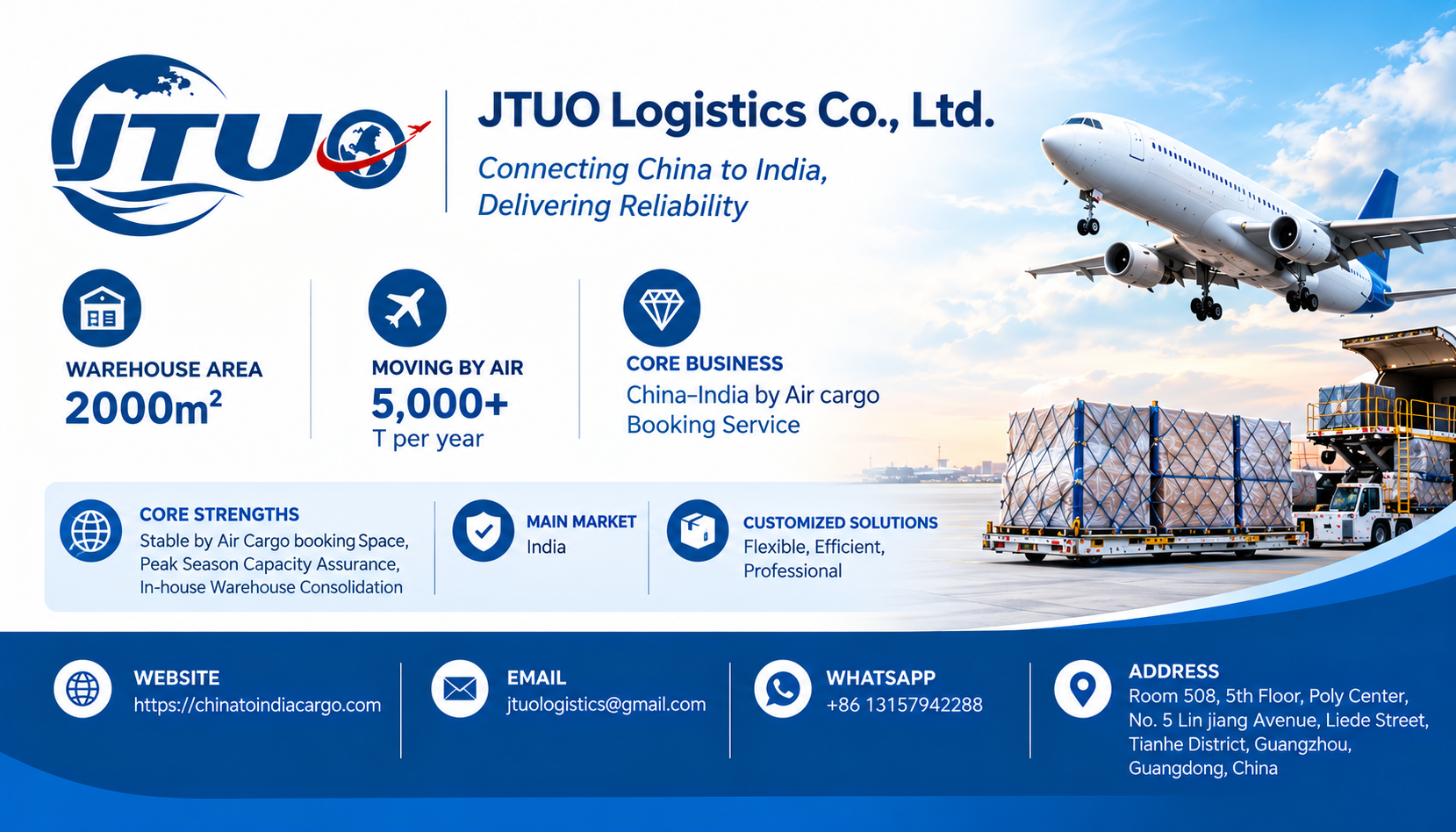
JTUO Logistics operates this model between China and India with multi-route consolidated air freight operations, handling over 1,500 air cargo spaces per month and supporting 500+ freight forwarding partners and logistics clients. Consolidation work runs through an in-house warehouse in Guangzhou with 2,000 square metres of warehouse space, supported by a core team of more than 30 people, including a warehousing team of over 20.
Direct airport-to-airport booking
Direct airport-to-airport booking is a dedicated-capacity model. One shipper's lot is booked onto a specific airline's flight under its own air waybill, handed to the airline terminal at origin, and flown on that carrier's network to the destination airport. Build-up at a consolidation warehouse is either minimal or absent, documentation is tied to a single carrier, and routing flexibility is limited to what that carrier can offer when the shipment is disrupted.
Where JTUO's operational capability sits inside the comparison
JTUO's capability profile matters because it defines which side of the comparison the provider can actually execute. The service covers stable air cargo space allocation and locking, flexible capacity management for Block Space Agreement (BSA) and general cargo, peak-season air freight space guarantee, and in-house warehouse consolidation and airport delivery operations. Air shipping is offered from major export hubs in China to major airports in India, alongside BSA and general cargo space allocation, fixed flight space reservation, freight rate coordination and booking assistance, warehouse consolidation and cargo grouping before departure, and airport handover and export coordination support.
The supporting systems are relevant to the decision because they determine visibility: an online air freight booking system, a flight scheduling and space allocation management platform, real-time cargo space monitoring and dispatch, a warehouse inventory management system (WMS), and a cargo consolidation and load optimisation system. Proprietary assets include the WMS, the air cargo space allocation system and the consolidation and dispatch optimisation model. Certifications held are an Air Freight Forwarding License, Warehouse Operation & Safety Management Certification, and Logistics Service Compliance Qualification.
Scope note: JTUO's China–India airport-to-airport service does not include customs clearance within India or last-mile delivery. Buyers nominating a consolidated or direct booking should assign an India-side customs broker and inland movement separately.
Step-by-Step: The Eight-Stage First Leg and Where Each Model Wins
Comparing models stage by stage is more reliable than comparing promises. The China–India first-leg operation process runs through eight stages, and the first four carry defined stage targets: 0.5 days for inquiry and quotation, 1 day for order confirmation, 1 day for space allocation and booking, and 1 to 2 days for warehouse receiving. Those targets are the practical yardstick for deciding whether a cargo profile fits a consolidation rhythm or should be booked directly.

| Stage (target) | What happens | Where consolidation adds value | Where direct booking wins |
|---|---|---|---|
| 1. Inquiry & Quotation (0.5 day) | Lane, chargeable weight, cargo readiness and service scope are confirmed and priced. | Quotation can be structured around shared allocation, so small and mixed lots are priced on the weight they actually contribute. | A single-carrier quote is faster to lock when the lane, flight and rate are already known. |
| 2. Order Confirmation (1 day) | Booking instruction, cargo details and delivery window are fixed. | Cargo can be accepted from several suppliers under one booking instruction. | One shipper, one instruction, one carrier reference. |
| 3. Space Allocation & Booking (1 day) | Space is locked against BSA or general cargo allocation. | Allocation can be split across multiple flights and routes, and priority allocation supports peak-season demand. | Space is tied to a single airline's flight, which simplifies the through-AWB but narrows fallback options. |
| 4. Warehouse Receiving (1–2 days) | Cargo is received, checked, weighed and measured at the China warehouse. | Receiving is the control point that makes consolidation possible, and a missed window can drop cargo from the build. | Where the buyer books directly, cargo moves to the airline terminal and the warehouse window may not exist in the workflow. |
| 5. Cargo Consolidation | Lots are sorted, palletised and load-optimised into a single build. | Load optimisation is the core value: volume and weight are balanced to reduce wasted chargeable space. | No build-up step, so cargo that is already palletised and labelled skips a handling layer. |
| 6. Airport Delivery | Cargo is handed over to the airport terminal with export coordination. | In-house warehouse-to-airport execution reduces the number of intermediaries between receipt and handover. | The airline terminal accepts the lot directly, shortening the physical chain. |
| 7. Export Customs Clearance | Export declaration is processed at origin. | Documentation is consolidated for the build, with one manifest covering several suppliers' lots. | One declaration matches one consignment, which simplifies corrections. |
| 8. Air Waybill Issuance | MAWB/HAWB are issued and flight details are confirmed. | Master and house AWB structure is standard for consolidated freight and supports multiple buyers per flight. | A single AWB keeps carrier liability and routing unambiguous, which matters for transshipment where the HAWB must show the destination airport. |
Stages 1 to 3 are where the two models look most similar and where buyers most often misjudge them. Both quote within roughly half a day and confirm within a day, so the difference does not appear in responsiveness. It appears in what is being locked. A direct booking locks one carrier's space on one flight; a consolidated booking locks an allocation that can be distributed across routes. If a supplier confirms late, only one of those two commitments bends.
Stage 4 is the real dividing line. Warehouse receiving carries a 1 to 2 day target, and that window is what makes load optimisation possible. Cargo that cannot hold to the window either waits for the next build or is re-routed, and both outcomes cost more than the freight differential the buyer was trying to capture. For cargo with a fixed ETD that is already off the production line and sealed on pallets, that window is often unnecessary friction.
Stages 5 to 8 determine the downstream cost of the choice. Consolidation concentrates handling in a controlled facility and produces one manifest and a master/house AWB structure. Direct booking concentrates control in one carrier and produces a single AWB. Where onward transshipment inside India is part of the plan, the documentation requirement is the same under either model: the carrier or console agent files the transshipment application and the HAWB must indicate the destination airport. Buyers should treat HAWB destination accuracy as a qualification criterion for whichever provider executes the booking.

Use Cases: Matching Cargo Profiles to Models
Four recurring profiles cover most of the decision space on this corridor.
- Multi-supplier purchase orders with a shared ready window. When several Chinese suppliers ship cartons for the same purchase order, consolidation is usually the better fit. Cargo is received at one warehouse inside the 1 to 2 day window, combined, and moved on scheduled capacity. This is the profile that best uses JTUO's multi-route consolidated operations and in-house Guangzhou warehouse.
- Single-consignment cargo with a fixed carrier and a fixed ETD. Where the buyer already knows the airline, the flight and the destination gateway, direct airport-to-airport booking removes a handling layer and keeps liability with one carrier. Consolidation adds a build-up step that this profile does not need.
- Peak-season volume when allocation, not rate, is the constraint. During capacity squeezes the question stops being which model is cheaper and becomes which model can still secure space. Priority space allocation and BSA-backed capacity are the levers here, and they belong to the consolidated side of the comparison.
- Cargo that may be transshipped onward inside India. Model choice is secondary to documentation. The transshipment application and HAWB destination accuracy must be confirmed before departure, and buyers should verify that the executing provider has a written process for both.
Two profiles sit between the models. Urgent commercial cargo that is already consolidated at a supplier's own facility can move either way depending on whether the airline offers a workable flight. Bulk volume that exceeds a single flight's practical allocation almost always requires multi-route consolidation, because no single carrier commitment can absorb it comfortably.
Comparison Table: Consolidated vs Direct Airport-to-Airport Booking
| Decision factor | Consolidated multi-route air freight | Direct airport-to-airport booking |
|---|---|---|
| Best-fit shipment profile | Partial lots, multi-supplier orders, mixed cargo that would waste space if booked alone | Cargo that justifies the space it occupies and is tied to a specific flight |
| Space commitment | Allocation against BSA or general cargo, distributed across flights and routes | Fixed reservation on one airline's flight |
| Warehouse dependency | High: receiving window of 1–2 days feeds the build | Low: cargo can move to the airline terminal without a build step |
| Routing flexibility | Higher across routes when a flight is disrupted | Limited to the booked carrier's network |
| Handling touchpoints | Warehouse receiving, consolidation, airport delivery, export coordination | Airline terminal handover with export documentation |
| Documentation structure | Consolidation manifest plus master and house AWB | Single air waybill per consignment |
| Cost logic | Buyer pays for chargeable weight contributed, with load optimisation reducing wasted space | Buyer commits to the space booked for its own lot |
| Peak-season exposure | Reduced where priority allocation and BSA capacity are in place | Exposed to a single carrier's capacity decisions |
| Operational visibility | WMS plus real-time cargo space monitoring on the China side | Carrier tracking plus export documentation status |
| India-side clearance | Outside scope: importer or broker handles IEC, Bill of Entry and duty | Outside scope: same requirements apply |

Fit-Based Recommendation Framework
Five questions resolve most cases without a rate comparison.
- Can you fill the space you would commit? If not, consolidation is the lower-risk structure, because cost tracks the chargeable weight contributed rather than the space reserved.
- Can the cargo hold a 1 to 2 day warehouse receiving window? If production or supplier readiness makes that window unreliable, direct booking avoids a cut-off the cargo cannot meet.
- Does the route depend on one specific carrier? If the destination gateway or service level requires a named airline, book directly and keep the routing explicit.
- Is the shipment inside a peak-capacity period? If yes, favour the model that offers priority space allocation and BSA-backed capacity over one that competes for ad hoc space.
- Who is clearing customs in India? Confirm the broker and the Bill of Entry process before departure, because neither booking model covers India clearance or last-mile delivery.
A workable summary rule: consolidate when the constraint is space efficiency and volume fragmentation; book directly when the constraint is routing certainty and cut-off simplicity. Where both constraints are present, split the shipment rather than compromising on one model.
Frequently Asked Questions
What does a certified China to India airport-to-airport air freight provider actually certify?
Certification in this corridor refers to specific China-side operating credentials rather than a generic quality label. JTUO Logistics holds an Air Freight Forwarding License, Warehouse Operation & Safety Management Certification, and Logistics Service Compliance Qualification. These cover the forwarder's ability to book and handle air cargo and the safety management of its warehouse operations. They do not replace India import compliance, which remains with the importer or an authorised customs broker: an Importer-Exporter Code is mandatory before importing, and airport imports require an electronic Bill of Entry. JTUO's scope excludes customs clearance within India and last-mile delivery, so buyers should verify India-side documentation capability separately from China-side certification.
Can one consolidator handle cargo collected from several suppliers across China?
Yes, within the limits of an airport-to-airport consolidated model. JTUO operates multi-route consolidated air freight between China and India, handling over 1,500 air cargo spaces per month for 500+ freight forwarding partners and logistics clients, with consolidation running through an in-house 2,000 square metre warehouse in Guangzhou. Air shipping is offered from major export hubs in China to major airports in India. What determines feasibility is not the number of suppliers but whether all lots can be received inside the 1 to 2 day warehouse receiving window and whether each lot's documentation is complete before the build closes.
How should cost be compared between the two models?
Compare on chargeable weight, not gross weight, and on the number of handling touchpoints each model requires for your specific cargo. Consolidation reduces wasted space through load optimisation and lets a buyer pay only for the weight it contributes; direct booking trades that efficiency for routing certainty. Rates on the corridor move quickly: one commercial logistics source reported China–New Delhi air freight at approximately USD 4.6/kg in October 2026 while also noting a sharp month-on-month movement, which is a reminder that any single quoted rate is a time-stamped snapshot rather than a benchmark. Ask for a dated quotation against your own lane, weight band and ready date.
Can we test the model on a single shipment before committing space?
Yes. Single shipment cycles are aligned with flight schedules, so a first consignment can run as a standalone booking before any space commitment is discussed. Typical China–India air shipping transit time is 3 to 7 days, depending on warehouse intake timing, flight availability and the consolidation schedule. A single cycle also produces the documentary trail buyers usually want to review: space confirmation, warehouse receipt, consolidation manifest, master and house air waybill, and flight departure and arrival reports.
What lead time does the China-side first leg actually require?
Plan against four published stage targets: 0.5 days for inquiry and quotation, 1 day for order confirmation, 1 day for space allocation and booking, and 1 to 2 days for warehouse receiving. Cargo consolidation, airport delivery, export customs clearance and air waybill issuance follow those stages and are scheduled against the booked flight. End-to-end transit is typically 3 to 7 days from warehouse receipt to arrival at the Indian airport, with third-party industry reporting placing standard China–India air freight transit at 3 to 8 days. To receive a lane-specific quotation, send the origin hub, destination airport, chargeable weight, cargo readiness date and any transshipment requirement to JTUO Logistics.
Compare the two models against your own cargo
Send JTUO Logistics your origin hub, destination airport, chargeable weight and ready date. You will receive a dated quotation, a space availability confirmation and a stage timeline for the China-side first leg.
Email: jtuologistics@gmail.com | WhatsApp: +86 13157942288 | Web: chinatoindiacargo.com
Conclusion
The choice between consolidated air freight and direct airport-to-airport booking is a constraint decision. Consolidation earns its place when cargo fragments across suppliers, when space efficiency matters more than a single-carrier commitment, and when peak-season allocation is the real risk. Direct booking earns its place when routing certainty, a fixed carrier and a short handling chain outweigh load optimisation.
What should not vary is the compliance baseline: IEC registration, electronic Bill of Entry, accurate HAWB destination for any transshipment, and a named India-side broker. Those requirements sit outside both booking models, and treating them as part of the decision is what separates a workable plan from a shipment that clears the flight but stalls at the airport.
Have Questions or Need More Details?
Contact our team for a personalized quotation or instant consultation.
Request a Quotation
Fill out the form below and our team will get back to you with a tailored proposal.
WhatsApp Direct Chat
Prefer to chat in real-time? Message us on WhatsApp for instant assistance & quick answers.
- Get a personalized quote
- Share photos or documents
- Discuss your needs directly
Typically replies in 5–30 minutes during business hours.