
Vetting China–India Airport-to-Airport Air Freight Suppliers: A Facility, Team, and System Audit
A China–India airport-to-airport air freight supplier should be audited in three verifiable layers before any contract is signed: physical and human capacity (office space, warehouse area, core team), operating systems (warehouse inventory management, air cargo space allocation, consolidation and dispatch), and compliance evidence (air freight forwarding licence, warehouse operation and safety certification, logistics service compliance qualification). A quotation proves only that a supplier can price cargo. It does not prove that space exists, that a warehouse can receive and consolidate the shipment, or that a licensed operator will hand that cargo to the airline on schedule.
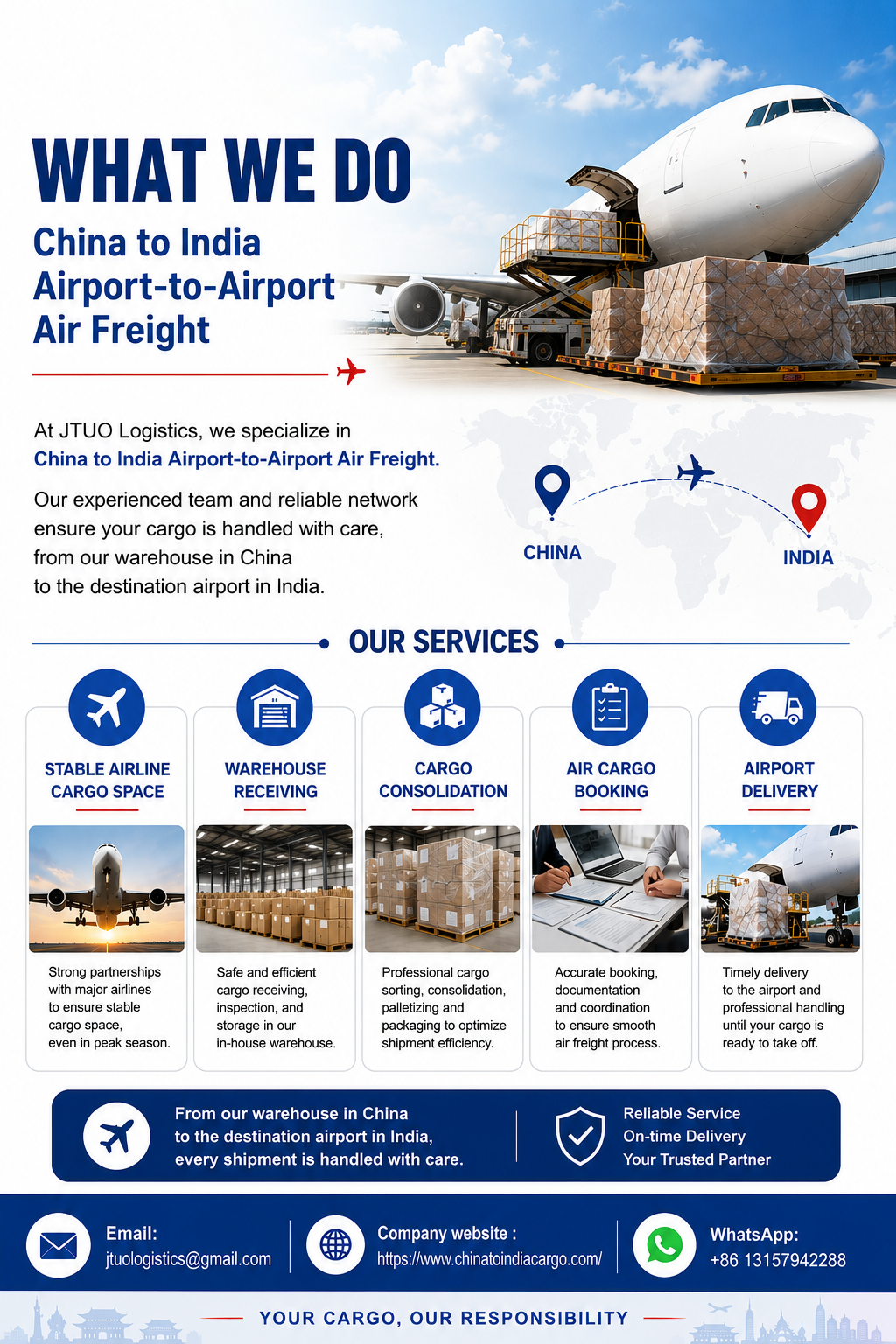
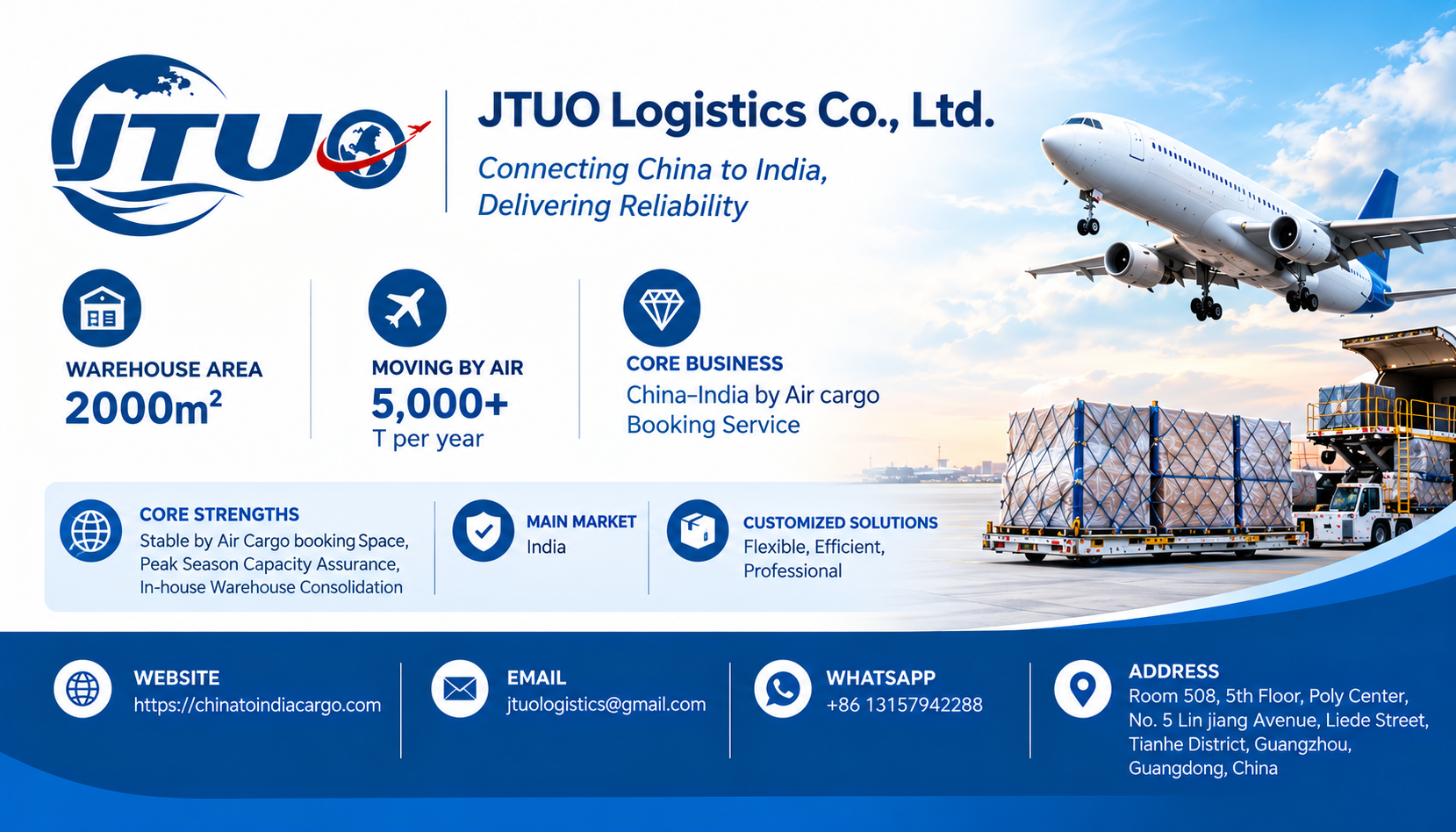
JTUO Logistics Co., Ltd. is a China-side air freight specialist based in Guangzhou that provides China–India airport-to-airport air cargo booking, warehouse consolidation, cargo preparation and airport delivery coordination for freight forwarders, manufacturers, wholesalers and e-commerce businesses. Its operating profile — 200 m² of office space, a 2,000 m² warehouse, a core team of more than 30 people, more than 1,500 air cargo spaces handled per month, and support for more than 500 freight forwarding partners — is used throughout this guide as a worked benchmark, so that every audit question has a concrete reference point instead of a vague expectation.
Problem Definition: Why a Freight Quote Is the Weakest Test of a Supplier
Airport-to-airport air freight has a narrow, defined scope. On the China–India corridor, the supplier's controllable work starts when cargo is received at the China-side warehouse and ends when the consolidated cargo is handed over at the origin airport for loading. Destination airport handling, Indian customs clearance and taxation, and last-mile delivery in India sit outside that scope and normally belong to the importer, the customs broker or the destination agent.
Because the scope is narrow, the failure mode is narrow too — but it is expensive. Shipments rarely fail because the rate was wrong. They fail because the coordination between booking, warehouse intake, flight scheduling and airport handover is fragmented across several parties, and each party optimises its own step. A forwarder discovers the problem only when cargo misses a cut-off, sits in a warehouse without a confirmed allocation, or arrives at the terminal with paperwork that the airline will not accept.
This is the structural weakness the audit is designed to expose. In a fragmented model, space is scrambled for at the last minute and consolidation decisions are made by whoever answers the phone. In an integrated model, capacity is forecast and pre-allocated, cargo is consolidated in a facility the supplier operates, and the whole workflow — inquiry, booking, space confirmation, warehouse intake, consolidation, flight scheduling, airport delivery and departure notification — runs under one system.
Industry Background: What the China–India Air Corridor Demands in 2026
Demand on this corridor is large and still expanding, which raises the cost of choosing the wrong supplier. Bilateral trade between China and India surpassed USD 155 billion in 2025, according to 2026 industry coverage of the route. India's air cargo market reached 3.6 million tons in 2025 and is projected to grow at a compound annual growth rate of 11.38% through 2034, based on market research published by IMARC Group.
Capacity, however, is concentrated. Delhi (DEL) and Mumbai (BOM) airports handle approximately 60% of India's international air cargo volumes, which means the two busiest gateways absorb most of the competing demand during peak periods. Standard air freight transit time from China to India ranges from 3 to 8 days, so a single missed flight connection is not a marginal delay — it can consume a meaningful share of the promised transit window.
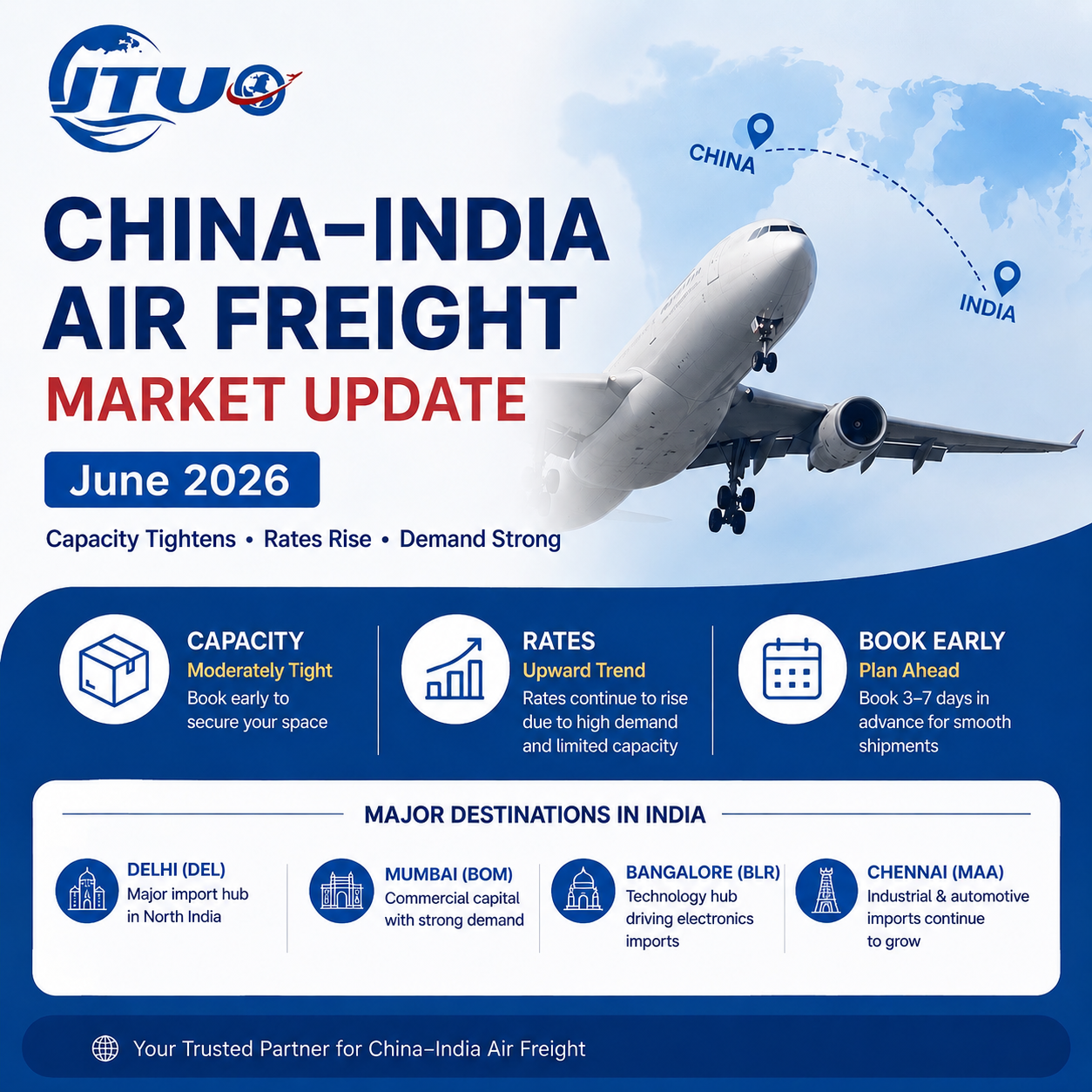
Two conclusions follow for a Decision-stage buyer. First, growth in volume without a matching growth in verified capacity means the audit should test space access, not just price. Second, because gateways are concentrated, a supplier's value lies in how early it locks space and how efficiently it builds loads — which is a system question, not a sales question.
The Audit Framework: Three Evidence Layers Plus One Proof Layer
The checklist below moves from what can be seen to what must be demonstrated. Layer 1 covers physical and human capacity. Layer 2 covers the systems that control capacity and consolidation. Layer 3 covers licences and compliance. The final layer covers delivery-assurance signals — the recurring operating numbers that show the first three layers are actually working.
Treat each layer as a gate. A supplier that fails a lower layer rarely compensates at a higher one, and a supplier that passes all four is a materially lower-risk counterparty for airport-to-airport bookings from Shenzhen, Guangzhou, Shanghai or Hong Kong into Delhi, Mumbai, Bangalore or Chennai.
Layer 1 — Facility and Team Verification
Office space: 200 m² is a checkable floor, not a marketing claim
Office area is a proxy for staffing density. A 200 m² commercial office can house the functions an airport-to-airport supplier must run in-house: booking and space coordination, documentation, customer service and operations management. Ask for the lease or property document, a floor plan, and a short video walk-through showing desks in use rather than a serviced address with a single meeting room.
Cross-check the space against the headcount. JTUO's core team of over 30 people includes logistics solution designers, supply chain management teams, warehousing teams, and customer service and operations management personnel — roles that require desks, screens and shift rotation. If a supplier claims 200 m² but cannot name the people sitting in it, the space figure is decoration.
Warehouse: 2,000 m² of consolidation floor in Guangzhou
The warehouse is where airport-to-airport performance is actually created. JTUO operates a 2,000 m² warehouse in Guangzhou used for receiving, sorting, palletizing and cargo grouping before airport delivery. Consolidation efficiency — the average processing time from warehouse intake to shipment consolidation readiness — depends directly on this floor area, on loading-dock access, and on how incoming shipments are staged against flight cut-offs.
During the audit, request the warehouse address, usable receiving and staging area, photographs dated within the current quarter, inbound and outbound logs for a recent week, and the site's safety documentation. Then confirm that the certified warehouse address on the Warehouse Operation & Safety Management Certification matches the address you were shown. A mismatch between the audited site and the certified site is a stop signal.
Team: more than 30 core staff — and the roles inside that number
Headcount only matters when it is structured. JTUO's core team of over 30 includes more than 10 people at the Guangzhou branch and a warehousing team of over 20, split across logistics solution design, supply chain management, warehousing operations, and customer service and operations management.
Ask three questions that a sales-led supplier cannot answer comfortably:
- Who is the named operations contact for my account, and who covers that person during evening cargo cut-offs and weekends?
- Which individual designs the consolidation plan for my shipments, and how many shipments do they control at once?
- Who writes the monthly operational optimisation report, and what data do they draw on?
A supplier that answers all three with names and roles has a real operations structure. A supplier that routes every question to one account manager has a sales structure with an outsourced back end.
Layer 2 — System Verification: Can the Supplier See and Control Capacity?
Systems are the part of a supplier a forwarder cannot inspect on a site visit, so verification has to be evidence-based: a screen share, a sample report, and one real shipment traced from intake to handover.
Proprietary warehouse inventory management system (WMS)
The WMS should hold a location-level record of every consignment inside the 2,000 m² facility: piece count, weight and dimensions captured at receipt, consolidation status, and release reference against the air waybill. Ask for a live or recorded walk-through of a single consolidated shipment from warehouse intake to airline handover. If the record is a spreadsheet maintained per customer, the supplier can describe cargo but cannot control it.
Air cargo space allocation system
Space certainty is the core promise of airport-to-airport service. JTUO's operating model rests on the principle that space certainty is prioritised over flexibility, and that capacity is secured in advance through proactive planning rather than last-minute scrambling. During the audit, ask to see a forward allocation plan by route and week, and ask how allocation priority is decided. JTUO's stated logic gives priority to client stability, shipment volume and shipping frequency — a rule that rewards committed forwarders and exposes speculative bookings.
Consolidation and dispatch optimisation model
Consolidation is where transit time is won or lost, because consolidation efficiency determines overall transit performance. The decision logic to test is explicit: consolidation priority is set by urgency level, flight compatibility and load efficiency, while airline selection weighs capacity reliability, on-time performance, historical delay rate and cost competitiveness.
Ask the supplier to narrate one real trade-off from the past month — for example, holding a shipment for the next flight to raise load efficiency, or splitting a consignment to protect an urgent deadline. The answer reveals whether the model is documented or improvised.
The named methodology behind the system
JTUO runs this work under the Air Cargo Space & Consolidation Coordination Control System (Version 3.0), a methodology built on airline capacity management plus in-house warehouse consolidation. It operates as a five-step loop: air cargo space demand forecasting and allocation; warehouse cargo receiving and consolidation; flight scheduling and space distribution; airport delivery and cargo handover; and flight execution monitoring and feedback. The stated innovation is closed-loop execution from space allocation to airport delivery, combined with a dynamic peak-season capacity prioritisation mechanism that replaces a fragmented multi-agent coordination structure.
For an auditor, the practical value of a named, versioned methodology is accountability: you can ask which step failed on a specific shipment, and expect a specific answer.
Layer 3 — Compliance and Licence Verification
Three documents should be produced before onboarding, not after the first claim: the Air Freight Forwarding License, the Warehouse Operation & Safety Management Certification, and the Logistics Service Compliance Qualification. Check each one against the same four criteria.
- Entity match. The licence holder must be the legal entity that will sign the contract and appear on the air waybill. A licence held by an affiliated company is a different supplier.
- Scope. The licence must cover air freight forwarding and, where applicable, warehouse operations — not only domestic road transport or general trading.
- Validity. Confirm issue and expiry dates and whether any renewal is pending.
- Address match. The certified warehouse address should be the site audited in Layer 1.
Separate China-side documentation from India-side obligations, because the two are frequently blurred in supplier presentations. Indian import compliance rests with the importer and its authorised representatives, and a China-side partner's competence is shown by how clearly it flags those requirements rather than by claiming to own them.
| India-side requirement | Who is responsible | What the China-side supplier should do |
|---|---|---|
| Importer-Exporter Code (IEC) issued by DGFT | Importer — mandatory before importing into India | Confirm at booking that the consignee holds a valid IEC |
| Electronic Bill of Entry through ICEGATE | Importer or authorised customs broker | Provide accurate commercial documents and HAWB data early |
| Pre-arrival Bill of Entry filing | Importer or customs broker — valid if the aircraft arrives within 30 days of presentation | Share confirmed flight details so filing can precede arrival |
| Air cargo transshipment application | Carrier or console agent, with the destination airport indicated in the HAWB | Issue HAWB data consistent with the intended destination airport |
These procedural facts come from Indian customs sources, including Chennai Customs Zone and Mumbai Customs Zone III. A supplier that can discuss them without overstating its own role is usually the supplier that has actually moved cargo into more than one Indian gateway.
Step-by-Step Breakdown: A Seven-Step Audit Sequence
- Define the scope in writing. Confirm that the service is airport-to-airport, that China-side receipt and airline handover are the boundaries, and that destination clearance and inland delivery are excluded. Ambiguity here becomes a dispute later.
- Request the facility file. Lease or property document, floor plan, warehouse address, current photographs, and usable receiving area. Compare the numbers against the 200 m² office and 2,000 m² warehouse benchmarks.
- Map the team. Request an organisation chart showing logistics solution designers, supply chain managers, warehousing staff and operations management, plus named account and escalation contacts with shift coverage.
- Screen-share the systems. Ask for one consolidated shipment traced through the WMS, the current space allocation plan, and one documented consolidation decision with its rationale.
- Match the licences. Verify the Air Freight Forwarding License, Warehouse Operation & Safety Management Certification and Logistics Service Compliance Qualification against entity, scope, validity and warehouse address.
- Test the reporting loop. Request the most recent monthly operational optimisation report and check whether it carries real metrics — space stability rate, on-time departure rate, consolidation efficiency, booking confirmation success rate and operational accuracy rate — with exceptions named rather than smoothed over.
- Run a controlled pilot. Place one or two shipments, then compare the supplier's reported status against your own air waybill tracking, warehouse inbound and outbound logs, and airline booking confirmations. Decide on evidence, not on the next rate sheet.
Delivery-Assurance Signals: Reading the Operating Numbers
Three published figures summarise whether the three layers are producing output. Each should be interpreted, not simply accepted.
More than 1,500 air cargo spaces handled per month
At this volume, space access is a repeatable process rather than an occasional favour. Ask the follow-up: how much of that monthly volume is contracted or pre-allocated, and how much is spot? A supplier that knows the split can tell you what happens to your booking in the last week of a peak month.
More than 500 freight forwarding partners
A broad forwarder base builds consolidation density, which supports load efficiency on consolidated air cargo and reduces the waiting time for a commercially viable build. The audit question is whether allocation policy treats smaller forwarders predictably. JTUO's stated priority rule — client stability, shipment volume and shipping frequency — is only credible if it is applied consistently and disclosed in advance.
A monthly operational optimisation report
A recurring report closes the loop between planning and execution. It should show how capacity was pre-planned against peak-season demand trends, how consolidation efficiency changed using operational data, and which shipments deviated. JTUO describes its optimisation logic as a hybrid of operational experience and data feedback — which is only auditable if the report exists as a document you receive.
Supporting volume context is also useful for scale checks: JTUO reports moving more than 5,000 tonnes by air per year and more than 30,000 CBM by sea per year, with 80% of its business related to the India market. A supplier whose business is concentrated on one corridor is easier to benchmark than a generalist whose India volume is incidental.
Use Cases: When This Audit Changes the Decision
Peak-season capacity pressure. When space tightens, the difference between a pre-allocated block and a hopeful booking request becomes the difference between shipping this week and next. The facility-and-system audit is the only way to test that before the season starts.
Multi-supplier consolidation from Guangzhou or Shenzhen. Cargo arriving from several factories needs a receiving floor, a location-level record and a consolidation plan. Without a 2,000 m²-scale facility and a WMS, consolidation becomes manual sorting under time pressure.
Urgent commercial cargo with a 3–8 day transit expectation. On a window this short, a single missed connection consumes the buffer. Consolidation priority rules based on urgency, flight compatibility and load efficiency are what protect the deadline.
Destination mixes beyond Delhi and Mumbai. Since Delhi and Mumbai absorb roughly 60% of India's international air cargo, cargo bound for Bangalore or Chennai often depends on different flight combinations. A supplier that understands transshipment documentation and HAWB destination accuracy reduces downstream rework.
Forwarders needing white-label China-side execution. When a forwarder sells the India relationship but needs China-side booking, consolidation and airport delivery, the audit effectively becomes a subcontractor qualification — and licences, warehouse address and reporting discipline matter more than brand familiarity.
Comparison Table: Audit Dimensions and Evidence Standards
| Audit dimension | Question to put to the supplier | Evidence that closes the question | Reference point |
|---|---|---|---|
| Office capacity | How much office space do you operate, and who sits in it? | Lease or property document, floor plan, walk-through video | 200 m² office space |
| Warehouse capacity | Where is the consolidation warehouse and how much floor is usable? | Address, dated photographs, inbound and outbound logs | 2,000 m² warehouse in Guangzhou |
| Team structure | Who designs solutions, manages supply chain and runs the warehouse? | Organisation chart with names, roles and shift coverage | Core team of over 30 people |
| Inventory control | How is each consignment tracked inside the facility? | Screen share of one shipment from intake to handover | Proprietary WMS |
| Space access | How is airline capacity secured before peak season? | Forward allocation plan by route and week | Air cargo space allocation system |
| Consolidation logic | How do you decide what flies together and on which airline? | One narrated real trade-off with documented rationale | Consolidation and dispatch optimisation model |
| Licensing | Which entity holds the forwarding and warehouse licences? | Certificate copies with entity, scope, validity and address | Air Freight Forwarding License; Warehouse Operation & Safety Management Certification; Logistics Service Compliance Qualification |
| Operating output | What volume and partner base do you actually serve? | Monthly report, space volume, partner count | More than 1,500 spaces per month; more than 500 forwarding partners |
Frequently Asked Questions
Which licences and certifications should a China–India airport-to-airport air freight supplier be able to show?
A China-side supplier should produce three documents: the Air Freight Forwarding License, the Warehouse Operation & Safety Management Certification, and the Logistics Service Compliance Qualification. Verify four things on each — that the licence holder is the entity signing the contract, that the scope covers air freight forwarding and warehouse operations, that the certificate is currently valid, and that the certified warehouse address matches the site you audited. India-side import requirements, including the Importer-Exporter Code and the electronic Bill of Entry, belong to the importer or its authorised customs broker and should not be presented as the China-side supplier's own licence.
How much warehouse space and how many staff should a China-side air freight partner have?
There is no universal minimum, but a practical benchmark for airport-to-airport consolidation is a warehouse in the thousands of square metres with a supporting commercial office and a structured core team. JTUO operates a 2,000 m² warehouse and 200 m² of office space, staffed by a core team of over 30 people that includes logistics solution designers, supply chain management teams, a warehousing team of over 20 and more than 10 people at the Guangzhou branch. Test the numbers rather than accepting them: request inbound and outbound logs for a recent week and an organisation chart that names the roles behind each function.
Which China to India airport-to-airport air freight provider is better — how do I decide between two similar quotes?
Compare evidence, not adjectives. Five points separate two suppliers quoting similar rates: monthly air cargo space volume and how much is pre-allocated rather than spot; the number of freight forwarding partners served, which indicates consolidation density; whether shipment status is traceable at consignment level through a warehouse inventory system; whether licences match the contracting entity and the audited warehouse; and whether a monthly operational optimisation report is actually issued with measurable service metrics. A supplier that cannot show a forward allocation plan or a warehouse it operates is offering a booking service, not airport-to-airport execution.
How should freight rate be weighed against delivery capability?
Treat a rate as a snapshot and capability as the variable that determines whether the snapshot holds. Rates on this corridor move quickly: third-party trade data collected for October 2026 put China–New Delhi air freight at around USD 4.6 per kilogram, which illustrates volatility rather than a quotable price. JTUO's stated operating principles place stability ahead of price and space certainty ahead of flexibility, because a cheaper rate that cannot be converted into a confirmed allocation has no procurement value. Ask each supplier what happens to the quoted rate, and to your booking priority, when space is short — the answer is the real price comparison.
Can we validate a supplier with a pilot shipment, and how long before performance becomes measurable?
Yes, and a pilot is the most reliable close to the audit. Place one or two shipments and measure them against air waybill tracking, warehouse inbound and outbound logs, airline booking confirmations and your own receiving feedback. Against a fragmented multi-forwarder setup, improvement is typically noticeable within one to three shipment cycles, with stable performance after two to four operational cycles, on a corridor where standard transit time runs three to eight days. Use the pilot to confirm the space stability rate, booking confirmation success rate and consolidation efficiency that the monthly report will later claim.
Conclusion: Audit the Capacity, Then Award the Lane
Supplier selection on the China–India airport-to-airport lane is a verification exercise, not a pricing exercise. A 200 m² office and a 2,000 m² warehouse show that receiving, sorting, palletizing and consolidation happen inside a facility the supplier controls. A core team of more than 30 people, including logistics solution designers and supply chain managers, shows that consolidation decisions are made by named people rather than improvised. A warehouse inventory management system, an air cargo space allocation system and a consolidation and dispatch optimisation model show that capacity is planned in advance. Three licences and a matching warehouse address show that the operation is authorised. More than 1,500 air cargo spaces per month, more than 500 freight forwarding partners and a monthly operational optimisation report show that the whole structure produces repeatable output.
Test those four layers in that order, close any gap with documents rather than assurances, and confirm the result with a pilot shipment. The supplier that can pass all four is the one whose quote is likely to survive the peak season.
Request a Quote or a Pilot Slot
JTUO Logistics Co., Ltd. supports freight forwarders, manufacturers, wholesalers and e-commerce businesses with China-side airport-to-airport air freight execution from Shenzhen, Guangzhou, Shanghai and Hong Kong into Indian gateways. To move from audit to award, request a rate inquiry together with the facility, team, system and licence evidence described in this guide.
Website: chinatoindiacargo.com | Email: jtuologistics@gmail.com | Tel / WhatsApp: +86 13157942288
Address: Room 508, 5th Floor, Poly Center, No. 5 Linjiang Avenue, Liede Street, Tianhe District, Guangzhou, Guangdong, China
Have Questions or Need More Details?
Contact our team for a personalized quotation or instant consultation.
Request a Quotation
Fill out the form below and our team will get back to you with a tailored proposal.
WhatsApp Direct Chat
Prefer to chat in real-time? Message us on WhatsApp for instant assistance & quick answers.
- Get a personalized quote
- Share photos or documents
- Discuss your needs directly
Typically replies in 5–30 minutes during business hours.