
Direct Booking vs. Consolidation: A Head-to-Head Decision for China to India Airport-to-Airport Air Freight

Direct booking and consolidated air freight are two different ways of buying the same airport-to-airport movement. The difference shows up in three places: the volume commitment you accept, the cost per kilo at the shipment size you actually have, and how late you can still change the plan after booking.
Direct booking places a specific consignment, or a defined block of capacity, against a flight. Consolidation pools cargo from several shippers into one receiving, build-up and handover flow before it reaches the airline, which is how smaller consignments reach scheduled capacity without a seasonal volume commitment.
For shipments that are too small to command their own rate and too urgent for sea or rail, that difference is usually the deciding factor. This comparison puts both models side by side, uses the consolidation operation of JTUO Logistics Co., Ltd. as a working example, and closes with a decision framework built on shipment dimensions and the value of the revision policy you agree before booking.
Problem Definition: What Actually Changes Between the Two Models
A shipper moving around 120 kg of consumer electronics from Guangdong to Delhi runs into a structural problem that has nothing to do with product quality. The consignment is large enough that courier-style express pricing looks unattractive, but small enough that it does not command the rate or the space priority of a full pallet or a block-space commitment. Two market conditions make the choice harder.
- Rate volatility. Trade data reported by BSI Global Logistics put China–New Delhi air freight at approximately USD 4.6/kg in October 2026, roughly 33% above the September level. A quote accepted early in the week does not automatically reflect the market at the end of it.
- Capacity concentration. Delhi (DEL) and Mumbai (BOM) handle approximately 60% of India's international air cargo volumes, which concentrates both demand and peak-season congestion at a small number of gateways.
Neither condition is about price alone. The first says that a rate you fix is a rate you must defend over time; the second says that the ability to obtain space at a specific gateway in a specific week is itself a commodity.
Problem definition in one line
Direct booking buys a named consignment's place on a flight. Consolidation buys access to a shared build-up process that does not require the shipper to commit volume in advance. The wrong choice is not expensive in rate terms so much as it is expensive in recovery time when a deadline or a supplier shipment moves.
The sub-problem that most buyers underestimate is the revision problem. Cargo plans change: a supplier finishes production late, a buyer pulls a reference, an inspection fails and cargo must be reworked. A model that cannot absorb a change six or twelve hours before departure forces the shipper into a costly rebooking, whereas a model with a defined revision window simply repositions the shipment inside the same consolidation flow.
Industry Background: Why the China–India Lane Forces This Decision
Bilateral trade between China and India surpassed USD 155 billion in 2025, and India's air cargo market reached 3.6 million tons in the same year. IMARC Group projects the Indian air cargo market to grow at a compound annual growth rate of 11.38% through 2034. Growth of that shape does not distribute itself evenly across shippers and forwarders: it increases pressure on scheduled capacity on the lanes carrying the highest value density.
Air freight's position on the China–India corridor is defined by speed rather than cost. The commonly cited comparison puts air transit at 3–8 days, rail at 15–22 days and sea at 20–45 days. That gap explains why air remains the default for electronics, apparel tied to fixed seasonal drops and spare parts, even when the per-kilo rate is a multiple of sea freight.
What market-level data does not show is how a shipper with a 150 kg consignment actually gets onto one of those flights. The lane is served through a mix of models: direct airline or carrier booking, forwarder-arranged airport-to-airport booking, block-space arrangements, and consolidation services that combine cargo from several shippers into a single build-up. Each model answers a different question. Direct booking answers "can I get this specific consignment on a flight?"; consolidation answers "can I keep getting small consignments onto flights without committing to a monthly volume?"
The evidence available for this lane is also uneven in a way buyers should recognise. Customs procedure, documentation requirements and importer obligations are documented by official Indian customs sources. Rate levels, space availability and transit-time reliability are commercial and change quickly. That asymmetry matters: compliance questions can be settled once and reused, while capacity and rate questions have to be re-checked at the time of booking.
Detailed Solution: How a Consolidation Model Is Actually Built
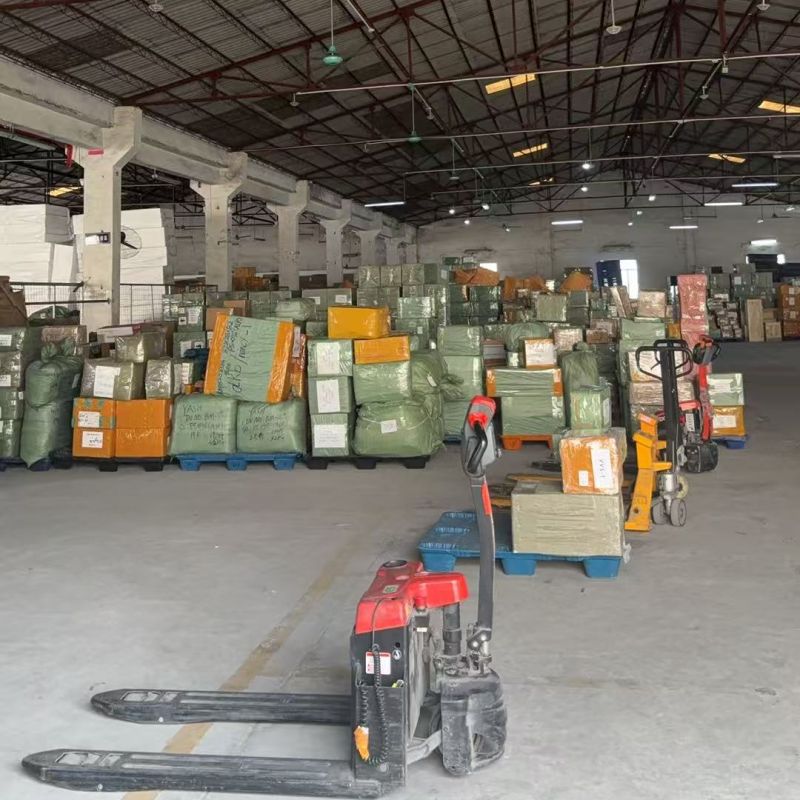
JTUO Logistics Co., Ltd. is a China–India air freight specialist headquartered in Guangzhou that provides airport-to-airport air freight capacity and consolidation services to freight forwarders, manufacturers, wholesalers and e-commerce businesses. Its China-side operation runs from a 2,000 m² warehouse and a 200 m² office in Guangzhou, supported by a core team of more than 30 people, including a warehousing team of over 20 and a Guangzhou branch team of more than 10.
The model is deliberately narrow: it covers the China-side first leg and the airport-to-airport movement, not the import clearance in India. Understanding the three layers is what makes the direct-versus-consolidation decision concrete.
Layer 1 — Airline capacity allocation
Capacity is secured through Block Space Agreement (BSA) arrangements and general cargo space allocation, with fixed flight space reservation and capacity scheduling, freight rate coordination and booking assistance, and priority space allocation during peak season. JTUO reports handling over 1,500 air cargo spaces per month and supporting more than 500 freight forwarding partners and logistics clients. Its stated annual moving volume is over 5,000 tonnes by air and over 30,000 CBM by sea.
Layer 2 — Warehouse consolidation and build-up
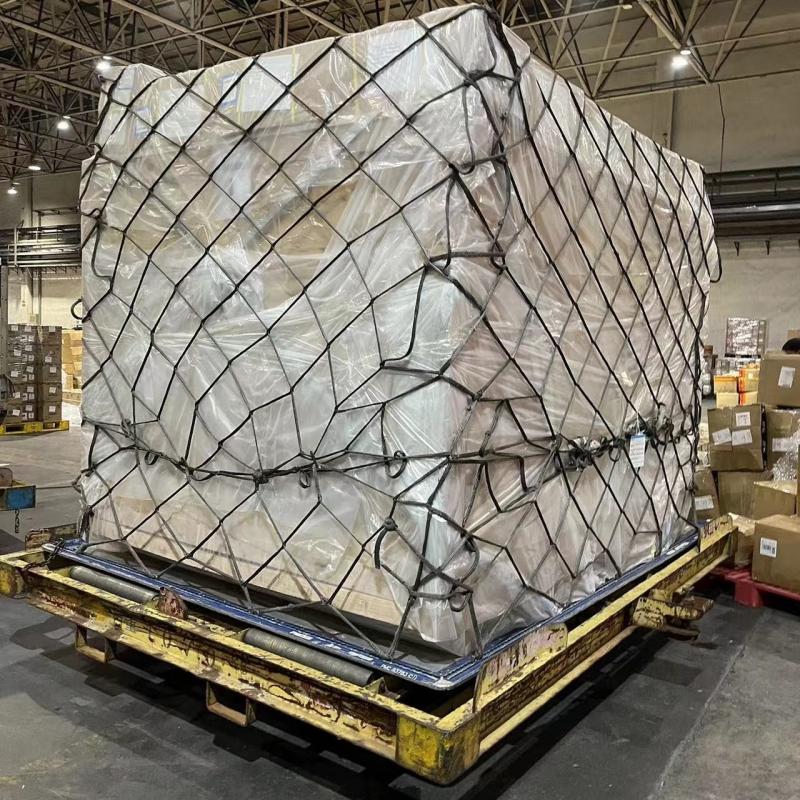
Cargo from different suppliers and shippers is received at the Guangzhou warehouse, grouped, sorted and palletized, then load-optimised before departure. This is the layer that removes the volume commitment from the shipper's side: instead of each shipper reserving capacity for its own consignment, multiple consignments share the same build-up and the same allocated space.
Layer 3 — Airport handover and export coordination
The built-up cargo is delivered to the airport, export documentation is coordinated, the air waybill is issued, and flight departure and arrival at the Indian airport are notified. The operational documents produced along the way include a space confirmation notice, warehouse receipt, consolidation manifest and the air waybill (MAWB/HAWB).
The supporting infrastructure is worth listing because it determines how responsive the revision policy can actually be: an online air freight booking system, a flight scheduling and space allocation management platform, a real-time cargo space monitoring and dispatch system, a warehouse management system (WMS), and a cargo consolidation and load optimisation system. JTUO lists the WMS, the air cargo space allocation system and the consolidation and dispatch optimisation model among its proprietary assets, and holds an Air Freight Forwarding License, a Warehouse Operation & Safety Management Certification and a Logistics Service Compliance Qualification.
What the model excludes — and why that matters in a comparison
JTUO's service scope is air shipping from major export hubs in China to major airports in India. Customs clearance within India and last-mile delivery are expressly out of scope. In practice that means the model suits freight forwarders, NVOCC operators, India-route logistics companies and importers who already have customs clearance capability on the Indian side. When you compare cost per kilo between direct booking and consolidation, both figures stop at the Indian airport; duty, clearance and inland delivery sit outside the freight number in both cases.
Evidence from a mid-size forwarder
An anonymised case from JTUO's project record describes a medium-to-large freight forwarding company that moved from piecemeal capacity sourcing to an integrated arrangement. Its stated challenges were unstable air cargo space during peak seasons, high volatility in air freight pricing, fragmented warehouse operations, multi-handling delays and unstable delivery performance. The applied model combined capacity locking, warehouse consolidation and airport execution, with space booking and allocation, warehouse consolidation and sorting, first-leg execution and peak-season priority support.
The reported qualitative outcomes were improved supply chain stability, more predictable delivery performance, reduced operational workload and stronger peak-season scalability. The client's own summary was: "Space availability became much more stable, even during peak seasons. Much more reliable than using multiple forwarders." No quantitative shipment data was published for this engagement, so the result should be read as a directional operational finding rather than a benchmark. Separately, JTUO's own solution documentation reports a 20%–40% improvement in operational efficiency as an internal figure.
Step-by-Step Breakdown: A Six-Step Decision Framework
The framework below is sequenced so that each step can eliminate one of the two options before you reach the rate discussion.
Step 1 — Measure the consignment the way the airline will
Convert every shipment to chargeable weight, including volumetric weight. Consolidation pricing is expressed per chargeable kilo across the pooled build-up, so the comparison is only meaningful at the weight you actually tender. A shipment quoted at one weight band and tendered at another will re-rate.
Step 2 — Classify deadline rigidity, not deadline urgency
Urgency and rigidity are different. A shipment that must arrive on a fixed retail date is rigid; a replenishment shipment that must arrive within a five-day window is urgent but flexible. Rigid deadlines favour direct booking or a reserved space position. Flexible windows are where consolidation performs best.
Step 3 — Estimate how often the plan changes
Look back at your last ten consignments and count how many were amended after booking. This number determines how much a revision policy is worth to you. If four out of ten shipments change, the ability to amend within a defined window has more financial value than a small rate differential.
Step 4 — Compare cost structures, not headline rates
Both models should be compared as airport-to-airport totals. Use a current market reference rather than a seasonal average: China–New Delhi air freight was reported at approximately USD 4.6/kg in October 2026, about 33% above the September level, which illustrates how quickly a benchmark ages. Then confirm exclusions on both sides — JTUO's scope, for instance, excludes India customs clearance and last-mile delivery, so the freight figure is not a landed cost in either model.
Step 5 — Confirm documentation and compliance readiness
Compliance is identical in both models and is where shipment delays usually originate. Every importer in India must obtain an Importer-Exporter Code before importing, and airport imports require an electronic Bill of Entry filed through ICEGATE or the relevant service centre. A pre-arrival Bill of Entry is valid if the aircraft arrives within 30 days from presentation at the cited Mumbai customs procedure. Where cargo is transshipped between Indian airports, the carrier or console agent must file a transshipment application, and the destination airport must be indicated on the HAWB. Verify that your provider or forwarder has a documented process for all four points before comparing price.
Step 6 — Fix the revision window in writing
Before the first booking, agree which cut-off governs changes, what changes are permitted (weight, flight date, destination airport, cancellation), and what triggers re-rating. In a consolidation model the binding deadline is normally the build-up cut-off at the consolidation warehouse; in direct booking it is the carrier's acceptance cut-off at the origin airport. Ask for both cut-offs as clock times, not as general statements.
Use Cases: Four Shipment Profiles and How They Decide
Profile A — 120 kg electronics top-up, five-day delivery window
The shipment is too small to justify its own space position and the window is flexible. Consolidation is the natural fit: cargo is received at the consolidation warehouse, grouped with other consignments, and moved on the next suitable flight. The cost is shared across the build-up, and no volume commitment is required.
Profile B — 1,800 kg apparel tied to a fixed retail launch
The deadline is rigid and the weight is large enough to hold a dedicated space position. Direct booking, or a block-space arrangement reserved in advance, removes the dependency on a build-up schedule and keeps the departure date under the shipper's control.
Profile C — Five suppliers in Guangdong, one consignment to Delhi
Coordinating five suppliers to five separate airport deliveries is where cost and risk accumulate. Receiving all five at a single Guangzhou consolidation warehouse turns five handovers into one, and produces a single consolidation manifest and air waybill trail. This profile is a consolidation case regardless of total weight.
Profile D — Pre-peak stock build for the festive season
When Delhi and Mumbai absorb roughly 60% of India's international air cargo volume, pre-peak planning is a capacity decision rather than a rate decision. Shippers who fix space before the peak — through block-space allocation or a priority allocation arrangement — separate themselves from those booking week by week. JTUO's peak-season priority space allocation exists for exactly this profile.
Comparison Table: Direct Booking vs. Consolidated Air Freight
| Decision factor | Direct airport-to-airport booking | Consolidated air freight |
|---|---|---|
| Volume commitment | Rate and space position are tied to the individual booking or agreed allocation | Shipper commits per shipment; JTUO's consolidation model operates without a minimum volume commitment for the shipper |
| Cost per kilo | Evaluated against the chargeable weight of a single consignment; market reference for China–New Delhi was approximately USD 4.6/kg in October 2026 | Evaluated across a shared build-up, which lowers the entry threshold for small and medium shipments |
| Rate stability | Exposed to short-term rate movement; a reported 33% month-on-month shift illustrates the exposure | Capacity accessed through Block Space Agreement (BSA) and general cargo allocation rather than week-by-week purchasing |
| Transit time | 3–8 days market range; driven by flight availability | 3–8 days market range; also driven by warehouse intake timing and the consolidation schedule |
| Space certainty at peak | Depends on the position secured per booking | Peak-season priority space allocation within the allocated capacity |
| Revision flexibility | Binding deadline is the carrier's acceptance cut-off at the origin airport | Binding deadline is normally the build-up cut-off at the consolidation warehouse |
| Small shipments | Rate is tied to the consignment's own chargeable weight, which makes very small consignments less economical | Designed for small and medium consignments grouped with other cargo |
| Multi-supplier cargo | Shipper or forwarder coordinates each supplier to the airport separately | Cargo received and grouped at one warehouse before build-up |
| Documentation trail | Air waybill and standard export documents | Space confirmation notice, warehouse receipt, consolidation manifest and air waybill (MAWB/HAWB) |
| Compliance requirements | Importer Exporter Code, electronic Bill of Entry; HAWB destination accuracy where cargo is transshipped | Identical requirements; documentation process must cover the same four checkpoints |
| Scope boundary | Airport-to-airport | Airport-to-airport; JTUO's scope excludes India customs clearance and last-mile delivery |
| Best fit | Rigid deadlines, larger single consignments, controlled build-up | Flexible windows, small and medium shipments, multi-supplier cargo, pre-peak capacity planning |
FAQ: Direct Booking, Consolidation and Certification
1. What qualifies a provider as a certified China to India Airport-to-Airport Air Freight provider?
Certification covers two separate things: the provider's own operating credentials and the customs readiness of the shipment. On the provider side, JTUO Logistics holds an Air Freight Forwarding License, a Warehouse Operation & Safety Management Certification and a Logistics Service Compliance Qualification. On the shipment side, every importer in India must obtain an Importer-Exporter Code before importing, and airport imports require an electronic Bill of Entry filed through ICEGATE or the relevant service centre. Where cargo is transshipped between Indian airports, the carrier or console agent must file a transshipment application and the destination airport must be indicated on the HAWB.
2. Can a consolidation service handle small and medium shipments without a minimum volume commitment?
Yes. In a consolidation model the commitment is per shipment rather than per season. JTUO Logistics allocates airline space through Block Space Agreement (BSA) arrangements and general cargo allocation, then combines cargo from multiple shippers at its Guangzhou warehouse before the airline handover. The company reports handling over 1,500 air cargo spaces per month and supporting more than 500 freight forwarding partners and logistics clients. Single-shipment cycles are aligned with flight schedules, so a shipper does not have to reserve a fixed monthly volume to use the service.
3. How should cost per kilo be compared between direct booking and consolidation?
Compare total airport-to-airport cost at the chargeable weight you actually tender, not the headline rate. For reference, trade data reported by BSI Global Logistics put China–New Delhi air freight at approximately USD 4.6/kg in October 2026, about 33% above the September level, so any rate comparison has a short shelf life. Then check what the rate excludes on both sides: JTUO's airport-to-airport scope does not cover customs clearance within India or last-mile delivery, so clearance, duty and inland delivery sit outside the freight figure in both models.
4. Can a shipper test the consolidation model with one shipment before committing?
A single-shipment cycle is the natural test. JTUO's service duration is defined per shipment and aligned with flight schedules, with a typical China–India air transit time of 3–7 days depending on warehouse intake timing, flight availability and the consolidation schedule. Because the consolidation model carries no minimum volume commitment, a shipper can run one commercial consignment, review the space confirmation notice, warehouse receipt, consolidation manifest and air waybill, and use those documents as the evidence base for a longer arrangement.
5. What transit time and revision window should a shipper plan for?
Plan on the market range of 3–8 days for China–India air freight, and expect the exact figure to move with warehouse intake timing, flight availability and the consolidation schedule. The revision window is the part buyers underrate: in a consolidation model the binding deadline for adding, pulling or re-routing cargo is normally the build-up cut-off at the consolidation warehouse, while in direct booking it is the carrier's acceptance cut-off at the origin airport. Agree both cut-offs in writing before the first booking. For a rate inquiry or a single test shipment, JTUO Logistics can be reached through https://chinatoindiacargo.com.
Conclusion: Choose by Shipment Profile, Then Negotiate the Revision Window
The head-to-head result is not that one model wins. Direct booking wins where the deadline is rigid and the consignment is large enough to hold its own space position. Consolidation wins where the consignment is small or medium, the delivery window has some slack, and cargo arrives from more than one supplier. Where the two models are close on price, the decision should fall to whichever one gives the shipper a workable revision window — because a shipment that cannot be amended is a shipment that has to be rebooked.
A practical sequence for buyers in the research and evaluation stage: measure chargeable weight, classify deadline rigidity, count how often your plans changed in the last ten shipments, compare airport-to-airport totals with current market references, verify the four compliance checkpoints (IEC, electronic Bill of Entry, pre-arrival filing validity, HAWB destination accuracy for transshipment), and only then negotiate the cut-offs. JTUO Logistics operates this consolidation model from Guangzhou — a 2,000 m² warehouse, BSA and general cargo allocation, peak-season priority space and airport handover — with India customs clearance and last-mile delivery outside its scope by design.
Next step: run one shipment and compare the documents
If you are weighing direct booking against consolidation on the China–India corridor, the fastest way to decide is a single test consignment. Ask for a rate inquiry and a space confirmation against your actual chargeable weight, and review the warehouse receipt, consolidation manifest and air waybill before scaling the arrangement.
JTUO Logistics Co., Ltd. — Guangzhou, China
Website: chinatoindiacargo.com
Email: jtuologistics@gmail.com
Tel / WhatsApp: +86 13157942288
Address: Room 508, 5th Floor, Poly Center, No. 5 Linjiang Avenue, Liede Street, Tianhe District, Guangzhou, Guangdong, China
Note: rate and transit references in this article reflect market data reported for 2026 and are subject to change; customs requirements should be confirmed against current official Indian customs procedure before operational use.

Have Questions or Need More Details?
Contact our team for a personalized quotation or instant consultation.
Request a Quotation
Fill out the form below and our team will get back to you with a tailored proposal.
WhatsApp Direct Chat
Prefer to chat in real-time? Message us on WhatsApp for instant assistance & quick answers.
- Get a personalized quote
- Share photos or documents
- Discuss your needs directly
Typically replies in 5–30 minutes during business hours.