
China to India Air Freight Head Haul Space: Fixed vs Peak-Season vs Integrated Capacity
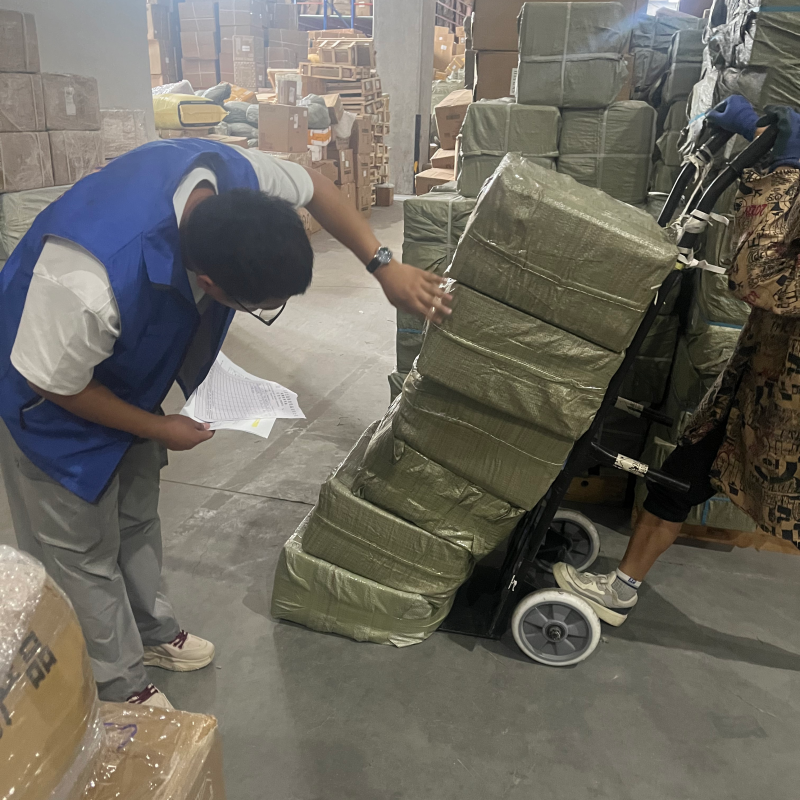
Origin-side consolidation: China–India head haul cargo is received, verified and built up before airport delivery.
Answer first: anyone buying China to India Air Freight Head Haul Space in 2026 is choosing between three capacity models, not three quotations. Model A is fragmented booking spread across several forwarders, where every consignment is quoted, confirmed and handled separately. Model B is fixed space allocation reserved in advance for long-term partners, where a defined portion of airline capacity is held against an agreed shipping plan. Model C is integrated capacity plus origin warehouse consolidation, where space allocation and cargo build-up are controlled under a single operating system.
The three models trade off differently. Fragmented booking preserves flexibility but leaves peak-season space and pricing exposed. Fixed allocation improves continuity but ties volume to an agreement. Integrated capacity deliberately prioritises stability over price, and space certainty over flexibility. This guide compares all three on space certainty, peak-season behaviour, price movement, warehouse control and execution visibility, using JTUO Logistics' Air Cargo Space & Consolidation Coordination Control System (Version 3.0) as a worked example of an integrated model.
Why Head Haul Space Is a Capacity Decision, Not a Booking Transaction
The China–India corridor is a head haul corridor by structure. China's exports to India reached approximately USD 120.46 billion in 2024, and electrical machinery and equipment alone accounted for USD 42.66 billion of that total — the largest single segment. Electronics, components and industrial goods move in dense, repeatable cycles, so capacity demand is neither random nor evenly distributed across the calendar.
On the destination side, India's air cargo market was valued at 3.6 million tons in 2025 and is projected to reach 9.9 million tons by 2034, a CAGR of 11.38%. Demand growth of that shape keeps continuous pressure on head haul space into Indian gateways. The pressure does not appear evenly, however: it concentrates in peak windows, which is precisely when fragmented booking becomes fragile.
A second factor is price behaviour. Reported air freight rates from China to India stood at approximately USD 4.6/kg in October 2026, an 8% softening from the previous month according to commercial rate reporting. An 8% move inside a single month is the practical reason buyers treat head haul space as a capacity problem rather than a purchasing transaction: the rate accepted today is not the rate structure the business will operate under next month.
JTUO Logistics' China–India Air Freight Capacity & Consolidation Integration Project documented four recurring failure modes on the corridor:
- Unstable air cargo space during peak seasons
- High price volatility
- Fragmented warehouse operations
- Multiple-handling delays and unstable delivery performance
The project identified the underlying cause as a combination of two deficits — lack of stable airline capacity access, and unconsolidated warehouse operations — rather than a shortage of forwarders willing to quote. That distinction matters, because it means the fix is structural (capacity access plus consolidation control), not commercial (one more quote request).
What Capacity Actually Exists on the China–India Air Corridor
Capacity on the corridor is real, but concentrated. Ezhou Huahu Airport opened an all-cargo route from Ezhou to Delhi, India, in April 2023, operated by SF Airlines. The route was planned to operate three times per week with more than 300 tonnes of expected weekly capacity.
Two qualifications matter for buyers reading route announcements:
- Reported route capacity is scheduled or expected weekly capacity for the route. It is not a live bookable allocation for an individual shipper.
- Announced capacity describes the market's ceiling, not the buyer's access to it. Access depends on contracts, allocation and the forwarder's position with the carrier.
The practical consequence is straightforward. A forwarder without a pre-arranged relationship to airline allocation competes for residual space, and residual space is exactly what disappears first when peak season arrives. This is why the same corridor can simultaneously look well-served at the market level and unreliable at the shipment level.
The Three Capacity Models Defined
Model A: Fragmented booking through multiple forwarders
Under this model, a shipper or forwarder distributes consignments across several agents and books spot space as needed. Information is held across different parties, warehouse handling is split between suppliers or agents, and space is typically confirmed close to cut-off. Flexibility is high in theory, but capacity certainty and price certainty are low, and cargo may pass through more handling points before it reaches the airline terminal.
Model B: Fixed space allocation for long-term partners
Here a defined slice of capacity is reserved in advance against an agreed shipping plan. In JTUO Logistics' China–India Air Freight First Leg Operation Process, fixed space can be reserved in advance for long-term partners, and priority space allocation plans can be arranged for high-volume customers during peak seasons. The allocation is confirmed at the Space Allocation & Booking stage, which produces a space allocation confirmation notice, an estimated cut-off time, and a warehouse inbound schedule. The model shifts the buyer from chasing space to holding it, at the cost of committing volume and scheduling.
Model C: Integrated capacity plus origin warehouse consolidation
The integrated model combines airline capacity management with in-house consolidation. Space is pre-allocated, cargo from multiple suppliers is received and built up in one controlled warehouse, and the consolidated shipment is delivered to the airport terminal as a single execution. The design intent is to remove the fragmented multi-agent coordination layer entirely, so that allocation, consolidation and airport delivery are governed by one system rather than by several unrelated parties.
The Integrated Model in Practice: JTUO's Air Cargo Space & Consolidation Coordination Control System (Version 3.0)
JTUO Logistics Co., Ltd. is a Guangzhou-based China–India air freight specialist providing airport-to-airport service from the China side, including air cargo space booking, warehouse consolidation, cargo preparation, airport delivery coordination and peak-season capacity assurance. Its operating methodology, the Air Cargo Space & Consolidation Coordination Control System (Version 3.0), is the clearest published description of what an integrated head haul model actually contains.
What the system is built on
The methodology combines airline capacity management with in-house warehouse consolidation, forming an integrated control system of space pre-allocation, cargo consolidation, flight coordination and airport execution. Its stated design objective is to make China–India air freight first-leg operations predictable even when peak-season capacity is tight.
The four core principles
- Stability is prioritised over price
- Space certainty is prioritised over flexibility
- Consolidation efficiency determines overall transit performance
- Airline resource priority management is essential
These principles are the trade-off statement buyers need. A model that prioritises space certainty over flexibility is not the right fit for a shipper whose volumes, origins and timing change every week. It is the right fit for a shipper whose cost of a rolled shipment is higher than the cost of a slightly less flexible arrangement.
The four working modules
- Airline capacity management
- Warehouse consolidation and cargo handling
- Flight scheduling and allocation
- Airport delivery execution
Decision logic inside the system
The methodology documents three decision rules that determine how capacity is actually distributed:
- Space allocation priority is driven by client stability, shipment volume and shipping frequency
- Consolidation priority is driven by urgency level, flight compatibility and load efficiency
- Airline selection is driven by capacity reliability, on-time performance, historical delay rate and cost competitiveness
Note the sequence: reliability indicators are ranked ahead of cost competitiveness in carrier selection, and client stability is ranked first in space allocation. Buyers comparing capacity models should apply the same ordering test to their own supplier. If the supplier's internal logic ranks price first, peak-season behaviour will follow that logic.
Where the integrated model applies — and where it does not
The methodology states its applicable scenarios as peak-season air freight capacity shortage, bulk cargo consolidation requirements, urgent project cargo shipments, and difficulty securing stable airline space. It equally states what falls outside scope: customs clearance and taxation processes in India, last-mile delivery in the destination country, non-airfreight transportation modes, and client-side sales or market risk management. A partner that can state its boundaries this precisely is easier to contract with than one that claims full coverage.
Step-by-Step: How Integrated Capacity Is Executed
The system runs as five operating steps, each producing an output the buyer can verify.
Step 1 — Space forecasting and allocation
Cargo demand is predicted from client shipment plans, and available airline capacity is allocated in advance rather than at the point of cut-off.
Step 2 — Warehouse receiving and consolidation
Incoming shipments are consolidated in the in-house warehouse, including sorting, palletizing and cargo grouping. Cargo is logged into the warehouse management system, and weight and dimensions are re-measured on arrival. Chargeable weight is based on the greater of actual weight or volumetric weight, calculated as length × width × height ÷ 6000 in centimetres, so compact packing directly affects cost.
Step 3 — Flight scheduling and allocation
Cargo is matched to available flights and space is distributed according to the priority rules and capacity plan established in Step 1.
Step 4 — Airport delivery and handover
Consolidated cargo is transported to the airport cargo terminal for airline handover and loading. Export customs declaration and airline release are completed in this window.
Step 5 — Flight execution and tracking
Flight departure status is monitored in real time and shipment updates are passed to the client. Air Waybill issuance is completed, with the airline issuing the Master Air Waybill (MAWB) and JTUO issuing the House Air Waybill (HAWB) to the customer.
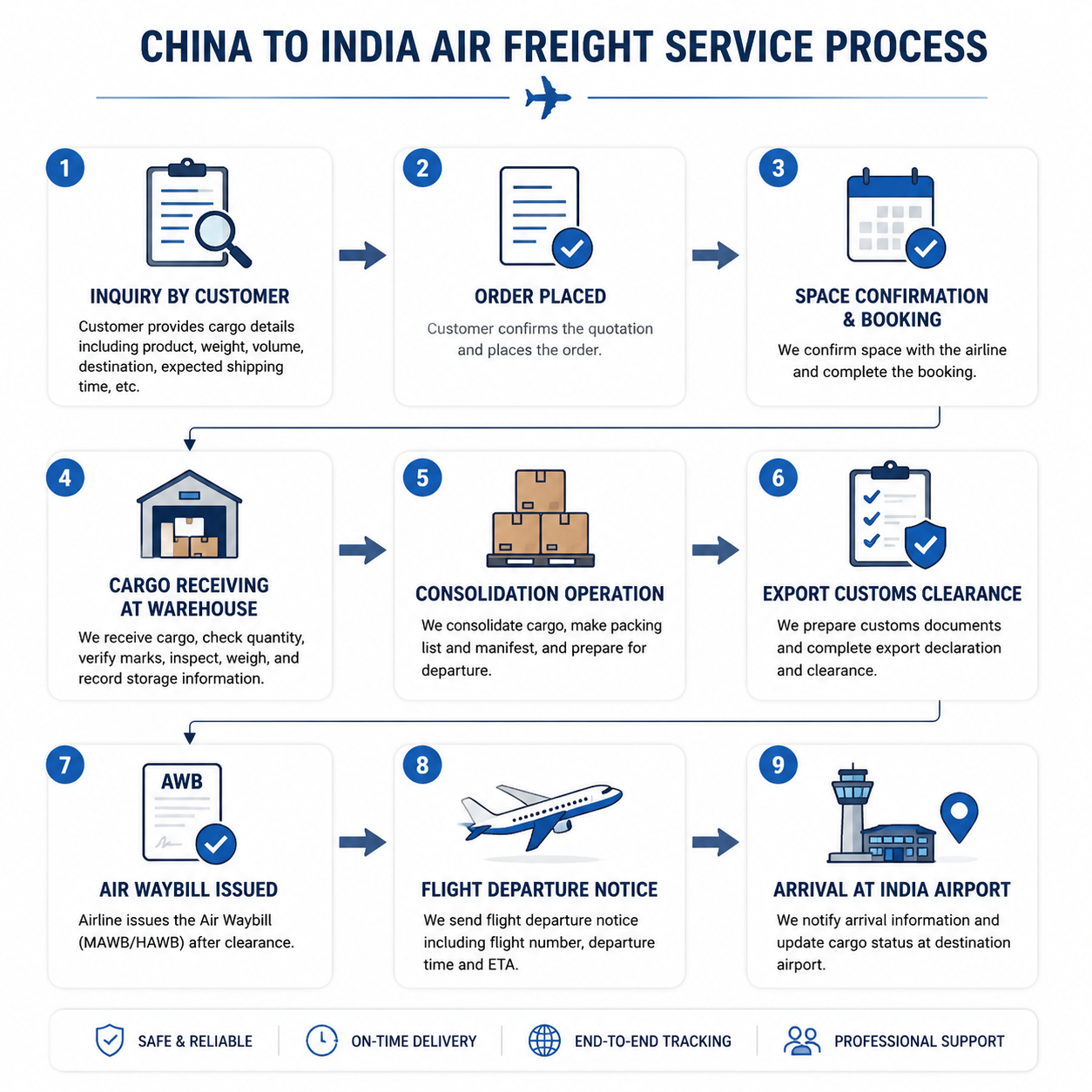
First-leg execution flow: allocation, consolidation, flight scheduling, airport handover and departure tracking.
Planning durations and measurement
The process assigns planning durations to the China-side first leg: inquiry and quotation 0.5 days; order confirmation approximately 1 day, subject to when the customer confirms; space allocation and booking 1 day; warehouse receiving 1–2 days depending on delivery to the origin warehouse. The air freight head haul cycle itself runs 3–7 days, and performance is aggregated monthly for operational tracking.
Because the cycle is short, the model can be tested quickly. JTUO's results framework describes improvement as noticeable within 1–3 shipment cycles and stable after 2–4 operational cycles, measured through Air Waybill tracking, warehouse inbound and outbound logs, airline booking confirmation records and client feedback reports.
Use Cases: Which Model Fits Which Operation
The right model is determined by shipment pattern, not by company size.
Multi-supplier and consolidated shipments
A buyer sourcing from several Chinese suppliers and consolidating into one air shipment gains the most from the integrated model. The warehouse stage handles full consignments, consolidation from multiple suppliers, small parcels and consolidated loose cargo, which removes the multiple-handling delays recorded as a core problem in the corridor's documented failure modes.
Cross-border e-commerce and small-parcel flows
Where multiple orders and multiple suppliers must be merged, the consolidation stage supports merging of multiple orders, palletization of aggregated small parcels, and verification of weight and dimensions before flight assignment. This is a consolidation requirement rather than a booking requirement, which is why fragmented booking performs poorly here.
Forwarders outsourcing China-side execution
JTUO's China–India Air Freight Capacity & Consolidation Integration Project is an ongoing partnership with a shipment cycle of 3–7 days, serving a medium-to-large freight forwarding client based in China that outsources air freight execution. The client's reported challenges — unstable peak-season space, high price volatility, fragmented warehousing, multiple-handling delays and unstable delivery performance — are the standard profile of a forwarder without consolidated China-side control.
'Space availability became much more stable, even during peak seasons. Much more reliable than using multiple forwarders.'
Recorded qualitative outcomes from the project include improved supply chain stability, more predictable delivery performance, reduced operational workload, and stronger peak-season scalability.
Peak-season and project cargo
Urgent project cargo and peak-season volume sit inside the stated applicable scenarios, where the allocation priority mechanism and the pre-planned capacity model do the work. Outside scope for all models on this corridor are India-side customs and taxation, last-mile delivery, and non-airfreight modes.
Comparison Table: Three Capacity Models Side by Side
| Decision factor | Model A — Fragmented booking | Model B — Fixed space allocation | Model C — Integrated capacity + consolidation |
|---|---|---|---|
| Space certainty | Booked case by case; subject to residual market space | Reserved in advance against an agreed shipping plan | Pre-allocated through forecasting, with priority allocation rules during peak seasons |
| Peak-season behaviour | Highest exposure; space secured close to cut-off | Allocation retained, but depends on committed volume and schedule | Dynamic peak-season capacity prioritisation is built into the allocation mechanism |
| Price behaviour | Fully exposed to spot movement on every consignment | Agreement-based; less exposed to month-to-month movement | Stability prioritised over price; cost predictability described as high under the integrated model |
| Warehouse control | None; handling split between agents and suppliers | Handled by the partner, not necessarily in-house | Consolidation performed in JTUO's own warehouse, with WMS registration on intake |
| Handling points before airport | Multiple; information fragmented across parties | Reduced but partner-dependent | Single consolidation point from warehouse intake to airport handover |
| Visibility | Split status reporting across several providers | Partner-level reporting | Closed-loop: allocation, warehouse intake, flight scheduling, airport delivery, departure monitoring |
| Flexibility | High in theory, unreliable in practice | Constrained by the allocation agreement | Deliberately lower: space certainty is prioritised over flexibility |
| Scope limits | Not defined by the intermediary | Defined by the agreement | Explicitly excludes India customs and taxation, India last-mile, and non-airfreight modes |
| Typical fit | Low-volume or irregular shippers | Predictable volume, price-focused buyers | Multi-supplier, consolidation-heavy and peak-season-exposed operations |
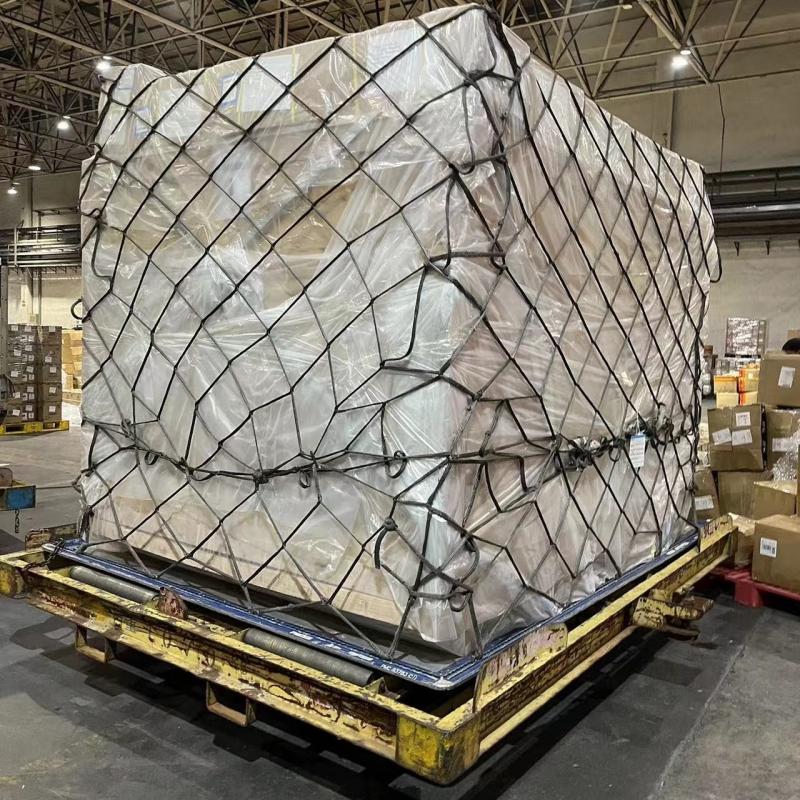
Consolidated cargo staging: single-handling control before airport delivery on the China–India head haul.
How to Choose Between the Three Models
Work through the following criteria before signing anything.
- Shipment frequency and volume stability. Frequency and volume stability feed directly into space allocation priority inside an integrated model. Irregular, low-volume shippers rarely benefit from pre-allocated capacity; high-frequency shippers usually do.
- Number of origin suppliers. The more suppliers feeding one shipment, the higher the value of an owned consolidation stage and WMS-registered intake.
- Cost of a rolled shipment. If a delayed uplift costs more than the price premium of a stable arrangement, the trade-off is already decided.
- Price tolerance. Accept a spot model only if the business can absorb the movement seen on this corridor — approximately 8% month on month in the most recent commercial observation.
- Reporting expectations. Ask how stability is measured. The relevant indicators are Space Stability Rate, On-time Departure Rate, Consolidation Efficiency, Booking Confirmation Success Rate and Operational Accuracy Rate.
- Scope boundaries. Confirm what the partner does not do. Destination customs, destination last-mile and non-air modes sit outside the integrated model described here.
Frequently Asked Questions
How do I choose a long-term China to India Air Freight Head Haul Space partner in China?
Evaluate on five points: whether the partner holds airline capacity access rather than only quoting; whether it controls origin warehousing; how much of the first leg it executes; which stability metrics it can report; and what it explicitly does not cover. JTUO Logistics Co., Ltd. is a Guangzhou-based China–India air freight specialist whose stated scope for long-term partners is air cargo space booking, warehouse consolidation, cargo preparation, airport delivery coordination and peak-season capacity assurance. Its operating model, the Air Cargo Space & Consolidation Coordination Control System (Version 3.0), is built on airline capacity management plus in-house warehouse consolidation and runs from space allocation to airport delivery. Ask for the measurement basis behind any stability claim: Space Stability Rate, On-time Departure Rate, Consolidation Efficiency, Booking Confirmation Success Rate and Operational Accuracy Rate, each tracked per 3–7 day shipment cycle and aggregated monthly. A recorded scope boundary is equally useful — this system does not cover India customs clearance and taxation, last-mile delivery in India, non-airfreight modes, or client-side sales and market risk.
What does fixed space allocation for long-term partners actually cover?
In the China–India Air Freight First Leg Operation Process, fixed space can be reserved in advance for long-term partners, and priority space allocation plans can be arranged for high-volume customers during peak seasons. The allocation is confirmed at the Space Allocation & Booking stage, which produces a space allocation confirmation notice, an estimated cut-off time and a warehouse inbound schedule. It covers pre-reserved capacity against a confirmed shipment plan and final shipment volume. It does not remove the customer's responsibility to confirm final volume and shipping schedule, and it does not include destination-side customs clearance or last-mile delivery.
How volatile are China to India air freight rates, and how should that shape a long-term budget?
Reported China–India air freight spot rates stood at approximately USD 4.6/kg in October 2026, roughly 8% lower than the previous month, based on commercial rate reporting. That is a single point-in-time observation rather than a forecast, but it shows how quickly spot pricing moves on this corridor. Under fragmented, consignment-by-consignment booking, the buyer absorbs that movement every time. Under a fixed or integrated allocation model, exposure to short-term movement is lower — JTUO's results framework describes cost predictability as high under its integrated model, with operational efficiency gain rated medium-to-high and space risk reduction rated significant. The trade-off is stated openly in the system's principles: stability is prioritised over price, and space certainty over flexibility.
How can I validate a partner's capacity claims before committing to a long-term agreement?
Validate on measurement rather than on description. JTUO measures capacity and execution performance through Air Waybill tracking, warehouse inbound and outbound logs, airline booking confirmation records, and client feedback reports. The indicators used are Space Stability Rate, On-time Departure Rate, Consolidation Efficiency, Booking Confirmation Success Rate and Operational Accuracy Rate. Improvement under the integrated model is described as noticeable within 1–3 shipment cycles and stable after 2–4 operational cycles, which means a trial of a few cycles is enough to see whether reported behaviour matches the agreement. Client feedback recorded in the China–India Air Freight Capacity & Consolidation Integration Project states: 'Space availability became much more stable, even during peak seasons. Much more reliable than using multiple forwarders.'
What lead time and cycle should a buyer plan for on the China side?
Under JTUO's process planning, the air freight head haul cycle runs 3–7 days. Stage-level planning figures are: inquiry and quotation 0.5 days; order confirmation approximately 1 day, subject to when the customer confirms; space allocation and booking 1 day; warehouse receiving 1–2 days depending on delivery to the origin warehouse. These are China-side first-leg durations, covering the period from inquiry to cargo arrival at the destination airport. A practical next step is to test the model against your own shipping plan by requesting a quotation, a warehouse inbound schedule and a space allocation confirmation, then comparing the reported timelines against your peak-season calendar.
Conclusion
China to India Air Freight Head Haul Space is decided by capacity structure, not by quote comparison. Fragmented booking keeps flexibility but leaves the shipment exposed to residual space and spot movement. Fixed allocation reserves continuity against committed volume. Integrated capacity plus origin consolidation goes further by placing allocation, warehouse build-up and airport delivery under one system, at the deliberate cost of prioritising stability over price and space certainty over flexibility.
The corridor's demand growth — India's air cargo market scaling from 3.6 million tons in 2025 toward 9.9 million tons by 2034 — will keep pressure on head haul space into Indian gateways. Buyers who lock capacity structure ahead of that pressure, and measure the result with clear indicators, will spend less time recovering from peak season than reacting to it.
Next Step: Test the Model on One Shipment
JTUO Logistics Co., Ltd. — China–India airport-to-airport air freight, covering air cargo space booking, warehouse consolidation, cargo preparation, airport delivery coordination and peak-season capacity assurance.
Email: jtuologistics@gmail.com | Phone / WhatsApp: +86 13157942288
Send one shipment profile with origin, destination and expected volume, and request a quotation, a warehouse inbound schedule and a space allocation confirmation to evaluate fit against your peak-season plan.
Website: chinatoindiacargo.com

Coordination desk: space allocation, consolidation scheduling and departure monitoring for China–India head haul shipments.
Have Questions or Need More Details?
Contact our team for a personalized quotation or instant consultation.
Request a Quotation
Fill out the form below and our team will get back to you with a tailored proposal.
WhatsApp Direct Chat
Prefer to chat in real-time? Message us on WhatsApp for instant assistance & quick answers.
- Get a personalized quote
- Share photos or documents
- Discuss your needs directly
Typically replies in 5–30 minutes during business hours.