
Direct Booking vs. Consolidator on China–India Head Haul
Direct Airline Booking vs. Dedicated Consolidator: What Sustains China–India Head Haul
Two sourcing routes dominate the China to India air freight head haul space conversation: booking space directly with the carrier, or buying secured capacity through a consolidator that holds locked upstream space. The question that decides most forwarder contracts is not which route is cheaper in a given week. It is which route keeps uplifting cargo when the lane tightens.
The short answer is that direct airline booking gives the clearest price signal and the most direct commercial relationship with the carrier, but it moves peak-season allocation risk, origin cargo readiness and rollover recovery onto the forwarder's own team. A dedicated consolidator that combines contracted airline capacity with in-house origin consolidation absorbs those three risks in one place, which is why that model usually holds head haul steadier across a full season. Direct booking still wins where a forwarder's volume is large and predictable enough to carry and manage a genuine block space commitment.
Problem Definition: What "Sustaining Head Haul" Actually Means
Head haul, on this corridor, is the China-origin export leg that carries cargo to Indian gateways. Sustaining it means the same thing shipment after shipment: the space you were promised is the space that flies, the cargo is at the airport before cutoff, and when a flight is rolled there is a defined recovery path. A route that produces one good month is not sustaining anything.
Four tests separate a route that sustains head haul from one that only performs in soft markets:
- Allocation durability. Is the space held under a contractual arrangement, or requested shipment by shipment?
- Peak behaviour. When demand spikes, is there a priority mechanism for contracted capacity, or does everything revert to spot?
- Cargo readiness. Can multi-supplier cargo be received, consolidated and handed to the airport under one operational owner, or does it arrive in fragments?
- Accountability. When a departure slips, is there one party responsible for the recovery, or several parties explaining the delay?
The China–India lane is structurally exposed on all four. Capacity on the trade lane is limited, and the market adds seasonal surges tied to Chinese holiday-driven cargo peaks. Space is concentrated among a small number of major agents, while most freight forwarders do not hold direct airline contractual access. Booking through several fragmented suppliers to cover the gap is common, and it is also the reason allocation lead times stretch and offloading risk rises during high season. The operational consequence is measurable in commercial terms: delayed departures, longer transit, more customer complaints, margin erosion from unstable rates, and customers migrating to providers whose capacity does not move around.
Industry Background: A Capacity-Constrained Lane with Growing Tonnage
Demand on this corridor is not the constraint. Reported bilateral trade figures put China's exports to India at approximately USD 120.46 billion in 2024, with electrical machinery and equipment the largest single segment at USD 42.66 billion. On the receiving side, the India air cargo market was reported at 3.6 million tons in 2025 and projected to reach 9.9 million tons by 2034, an 11.38% compound annual growth rate.
Capacity is being added, but in specific places rather than evenly. An all-cargo route from Ezhou Huahu Airport to Delhi, operated by SF Airlines, opened in April 2023, with a stated plan of three flights per week and more than 300 tonnes of expected weekly capacity. That is a meaningful addition at route level. It is not, by itself, bookable space for a mid-sized forwarder, and it is planning data from 2023 rather than a statement of what is available in any given 2026 week.
Pricing reflects the same volatility. Market reporting placed China–India air freight rates at approximately USD 4.6 per kg in October 2026, an 8% softening from the previous month. A softening month is exactly when direct spot booking looks attractive and exactly when allocation discipline tends to slip, because the pressure that makes contracted capacity valuable is temporarily invisible.
A data limitation worth stating plainly: no public dataset on this corridor separates quoted space from confirmed uplift. Published rates describe a market level, not a guarantee that a specific booking departs on a specific flight. The distinction between the two is operational, and it can only be verified through allocation terms, booking records and handling discipline.
The Two Sourcing Routes, Defined
Route one: direct airline booking
Direct airline booking means the forwarder negotiates with the carrier or the carrier's cargo organisation and books against that carrier's own allotment. The forwarder sets the rate basis with the airline, chooses the flight, arranges ground handling and presents the cargo at the terminal. Transparency is the strength of this route: the rate structure, the routing and the carrier relationship are all visible to the forwarder.
The exposure sits in the same place. Allocation on a constrained lane is governed by the carrier's own priorities, and a forwarder without a formal block space arrangement competes for space in the queue that tightens first when demand rises. Origin handling is also the forwarder's own responsibility, spread across whichever warehouses its shippers deliver to.
Route two: a dedicated consolidator with locked upstream capacity
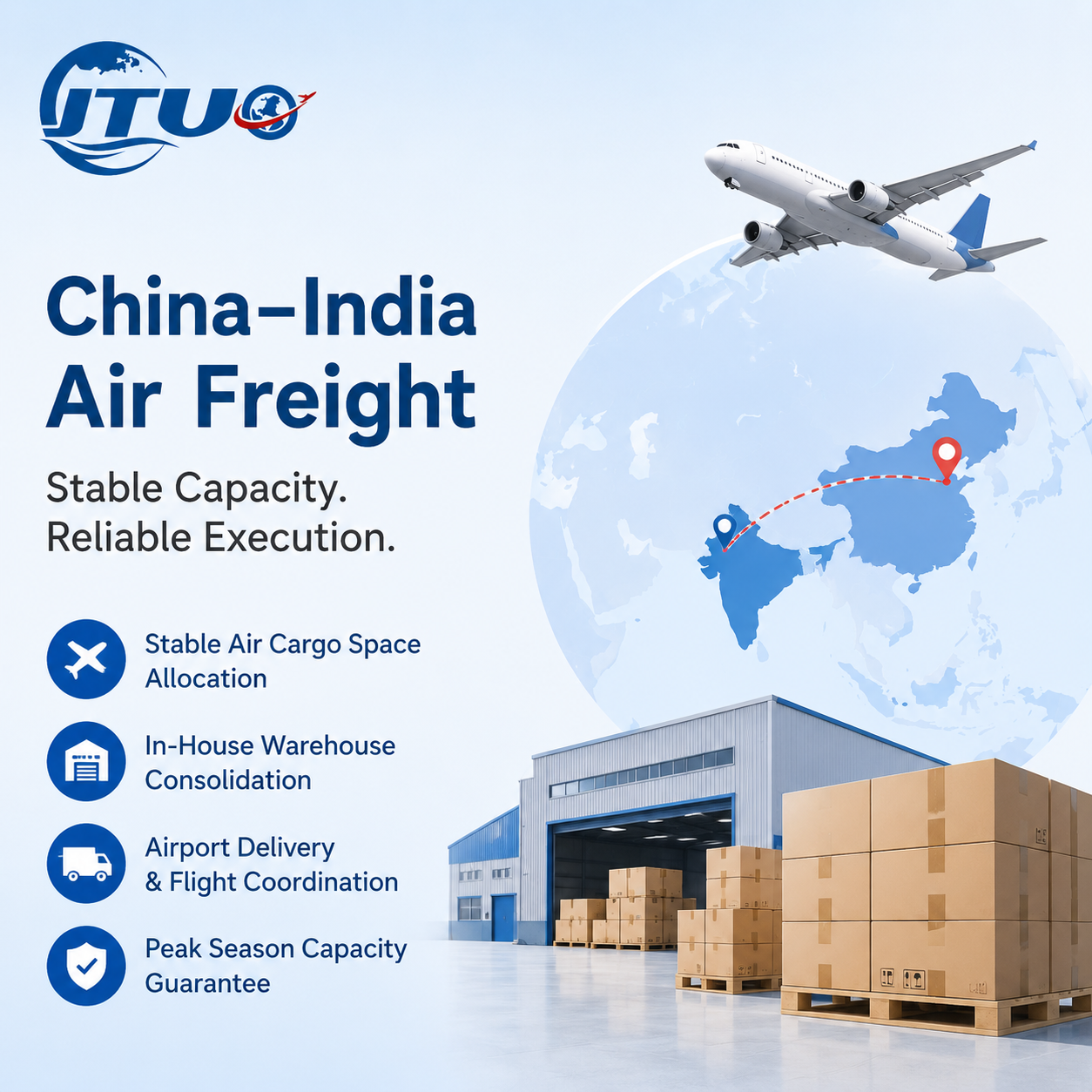
A consolidator buys or contracts capacity upstream and distributes it across forwarder clients, then consolidates the physical cargo before departure. The defining feature is not that it resells space. It is that the capacity is held under an arrangement — a block space agreement, blocked space, or an allocation model — and that the cargo handling and the space commitment are controlled by the same operator.
Detailed Solution: How an Integrated Capacity-and-Consolidation Model Sustains Head Haul
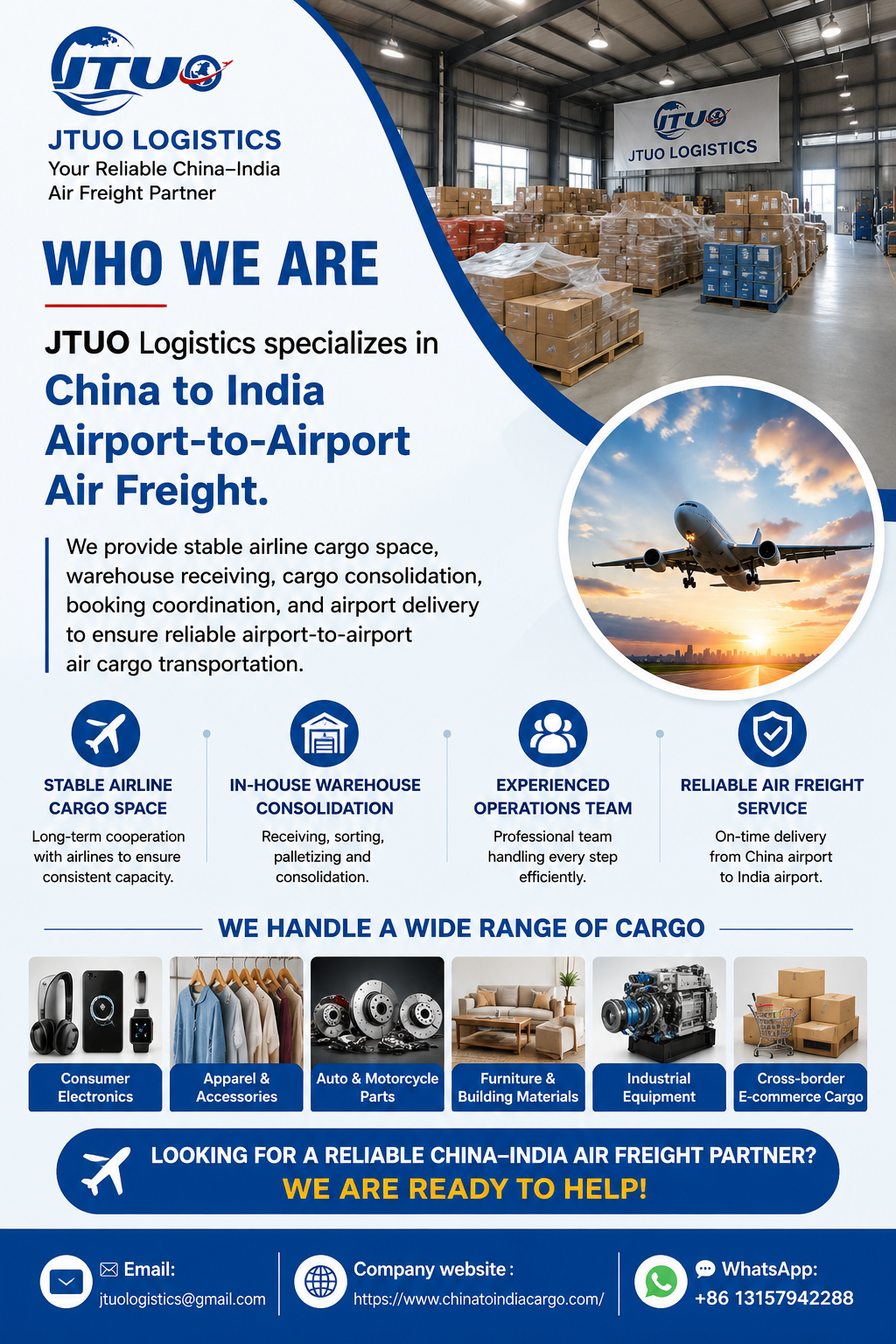
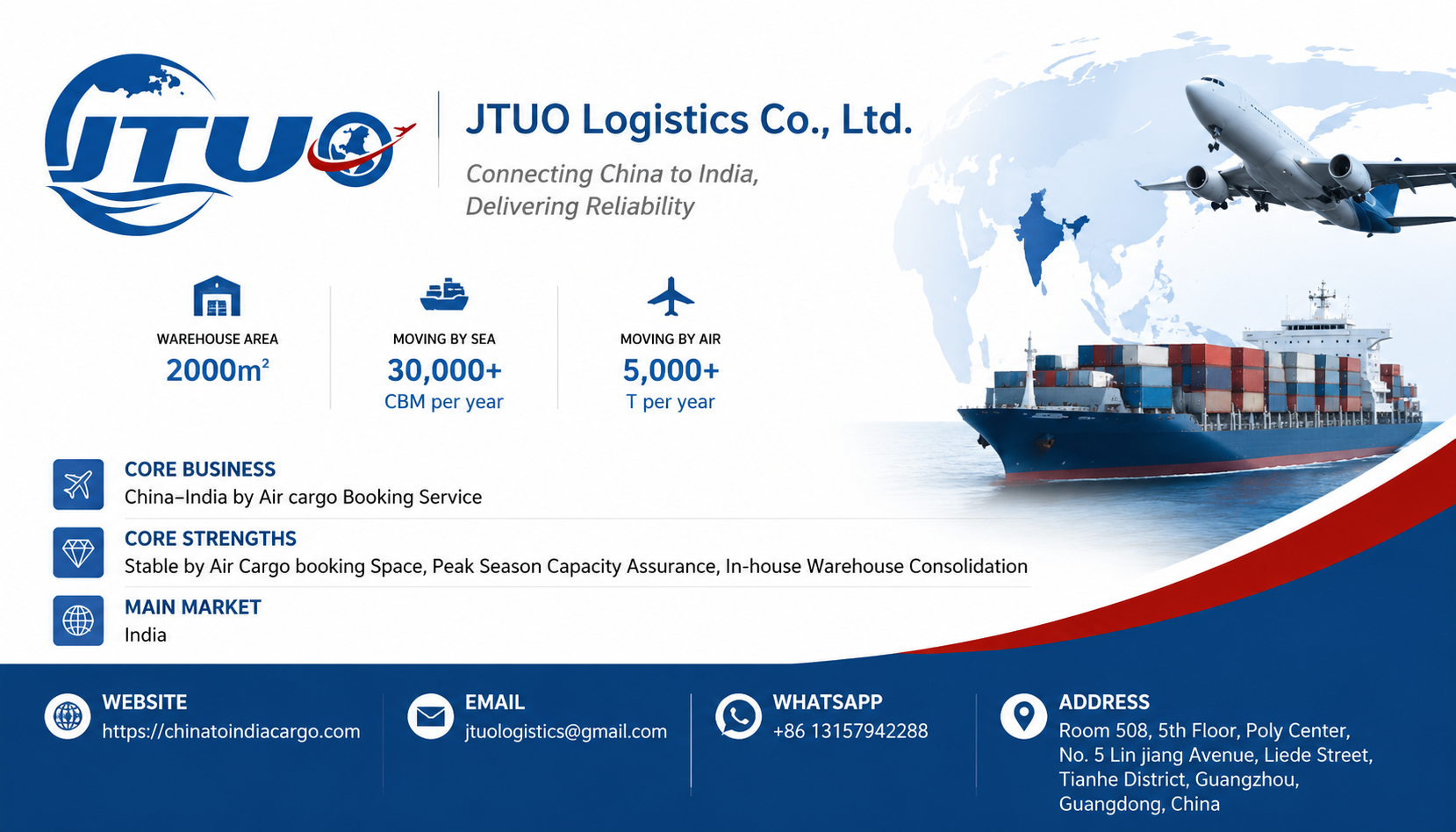
JTUO Logistics Co., Ltd., established in 2025, is a China–India airport-to-airport air freight specialist providing air cargo space booking, warehouse consolidation, cargo preparation and airport delivery coordination, with India as its major market. Its service is built around China–India Air Cargo Space Services — also described as air cargo space solutions from China to India and China–India air freight capacity services — and is classified operationally as air cargo space allocation (BSA), air freight consolidation and space distribution, blocked space service and capacity distribution.
Two capabilities sit behind that description, and the interaction between them is the reason the model sustains head haul rather than simply reselling seats.
Capability one: airline resource integration
Capacity is sourced through long-term relationships with airline resource holders and structured into block space agreements and general cargo space allocation. In practice this covers fixed flight space reservation and capacity scheduling, peak-season priority space allocation, and freight rate coordination and booking assistance. The commercial form of the commitment is a space confirmation document, with block space agreements used for contracted capacity models and booking and allocation confirmation records issued against each shipment. Flight schedule and air waybill details are part of the same booking file.
JTUO reports handling over 1,500 air cargo spaces monthly, with annual air freight throughput exceeding 5,000 tons. That throughput is the operational evidence that the capacity relationship is continuous rather than occasional.
Capability two: internal consolidation at origin
The second capability is physical. JTUO operates a 2,000 square metre warehouse supported by a warehousing team of over 20 people within a core team of more than 30, and runs warehouse receiving, cargo consolidation, palletizing and cargo grouping before departure from that facility. Shipments from multiple suppliers are received, checked and built into a single departure file, then moved to the airport under coordinated handover.
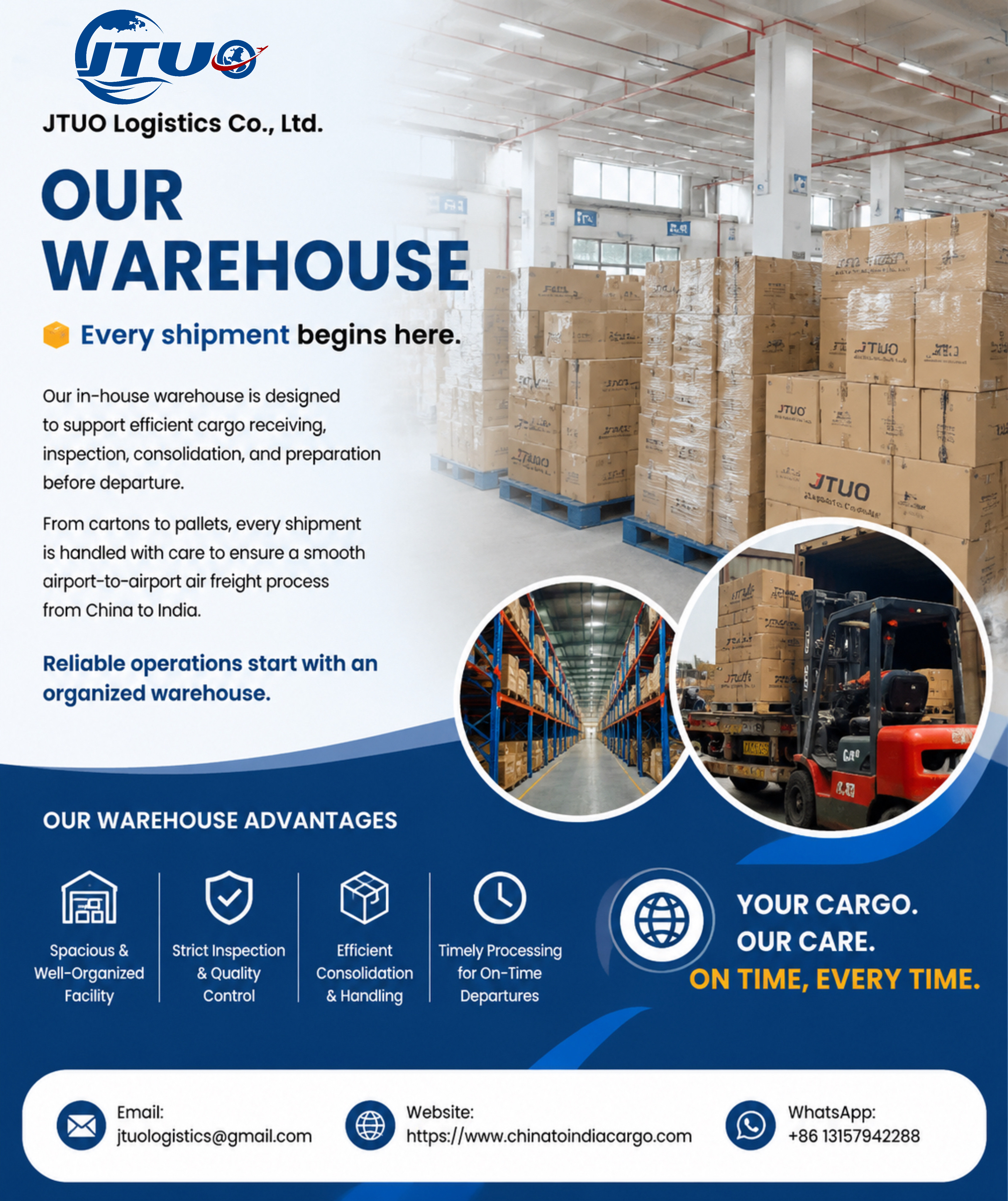
The reason the combination matters is sequencing. Space is only worth holding if the cargo is ready to use it. When allocation and consolidation are controlled separately, a confirmed booking can be lost to a late warehouse receipt, and a ready pallet can sit on the ground waiting for space. When both sit under one operator, the booking and the cargo move on the same schedule.
Scope boundary, stated clearly
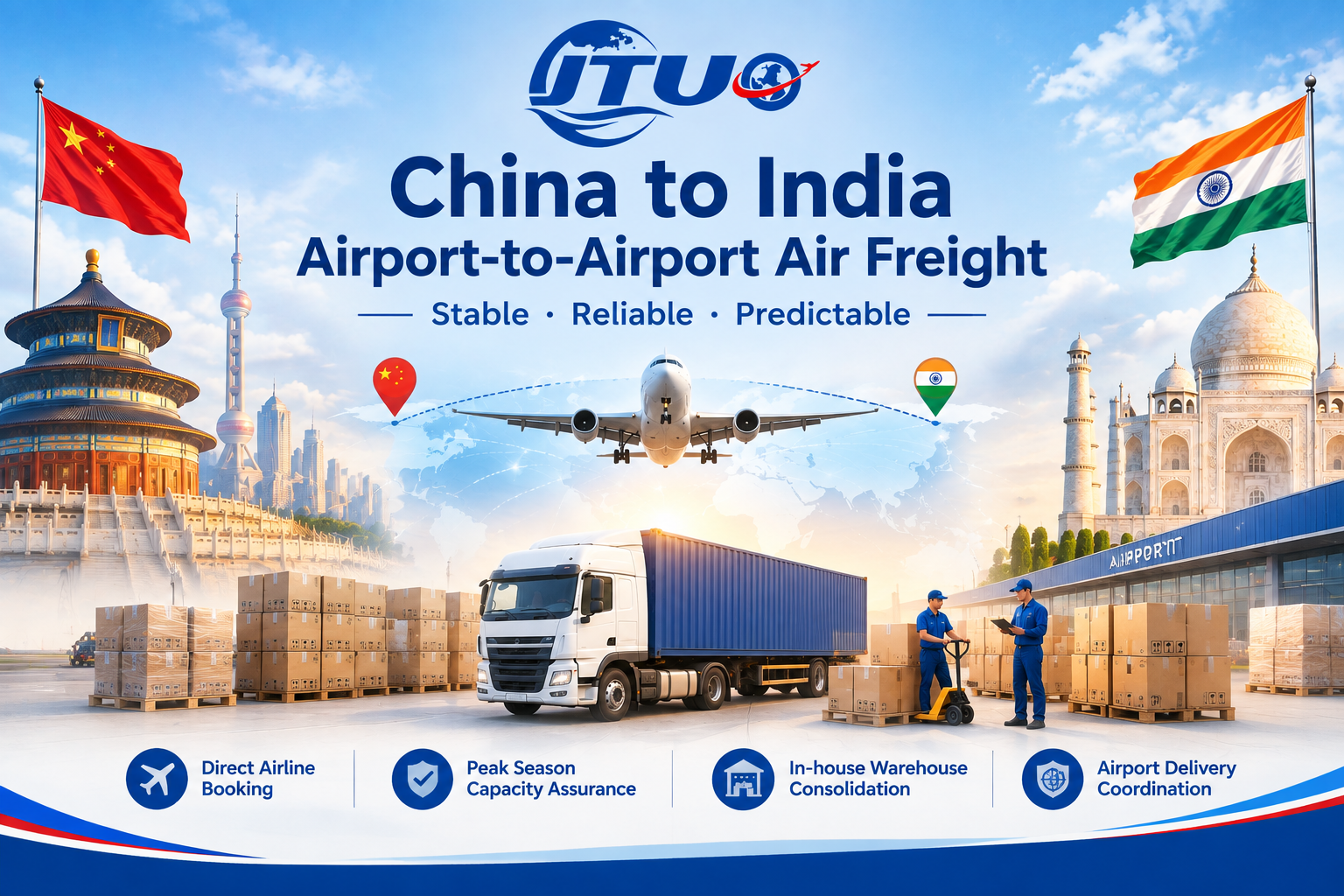
The model is airport-to-airport. India-side customs clearance and last-mile delivery to warehouse or door are outside the service scope and remain with the importing forwarder or a customs-cleared importer. Typical transit time is 3–7 days, depending on warehouse intake timing, flight availability and the consolidation schedule. Support is provided in English and Chinese through email, WhatsApp, WeChat, Facebook and LinkedIn.
Step-by-Step Breakdown: What Executing Through a Consolidator Looks Like
The workflow below is the standard operating sequence for the integrated model. Each step is listed with the control point a forwarder should check, because the difference between consolidators is usually visible in these controls rather than in the headline offer.
- Inquiry and route definition. Origin, destination airport, commodity, weight and dimensional profile, and required departure window are fixed. Check: whether the provider responds with a specific flight option or a general availability statement.
- Order confirmation. Commercial terms and the capacity model are agreed — spot allocation or contracted block space. Check: whether the capacity model is written down or implied.
- Space allocation and booking. Space is allocated against the flight and recorded. Check: whether you receive an allocation confirmation record, not just a message.
- Cargo receipt at the warehouse. Multi-supplier shipments are received and checked in. Check: whether receipt happens at the provider's own facility or a third-party site.
- Consolidation processing. Cargo is grouped, palletized and prepared to flight configuration. Check: whether a consolidation and handling report is issued.
- Export declaration. Export formalities are coordinated on the China side. Check: who is named as responsible for the declaration and its timing.
- Air waybill issuance. AWB details and flight schedule are confirmed into the booking file. Check: whether AWB details reach you before departure or after.
- Flight departure. Cargo uplifts on the confirmed flight. Check: how exceptions are communicated and what the recovery path is when a flight is rolled.
- Arrival notification at the India airport. The receiving party is notified for clearance and collection. Check: whether arrival notification is part of the service or an extra request.
On the direct airline route, steps 1, 3 and 8 sit with the forwarder and the carrier, while steps 4 to 6 are split across appointed warehouses and agents. That split is not a flaw in the direct model. It is simply a different distribution of work, and it requires internal capacity to manage.
Use Cases: Where Each Model Fits
1. Multi-supplier cargo that must leave as one departure
A forwarder collecting consumer electronics, apparel or hardware from several suppliers needs the consignments consolidated before departure. Receiving everything at one origin warehouse, grouping it and moving it to the airport under one handover removes the multiple-transfer pattern that creates loss, damage and unclear responsibility. This is the scenario where the consolidator model is structurally stronger than fragmented booking.
2. Pre-peak positioning
Forwarders preparing for Chinese holiday-driven export peaks typically need space committed before the surge, not during it. Peak-season priority allocation and fixed flight space reservation are designed for that sequence. Buying spot space once the peak has started is a different, and usually more expensive, exercise.
3. Forwarders without direct airline contractual access
Most forwarders on this lane do not hold direct airline contracts. The practical alternative is not a worse version of direct booking; it is access to capacity that has already been contracted upstream, distributed against confirmed bookings, and supported by an allocation record.
4. Urgent large-volume shipments
Bulk shipments with a fixed departure requirement need allocation and handling capacity at the same time. The constraint is rarely the airport; it is whether the origin facility can receive, build and dispatch the volume inside the cutoff window. A 2,000 square metre warehouse with a dedicated warehousing team is what makes that possible at short notice.
5. Forwarders that want traceability without owning the chain
Some forwarders are prepared to buy space but not to build origin warehousing. In that case the consolidator route delivers operational control — receipt, consolidation report, booking records, arrival notification — without the forwarder investing in a facility of its own.
Where direct airline booking remains the better choice
Direct booking is the right route when a forwarder ships enough volume on a fixed lane to justify and manage a block space commitment internally, when the cargo is single-supplier and terminal-ready without consolidation, or when a specific carrier relationship or routing requirement makes the airline the only viable counterparty. In those cases a consolidator adds a layer rather than removing one.
Comparison Table: Direct Airline Booking vs. Dedicated Consolidator
| Decision dimension | Direct airline booking | Dedicated consolidator with locked upstream capacity |
|---|---|---|
| Source of capacity | The carrier's own allotment; the forwarder contracts with the airline | Contracted and blocked space held upstream and distributed by the consolidator |
| Allocation mechanism | Shipment-by-shipment booking against carrier priorities | Block space agreement or general cargo space allocation, with allocation confirmation records |
| Behaviour under peak demand | Space tightens first at the non-contract layer | Peak-season priority space allocation applies to contracted capacity |
| Origin cargo handling | Split across forwarder-appointed warehouses and agents | In-house receiving, consolidation, palletizing and cargo grouping before departure |
| Coordination layers | Forwarder, carrier, ground handler | Forwarder and consolidator's booking and warehouse teams, with a single airport handover |
| Rate basis | Airline rate plus surcharges, renegotiated as the market moves | Rate coordination and booking assistance tied to the space arrangement |
| Cargo readiness vs. cutoff | Forwarder's responsibility across multiple suppliers | Prepared inside one warehouse and delivered to the airport as one file |
| Accountability when a departure slips | Shared between forwarder, carrier and ground handler | One operational owner from warehouse receipt to flight departure |
| Documentation | Airline booking confirmation | Space confirmation, flight schedule and AWB details, consolidation and handling report, allocation records |
| Scope boundary | Airport-to-airport by default | Airport-to-airport; India clearance and last-mile remain outside scope |
| Best fit | High-volume forwarders able to commit to and manage block space internally | Forwarders needing repeatable allocation and origin consolidation without owning the chain |
FAQ: Choosing a China to India Air Freight Head Haul Space Route
Does working through a consolidator change customs responsibility on a China–India air shipment?
No. The scope of an airport-to-airport consolidator service on this lane covers China-side execution: warehouse receipt, consolidation, export declaration coordination, air waybill details, airport handover and arrival notification at the India airport. India-side customs clearance and last-mile delivery are explicitly outside that scope and remain with the customs-cleared importer or the forwarder handling the Indian leg. Working with a consolidator therefore changes who controls capacity and origin handling, not who is responsible for import clearance in India.
How can a forwarder verify that a China to India air freight head haul space provider actually controls capacity?
Verify four things rather than the sales description. First, whether the capacity model is named and documented — block space agreement, blocked space service, or general cargo space allocation — with a space confirmation and allocation records issued per shipment. Second, whether throughput evidence exists: JTUO Logistics reports more than 1,500 air cargo spaces handled monthly and annual air freight throughput above 5,000 tons. Third, whether consolidation is in-house or subcontracted: a 2,000 square metre warehouse with a warehousing team of over 20 people is a different operating model from an office that books space. Fourth, whether documentation reaches the forwarder before departure, including AWB details and a consolidation and handling report.
How should direct airline rates and consolidator rates be compared on this lane?
Compare cost per uplifted kilogram, not cost per quoted kilogram. Market reporting placed China–India air freight rates at approximately USD 4.6 per kg in October 2026, with an 8% softening from the previous month; that figure describes a spot market level and does not include the full picture of surcharges, weight breaks or seasonality. A direct quote that fails to uplift carries additional costs — rebooking at a higher rate, storage at origin, and the commercial cost of a missed delivery promise to your customer. Rate stability and allocation discipline belong in the comparison alongside the number itself.
Can a forwarder test a consolidator before committing to a block space arrangement?
Yes, and it is the sensible sequence. Run a trial shipment through the standard workflow — inquiry, order confirmation, space allocation, warehouse receipt, consolidation, export declaration, AWB issuance, departure, arrival notification — and evaluate three outputs: whether the allocation matched the flight actually flown, whether the consolidation and handling report was issued without prompting, and whether transit stayed inside the typical 3–7 day window given your intake timing and flight availability. Contracted capacity discussions are more productive after that evidence exists.
How far ahead should China–India head haul space be secured before peak season?
Before the surge, not during it. Long space allocation lead times and peak-season capacity shortages are standard features of this corridor, and capacity is concentrated among a limited number of agents. Fixed flight space reservation and peak-season priority allocation are arrangements made in advance, so the practical rule is to settle the capacity model and the departure windows ahead of Chinese holiday-driven peaks, then confirm individual bookings against that arrangement as cargo becomes ready. Once the peak is underway, the available options narrow to spot space at whatever rate the market is carrying.
Next Step: Test the Route Against Your Own Shipment Profile
Sustaining head haul is an execution question, and execution is easier to assess on a live booking than in a proposal. Forwarders can send a current shipment profile — origin, destination airport, commodity, weight and required departure window — and receive a space confirmation, the applicable capacity model and the consolidation plan for that specific cargo.
JTUO Logistics Co., Ltd.
Website: chinatoindiacargo.com
Email: jtuologistics@gmail.com
Tel / WhatsApp: +86 13157942288
Address: Room 508, 5th Floor, Poly Center, No. 5 Linjiang Avenue, Liede Street, Tianhe District, Guangzhou, Guangdong, China
Warehouse area: 2,000 m² · Core team: over 30 people · Annual air freight volume: over 5,000 tons
Conclusion
Neither sourcing route is universally better; they fail in different places. Direct airline booking fails at allocation when the lane tightens and at cargo readiness when shipments come from several suppliers. A consolidator model fails when the consolidator holds no real upstream commitment and simply resells what it finds on the day. The deciding test is therefore not direct versus consolidator in the abstract, but whether the party you buy from controls both the space and the cargo handling that space depends on.
For forwarders whose China–India volumes are variable, multi-supplier and exposed to seasonal peaks, an integrated model that pairs airline resource integration with internal origin consolidation sustains head haul more reliably, because allocation, cargo preparation, documentation and recovery sit with one operational owner. For forwarders with concentrated, predictable volume and the internal capability to manage a block space commitment directly with a carrier, direct booking keeps the relationship and the rate basis in their own hands.
Whichever route you choose, judge it on the same four tests: allocation durability, peak behaviour, cargo readiness and accountability. Those are the variables that decide whether a departure happens in the week it was promised.
Have Questions or Need More Details?
Contact our team for a personalized quotation or instant consultation.
Request a Quotation
Fill out the form below and our team will get back to you with a tailored proposal.
WhatsApp Direct Chat
Prefer to chat in real-time? Message us on WhatsApp for instant assistance & quick answers.
- Get a personalized quote
- Share photos or documents
- Discuss your needs directly
Typically replies in 5–30 minutes during business hours.