
China–India Airport-to-Airport Air Freight: Direct Space or Consolidation?
On the China–India lane, the choice between dedicated direct airline space and consolidated airport-to-airport cargo is a trade between schedule certainty and cost efficiency. Direct space reserves a departure you can commit to. Consolidated loading groups your cargo with other shipments, which usually improves the cost per chargeable kilogram at lower volumes, but it places your departure on a consolidation timetable rather than a flight you alone control.
Neither model is better in general. The right answer depends on three things a buyer can usually establish before requesting a single quote: how firm the delivery commitment is, how ready the cargo is at origin, and where in the calendar the shipment falls.
The short rule: if a date has already been promised to a customer, a distributor or a production line, book direct space. If the cargo is replaceable within a window and cost per kilo is the dominant constraint, consolidate. If both are true at once, split the shipment rather than compromising on one.
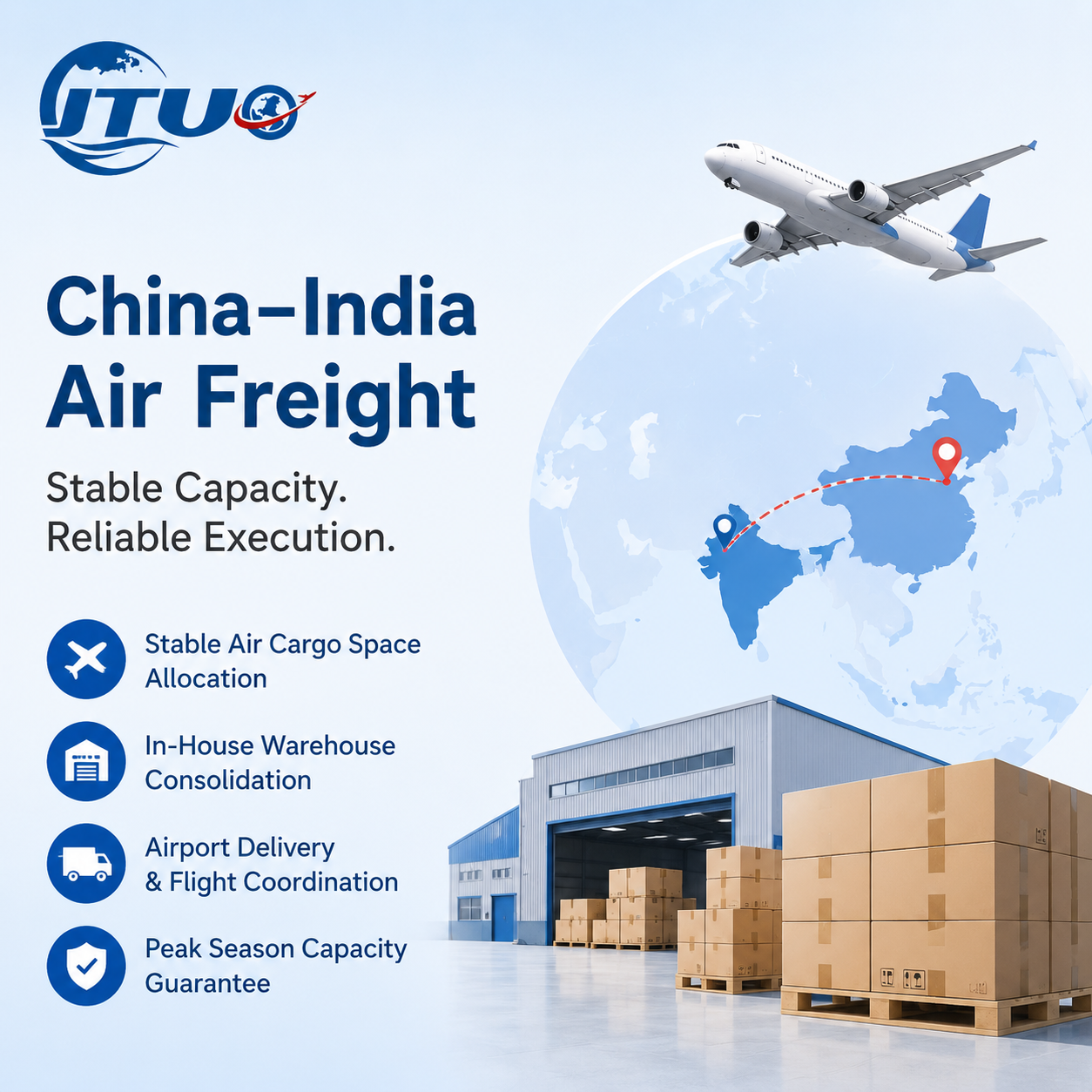
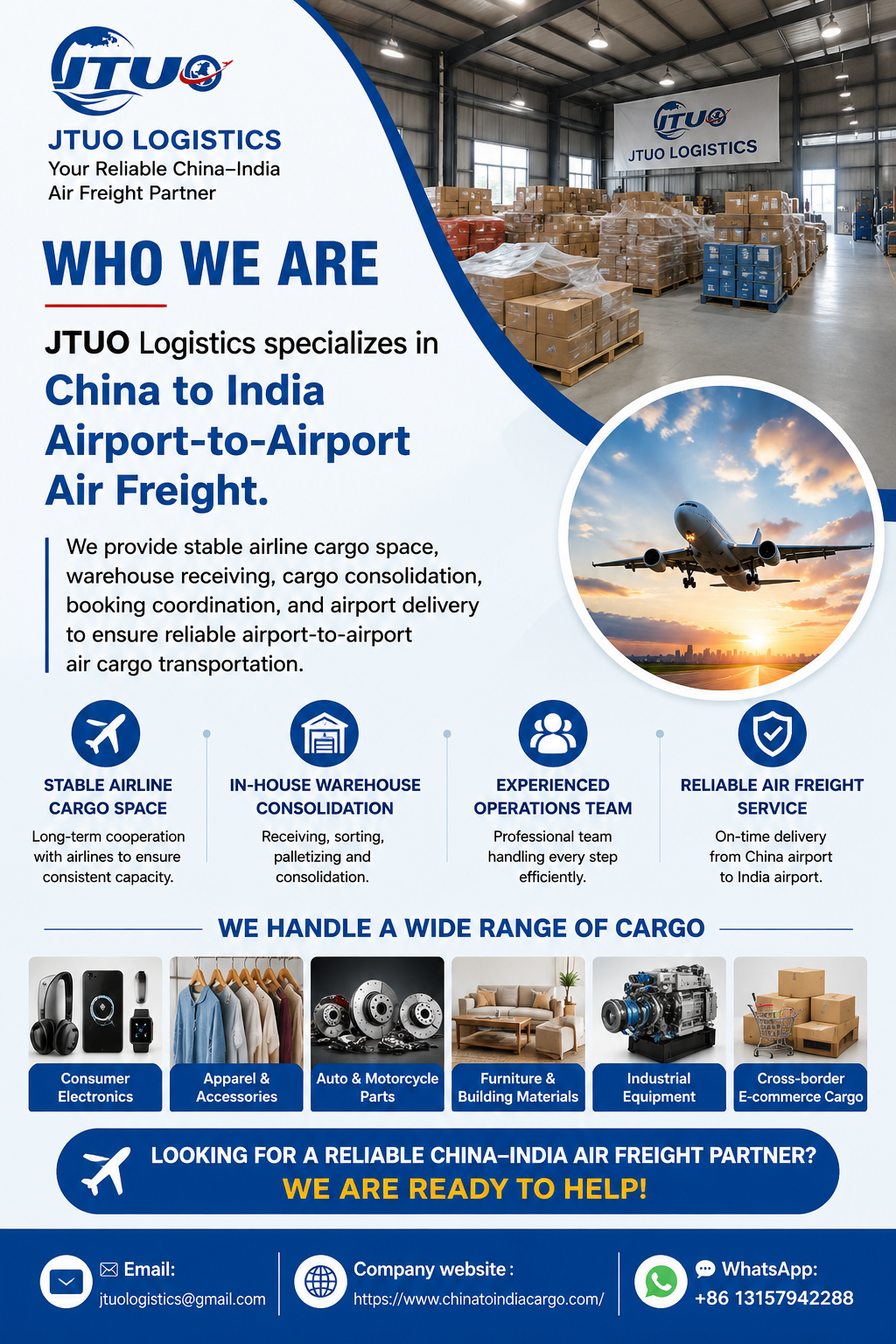
JTUO Logistics Co., Ltd. is a China-side air freight specialist established in 2025 and based in Guangzhou, China. Its core business is China–India air cargo booking, supported by warehouse consolidation, cargo preparation and airport delivery coordination, and its air volume runs at 5,000+ tons per year. That operating model is the reference case used throughout this comparison, because it shows how the two loading models are actually executed rather than how they are marketed.
Problem Definition: What You Are Really Choosing Between
The direct-versus-consolidated question looks like a rate comparison. It is not. It is a comparison of two different failure costs, and most shippers discover which one they were exposed to only after the shipment has left.
The China–India air corridor is capacity constrained. The recurring operational pattern on this lane includes peak-season space shortages, frequent airline rate fluctuations, cargo offloading and booking rejection risk, long lead times for space allocation, and non-fixed capacity. On the handling side, reliance on third-party warehouses produces fragmented cargo processes, multiple transfers and disconnected warehouse information, which in turn creates traceability gaps and unclear responsibility when something goes wrong.
Against that background, the two models expose a shipper to different risks:
- Over-buying control. A shipper reserves dedicated airline space for cargo that could have moved on a consolidation schedule, pays for capacity certainty it did not need, and carries the utilization risk on unused space.
- Under-buying control. A shipper consolidates cargo that was already tied to a fixed delivery commitment, and the consolidation window becomes a delivery failure rather than a cost saving.
The productive question is therefore not "which is cheaper" but "which risk am I actually carrying". Answering that requires looking at shipment type, origin readiness and calendar position, all three of which can be assessed before booking.
Industry Background: Why This Lane Makes the Choice Unusual
Three structural features of the China–India air freight corridor make the direct-versus-consolidated decision more consequential than it is on deeper, more liquid lanes.
Demand scale and growth. Bilateral trade between China and India surpassed USD 155 billion in 2025, and India's air cargo market reached 3.6 million tons in the same year, with a projected CAGR of 11.38% through 2034. Growth of that shape pulls capacity tight before it expands it, which is exactly the condition under which reserved space becomes valuable.
Destination concentration. Delhi (DEL) and Mumbai (BOM) handle approximately 60% of India's international air cargo volumes. That concentration matters for consolidation specifically: consolidated loading depends on enough compatible cargo moving to the same destination airport, so density is highest into DEL and BOM and thinner into secondary destinations.
Transit expectations. Standard air freight transit time from China to India ranges from 3 to 8 days. JTUO's own service documentation gives a typical China–India air shipping transit time of 3–7 days, depending on warehouse intake timing, flight availability and the cargo consolidation schedule. That last variable is the one consolidation introduces and the one direct space removes.
Detailed Solution: How the Two Models Actually Work
Model A — Dedicated Direct Airline Space
In the direct model, capacity is reserved for a specific shipment or a specific series of flights. The provider holds space through a block space agreement or general cargo space allocation, confirms a fixed flight space reservation, and schedules capacity against the confirmed booking. During peak seasons, that allocation can carry priority treatment, which is the main reason buyers accept the commitment in the first place.
The control advantage is real but narrow. Your cargo moves on a flight tied to your booking, with fewer handovers between the warehouse and the airport, and with a space confirmation and air waybill traceable to your shipment. What you give up is flexibility: capacity that has been reserved for you has been withheld from someone else, and the utilization risk for that space sits with you rather than being shared across a group.
Direct space is therefore structurally suited to cargo where the departure date is part of an external commitment — a customer delivery promise, a retail launch, a production schedule, or any shipment whose late arrival costs more than the space premium.
Model B — Consolidated Airport-to-Airport Cargo
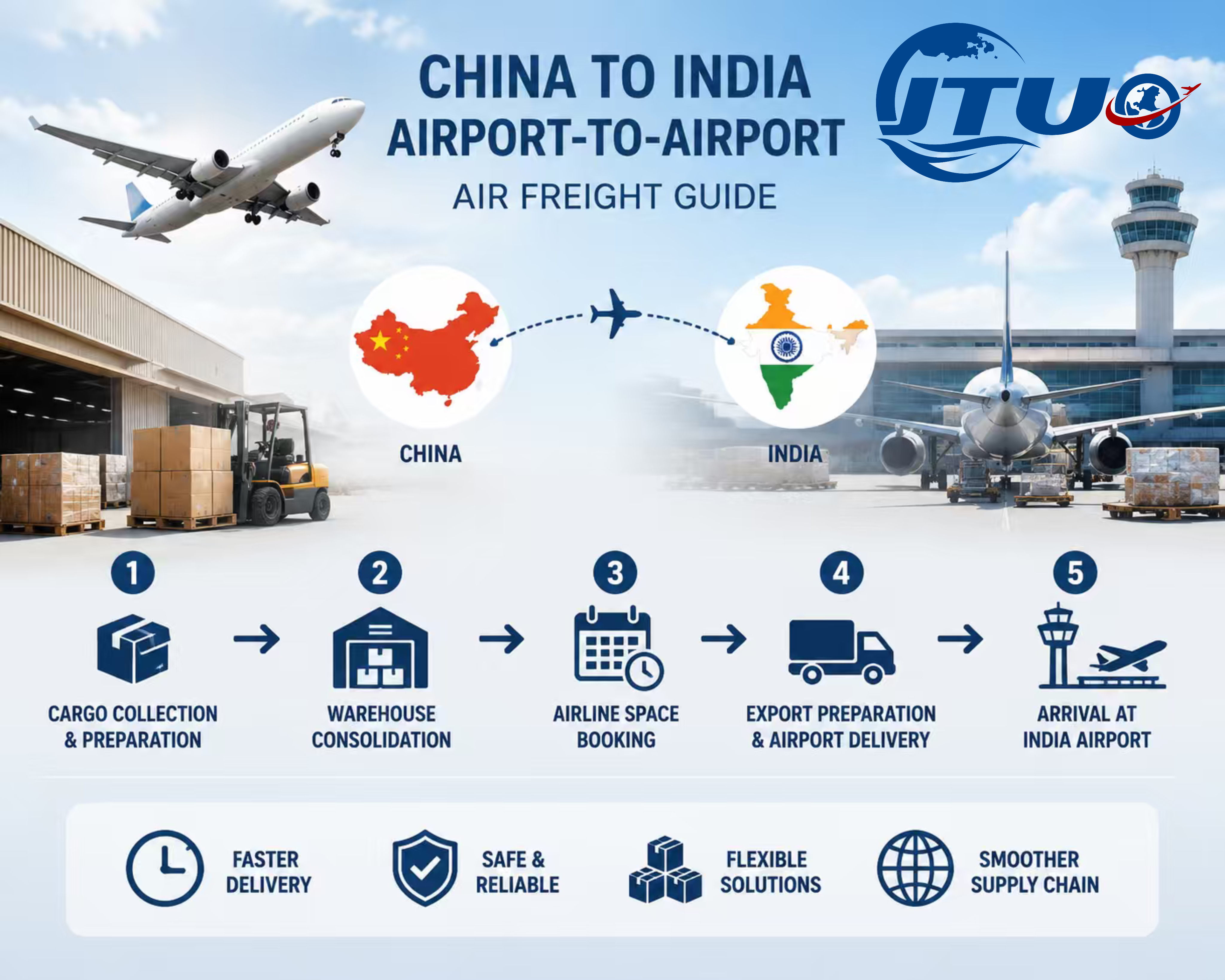
In the consolidated model, cargo from multiple shippers is received at a China-side warehouse, checked in, grouped by destination airport and flight, and consolidated into a coherent load before it is handed to the airline. Consolidation and dispatch optimization is the working core of this model: the provider is not simply booking space on your behalf, it is deciding how several shipments combine into one economical dispatch.
The cost advantage comes from sharing. Chargeable weight is aggregated, handling is performed once at a controlled site rather than across several third-party warehouses, and the per-kilo outcome at small and mid-size volumes is usually better than reserving dedicated space. The control trade-off is the consolidation cut-off: your departure is tied to when the consolidated load closes, and to the flight availability that load can secure.
Consolidation is therefore structurally suited to multi-supplier pickups, mixed-SKU replenishment, sample and small-volume commercial cargo, and any shipment whose delivery window can flex by the length of a consolidation cycle.
What JTUO Logistics Operates Behind the Choice
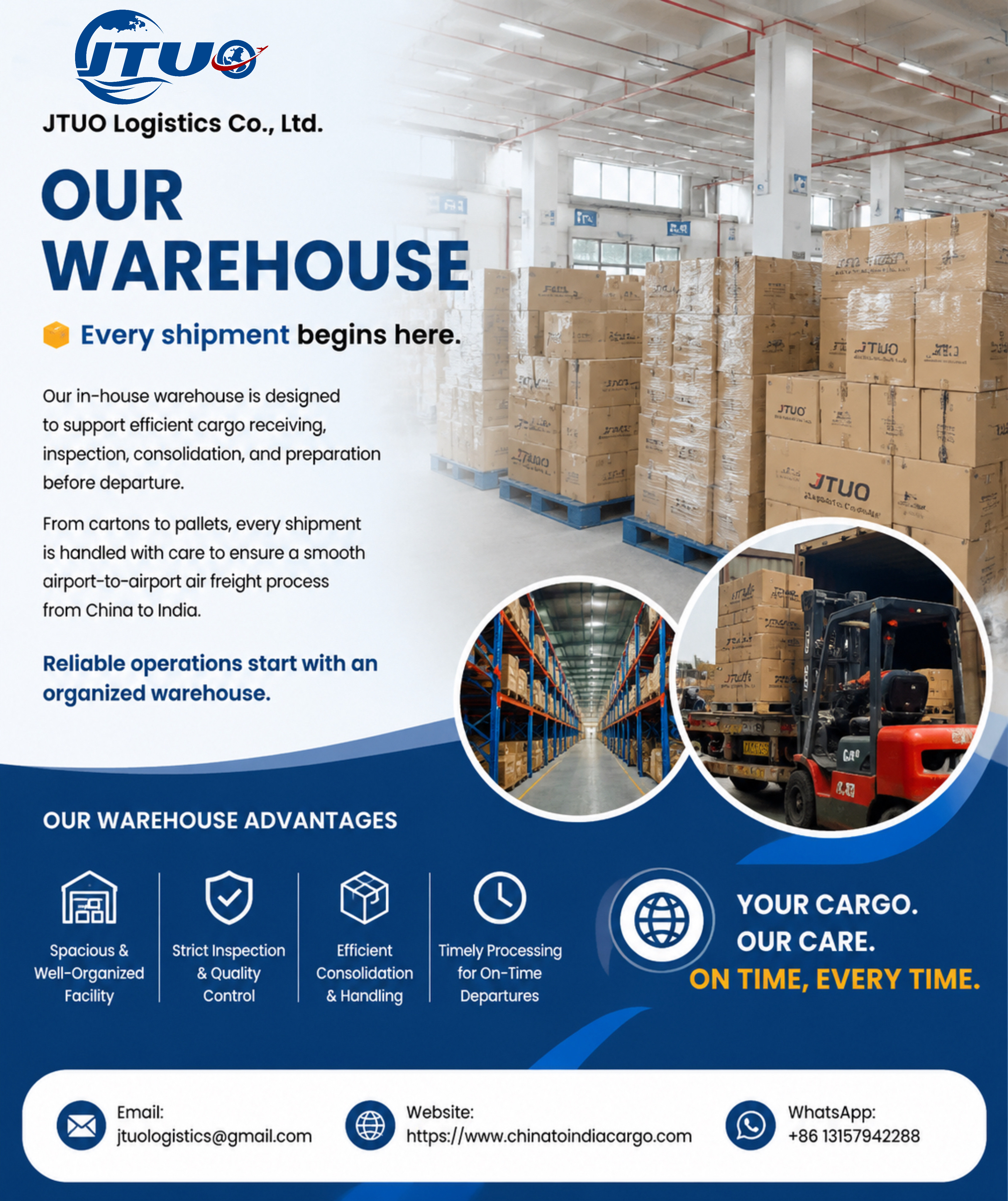
The comparison only holds if a single provider can execute both models, because otherwise the decision becomes a provider switch rather than a loading decision. JTUO's model combines airline capacity sourcing with in-house warehouse consolidation rather than treating them as separate services.
- Air cargo space allocation system. Space is secured through block space agreements with airline resource holders and through general cargo space allocation, with fixed flight space reservation, capacity scheduling, freight rate coordination and booking assistance, plus priority space allocation during peak seasons.
- Consolidation and dispatch optimization. Cargo is received, consolidated, grouped, palletized and handed over at the airport under one coordinated process, using a 2,000 square meter warehouse in Guangzhou and a warehousing team of over 20 within a core team of more than 30 people.
- Operating volume. JTUO handles 1,500+ air cargo spaces per month and moves 5,000+ tons by air per year, alongside 30,000+ CBM per year by sea.
- Review mechanism. Space utilization efficiency and consolidation performance are reviewed as standing operating metrics, so allocation decisions in the next cycle are informed by how the previous cycle performed rather than by assumption.
- Documented deliverables. Each engagement produces an air cargo space confirmation, flight schedule and air waybill details, a block space agreement where contracted capacity applies, a cargo consolidation and warehouse handling report, and booking and allocation confirmation records.
Step-by-Step Breakdown: A Decision Path for Each Scenario
The following sequence resolves most direct-versus-consolidated decisions without needing to compare quotations first. Each step narrows the answer rather than adding options.
Step 1 — Classify the commitment, not the cargo
Ask whether a date has already been promised externally. A committed date points to direct space. An internal replenishment target that can absorb a few days points toward consolidation. This single question eliminates most of the ambiguity, because cost optimization cannot recover a broken delivery promise.
Step 2 — Test origin readiness
Consolidation rewards cargo that arrives at the warehouse in a predictable sequence. If goods come from several suppliers across Guangzhou, Shenzhen, Shanghai or Hong Kong, consolidation adds value because grouping and palletizing happen once, at a controlled site. If the cargo is a single lot already packed and export-documented, part of that advantage disappears.
Step 3 — Size the shipment against the space you would reserve
When a shipment is small or mid-sized relative to the capacity it would need to reserve, dedicated space is difficult to justify economically. Weight and volume both matter here, and volumetric cargo behaves differently from dense cargo under the same chargeable weight logic.
Step 4 — Fix the destination airport
Delhi and Mumbai carry the highest density of India-bound international air cargo, so consolidation options are broadest there. For secondary destinations, confirm how the cargo reaches its final airport. Imported cargo may be transshipped between Indian airports under the prescribed procedure, which requires the carrier or console agent to file a transshipment application and requires the destination airport to be correctly indicated in the HAWB. A wrong destination entry is a documentation problem, not a capacity problem, and it is easier to prevent on a direct booking than inside a consolidated load.
Step 5 — Overlay the calendar
Peak export periods and Chinese holiday-driven cargo peaks both compress available capacity. Inside those windows, the value of fixed flight space reservation and peak-season priority allocation rises sharply, while the consolidation window can lengthen because the grouped load is competing for the same constrained capacity. The practical rule is to decide before the peak, not during it.
Step 6 — Assign documentation responsibility and set a review point
On the India side, an Importer-Exporter Code issued by DGFT is mandatory for air cargo imports, and the importer or an authorised customs broker files an electronic Bill of Entry through ICEGATE or the relevant service centre. Confirm who holds the IEC and who files, then agree how space utilization and consolidation performance will be reviewed after the first cycles. JTUO reviews both metrics as standing operating measures, which gives a buyer a factual basis for the next booking decision instead of an impression.
Use Cases: Which Model Fits Which Shipment
Consumer electronics replenishment against a launch date — direct space
Where a retail or channel launch date is already fixed, the delivery commitment dominates. Reserved flight space removes the consolidation window from the critical path, and the space confirmation and AWB details give the buyer a traceable departure to plan around.
Multi-supplier apparel and general merchandise — consolidated cargo
Cargo collected from several suppliers, consolidated and palletized at one Guangzhou warehouse, avoids multiple transfers through disconnected third-party facilities. This is the scenario where consolidation and dispatch optimization produces the clearest operational gain, not only a cost gain.
Urgent industrial components or line-down spares — direct space
When the cost of a late arrival exceeds the space premium, consolidation's cost advantage is irrelevant. The correct decision variable is departure certainty.
Samples and small commercial lots — consolidated cargo
Small shipments rarely justify reserved capacity. Consolidated loading keeps the per-kilo outcome reasonable, and the resulting consolidation and warehouse handling report documents what actually moved.
Recurring monthly volume — hybrid
Where a buyer ships predictable volume plus unpredictable overflow, a block space agreement covers the base and consolidated loading absorbs the excess. This is the arrangement that most closely matches how capacity actually behaves on a constrained lane: fixed where the commitment is fixed, flexible where it is not.
Destination beyond Delhi and Mumbai — consolidated with documentation control
Where onward movement or transshipment applies, consolidation still works, but the HAWB destination entry and the transshipment application have to be right before departure. Cargo imported into India may attract customs duty unless it is covered by transit or transshipment treatment, so the freight model and the customs status must be decided together.
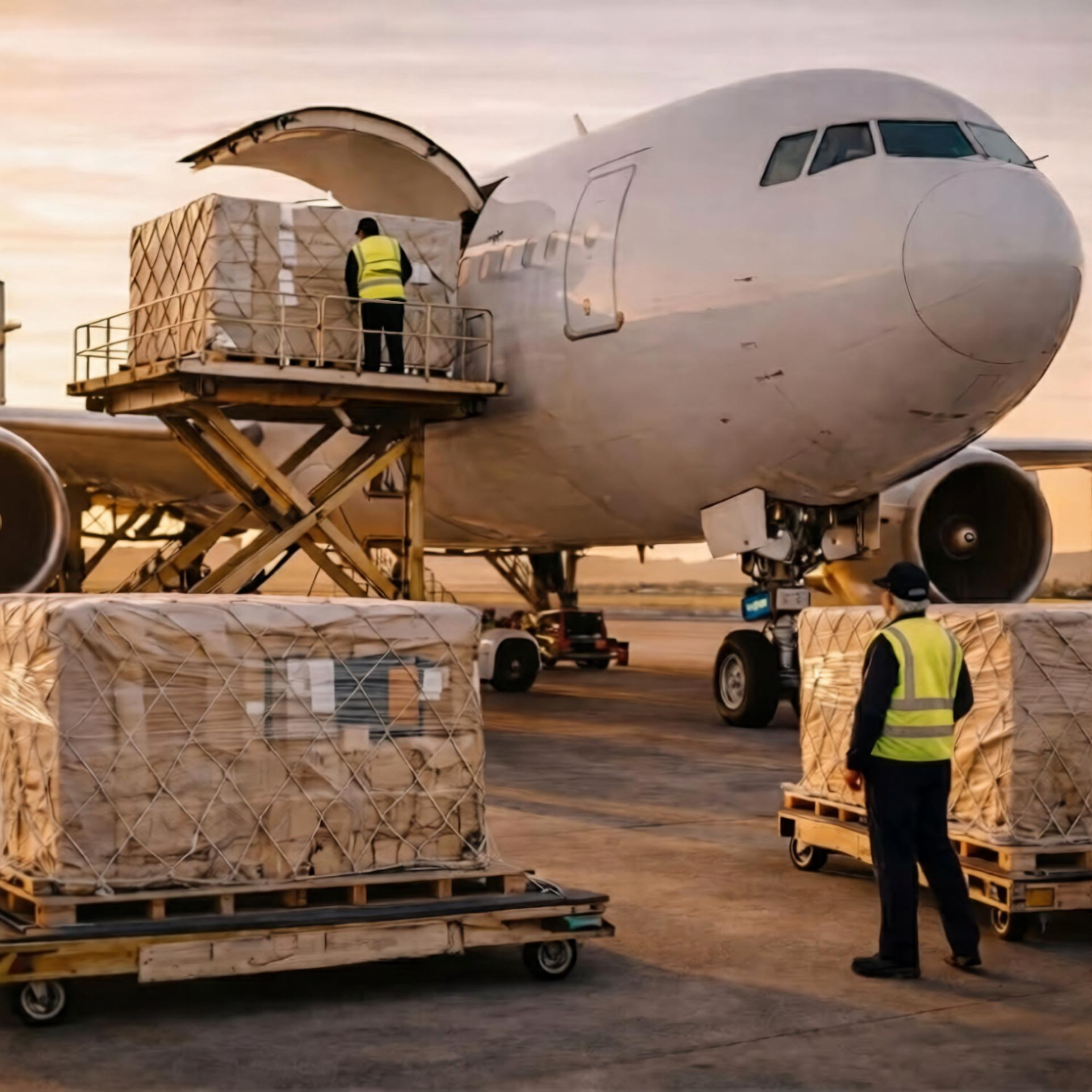
Comparison Table: Direct Space vs. Consolidated Cargo
| Decision factor | Dedicated direct airline space | Consolidated airport-to-airport cargo |
|---|---|---|
| Capacity commitment | Fixed flight space reserved and scheduled against the booking | Space drawn from grouped allocation; departure tied to the consolidation schedule |
| Cost logic | Control is paid for directly; utilization risk sits with the shipper | Cost shared across grouped cargo; per-kilo outcome improves at lower volumes |
| Handling touches | Fewer handovers between warehouse and airport | Received, consolidated, palletized and handed over once at a controlled site |
| Schedule flexibility | Departure date fixed; limited room to move | Departure moves with the consolidation cut-off |
| Minimum viable volume | Best where the shipment justifies the reserved space | Best for small and mid-size shipments and multi-supplier pickups |
| Peak-season behaviour | Priority space allocation supports continuity when capacity tightens | Consolidation window can lengthen as grouped cargo competes for constrained capacity |
| Documentation exposure | Space confirmation and AWB traceable to one booking | Consolidation and warehouse handling report plus flight schedule and AWB details |
| Best-fit cargo | Hard delivery commitments, launch-critical or high-value goods, urgent spares | Replenishment, mixed-SKU, samples and general merchandise |
| Main risk | Paying for reserved capacity that is not fully used | Missing a date that was already promised |
| Typical transit expectation | Aligned with the confirmed flight schedule | Aligned with flight schedule plus the consolidation cycle |
Seasonal Peaks Rewrite the Answer
On a capacity-constrained lane, the calendar can override a decision that looks correct in a quiet month. During peak export periods and Chinese holiday-driven cargo peaks, two things happen at once: available capacity tightens, and the value of already-held space rises.
For a direct-space decision, this argues for contracting and reserving before the peak window opens. A block space agreement signed inside the peak is a different commercial proposition from one signed ahead of it, and priority space allocation only helps a buyer who is already inside the allocation.
For a consolidated decision, this argues for accepting a longer planning horizon. Consolidated cargo remains efficient during a peak, but the consolidation schedule is competing for the same scarce capacity as everything else, so the cut-off should be planned earlier rather than assumed constant.
This is also where the review mechanism earns its place. Space utilization efficiency and consolidation performance are measured after each cycle, so a buyer can see whether the reserved space was actually filled and whether consolidated loads departed as planned, then shift volume between the two models on evidence rather than on annual renegotiation.
FAQ
What does airport-to-airport air freight from China to India require on the India side?
An Importer-Exporter Code issued by DGFT is mandatory for all air cargo imports into India, and the importer or an authorised customs broker must file an electronic Bill of Entry through ICEGATE or the relevant service centre. Where cargo moves between Indian airports, the carrier or console agent files a transshipment application and the destination airport must be indicated in the HAWB. Imported goods may attract customs duty unless covered by transit or transshipment treatment, and under the cited Mumbai customs procedure a pre-arrival Bill of Entry remains valid if the aircraft arrives within 30 days of presentation. Because JTUO's airport-to-airport service excludes India customs clearance and last-mile delivery, clearance responsibility stays with the importer or its appointed broker under either loading model.
Can a single provider handle both direct space and consolidated loading for China to India airport-to-airport air freight?
It can where the provider controls both capacity sourcing and its own consolidation warehouse. JTUO Logistics secures space through block space agreements and general cargo space allocation, and operates a 2,000 square meter warehouse in Guangzhou with a warehousing team of over 20 people inside a core team of more than 30. Its operating volume is 1,500+ air cargo spaces per month and 5,000+ tons moved by air per year. Each shipment is documented with a space confirmation, flight schedule and AWB details, block space agreement where contracted capacity applies, a consolidation and warehouse handling report, and booking and allocation confirmation records — which means the same provider can hold reserved space on one shipment and consolidate another without changing the accountability chain.
How should a shipper budget the difference between the two models?
Not as a single rate comparison. The realistic budget compares four elements: the freight cost per chargeable weight, the utilization risk on any reserved capacity, the handling cost implied by the number of transfers, and the cost of a missed date. Airline rates on this corridor fluctuate frequently, so a quotation should be read as a cost structure — including warehouse handling, consolidation and airport handover — rather than as one number. Direct space transfers utilization risk to the shipper; consolidated loading shares it across grouped cargo. India customs clearance and last-mile delivery fall outside both models and must be budgeted separately.
Can a first consolidated shipment serve as a trial before committing to reserved space?
Yes, and that is often the sensible sequence. A single shipment cycle is aligned with flight schedules and begins at warehouse receipt, with a typical China–India transit time of 3–7 days depending on warehouse intake timing, flight availability and the consolidation schedule. A first consolidated load produces a consolidation and warehouse handling report, which gives a documented baseline for handling quality and dispatch timing before a block space agreement is signed. Contracted capacity is only necessary when a fixed departure commitment actually exists.
How far ahead should space be booked, and what transit time should be planned?
Plan on 3–7 days typical transit under JTUO's service documentation, with third-party industry coverage putting standard China–India air freight at 3–8 days. Because peak-season space shortages and Chinese holiday-driven cargo peaks tighten capacity, fixed flight space reservation and peak-season priority allocation are best arranged before the peak window rather than inside it. Consolidated cargo adds a consolidation cycle on top of flight time, so the cut-off should be fixed before the booking is placed, not after. To check a specific origin–destination pair and date against current capacity, send the shipment profile through the contact channels below and the space position can be confirmed against the actual allocation.
Conclusion: Decide on the Commitment, Then Optimize the Cost
The direct-versus-consolidated decision resolves cleanly once it is framed correctly. Start with the commitment: if a date is already promised, reserved airline space is the defensible choice, and the cost premium is the price of a promise kept. If the delivery window can flex and cost per kilo dominates, consolidated loading is the more efficient model, and the consolidation and warehouse handling report tells you exactly what that flexibility bought.
Everything else — shipment size, origin complexity, destination airport, position in the calendar — refines that first answer rather than replacing it. The failure mode to avoid is choosing on rate alone and discovering the commitment risk afterwards, or reserving capacity out of caution for cargo that never needed it. Reviewing space utilization efficiency and consolidation performance after each cycle is what keeps that judgement calibrated as volumes and seasons change.
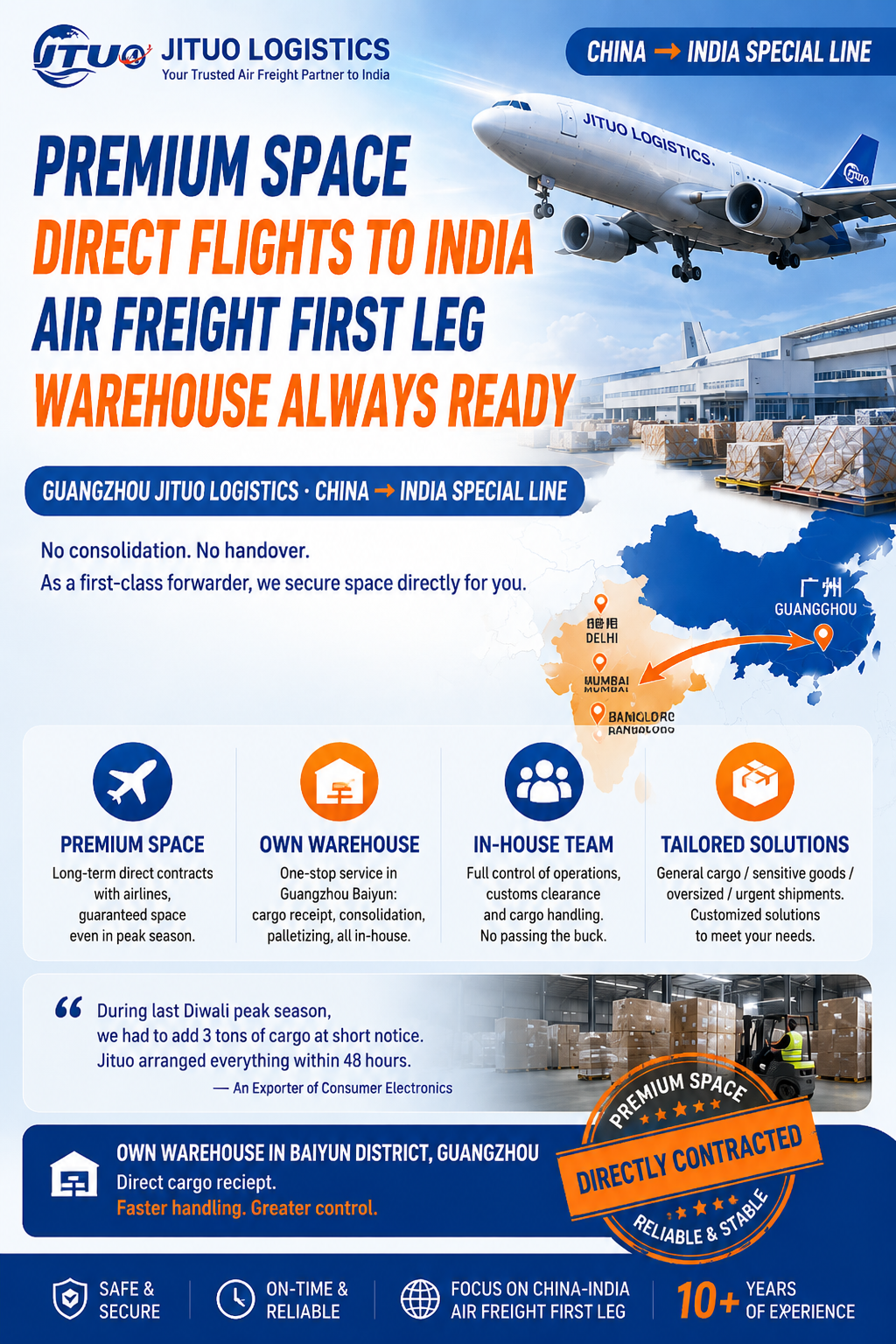
Next Step: Check Space and Consolidation Fit for Your Shipment
Send the origin city, destination airport, cargo dimensions, chargeable weight and required delivery date, and JTUO Logistics will confirm whether direct space or consolidated loading fits the shipment — including the current consolidation cut-off and the space position for that week.
Website: chinatoindiacargo.com
Email: jtuologistics@gmail.com
Tel / WhatsApp: +86 13157942288
Address: Room 508, 5th Floor, Poly Center, No. 5 Linjiang Avenue, Liede Street, Tianhe District, Guangzhou, Guangdong, China
Service channels include Email, WhatsApp, WeChat, Facebook and LinkedIn, with support in English and Chinese.
Have Questions or Need More Details?
Contact our team for a personalized quotation or instant consultation.
Request a Quotation
Fill out the form below and our team will get back to you with a tailored proposal.
WhatsApp Direct Chat
Prefer to chat in real-time? Message us on WhatsApp for instant assistance & quick answers.
- Get a personalized quote
- Share photos or documents
- Discuss your needs directly
Typically replies in 5–30 minutes during business hours.