
When Peak Season Hits the China–India Air Corridor: A Capacity Reliability Playbook
When Peak Season Hits the China–India Air Corridor: A Capacity Reliability Playbook
Peak-season capacity failure on the China–India air head haul is rarely caused by one missed booking. It is usually the cumulative result of fragmented space requests, unverified cargo data, and warehouse handoffs that no single party controls end to end. This playbook explains how freight forwarders and logistics managers can replace that fragmentation with a controlled execution chain — and how JTUO Logistics applies its Air Freight Capacity & Consolidation Control System (Version 3.0), built on space locking, origin warehouse consolidation, and airport execution, to keep China to India air freight head haul space reliable when demand peaks.
What “Capacity Reliability” Actually Means on a Head Haul Lane
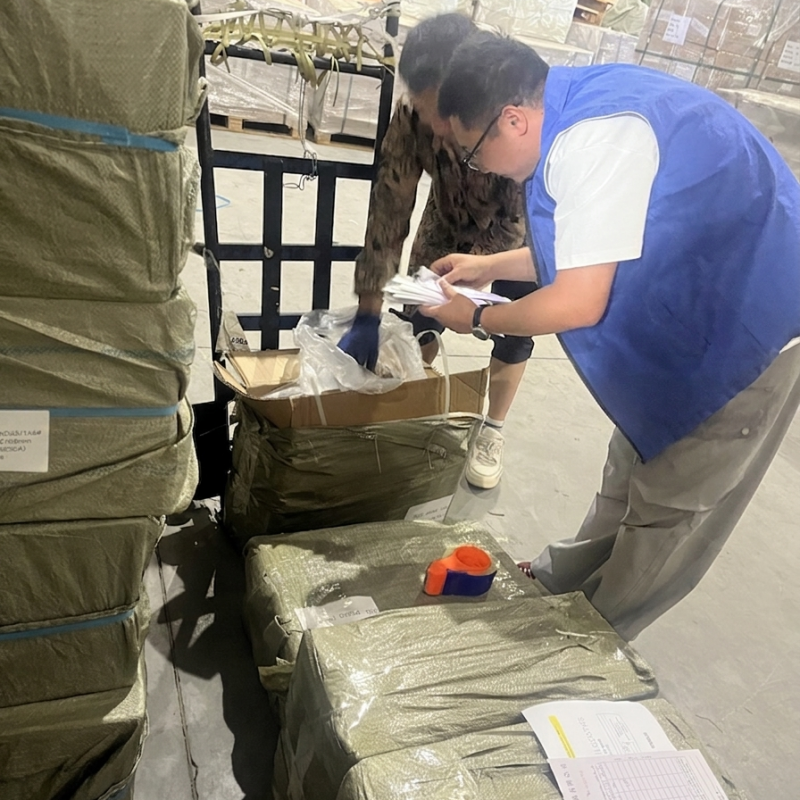
Capacity reliability describes whether a confirmed booking becomes an actually uplifted shipment on the planned flight — at a cost quoted in advance and with export documentation that clears without a hold. It is an execution property, not a price property. A forwarder can buy the lowest rate on the lane and still fail, because the space was never locked, the cargo data was never verified, or the goods never reached the airline terminal inside the cut-off window.
On China–India head haul operations, three failure points break that chain most often:
- Space volatility. Allocated space is reduced, bookings are rejected, or cargo is offloaded when peak-season demand outruns committed airline capacity.
- Rate volatility. Spot pricing moves with demand, so a shipment quoted early in the week can be repriced before the cargo is even delivered to the origin warehouse.
- Fragmented warehouse operations. When several vendors receive, label, and hand over cargo independently, every extra handoff adds delay risk and data inconsistency.
For freight forwarders, India-specialized logistics companies, cross-border e-commerce logistics operators, and supply chain service providers, those three points produce a predictable set of consequences: booking rejection and cargo-offloading risk, multi-handling delays, unstable delivery performance against customer promises, and a rising internal workload spent re-booking instead of selling.
That is the problem this playbook works from. The objective is not a better rate on a single shipment; it is a control system that makes peak-season uplift behaviour repeatable.
Why the China–India Lane Tightens Every Peak Season
Answer first: peak-season pressure on this corridor is structural rather than seasonal sentiment. Trade and e-commerce volumes have grown faster than the committed freighter capacity available to non-contracted shippers, and regulatory limits restrict how quickly ad-hoc charter capacity can be added to the lane.
Several publicly reported data points illustrate the pressure:
- China’s exports to India reached approximately USD 120.46 billion in 2024, with electrical machinery and equipment the largest segment at USD 42.66 billion (The Dollar Business). Electrical machinery, electronics, and components are typical air freight commodities, which is one reason the corridor reacts quickly to demand spikes.
- India’s air cargo market was valued at 3.6 million tons in 2025 and is projected to reach 9.9 million tons by 2034, an 11.38% CAGR (IMARC Group). The demand side of the lane is expanding, not flattening.
- Asia-Pacific airlines led international air cargo growth with an 8.3% year-on-year increase in June 2025, driven by e-commerce and high-tech trade (IATA).
- On the supply side, CAAC regulation AC-129-FS-001R2 limits foreign carriers without a CCAR-129 certificate to 10 cargo charter flights per 12-month period (CAAC / Aviation Jeta), so charter capacity cannot be scaled quickly in response to a short seasonal spike.
- Direct capacity on the corridor exists, but it is concentrated: the Ezhou (China)–Bangalore (India) direct air cargo route provides annual transport capacity of over 5,000 tons via SF Airlines (SF Airlines / Xinhua).
What this means for buyers: peak-season space on the China–India lane is not reliably purchasable on demand. It has to be contracted in advance, locked against a specific flight, and executed through a controlled origin process — which is exactly the gap an integrated capacity and consolidation model is built to close.
Case Snapshot: How Space Volatility Affects a Mid-Size Forwarder
The scenario behind this playbook comes from JTUO Logistics’ China–India Air Freight Capacity & Consolidation Integration Project. The client is an anonymized mid-to-large freight forwarding company based in China that outsources air freight execution to a specialized capacity and consolidation provider in order to improve shipment stability and cost efficiency.
Before the project, the client’s air freight execution showed five recurring problems: unstable air cargo space during peak seasons, high volatility in air freight pricing, fragmented warehouse operations, multiple-handling delays and shipment risks, and unstable delivery performance.
The diagnosis was that these symptoms shared a single root cause. The company lacked stable airline capacity access and consolidated warehouse operations, so the execution chain behaved as a series of disconnected handoffs instead of one controlled flow. Every peak-season shipment was, in effect, re-negotiated from zero.
JTUO Logistics deployed an integrated “Capacity Locking + Warehouse Consolidation + Airport Execution” air freight system — the operational expression of its Air Freight Capacity & Consolidation Control System (Version 3.0) — to rebuild the client’s execution chain from the origin warehouse through to the airport release point.
The results recorded in the project are qualitative rather than statistical: improved supply chain stability, more predictable delivery performance, reduced operational workload, and stronger peak-season scalability. The client’s own feedback summarized the change in one sentence:
“Space availability became much more stable, even during peak seasons. Much more reliable than using multiple forwarders.”
The partnership is ongoing, and a full shipment cycle on the corridor runs 3–7 days. Documented proof assets from the project include space booking confirmations, air waybills (MAWB/HAWB), warehouse inbound records, shipment execution reports, and flight tracking reports.
The Solution Framework: Air Freight Capacity & Consolidation Control System (Version 3.0)
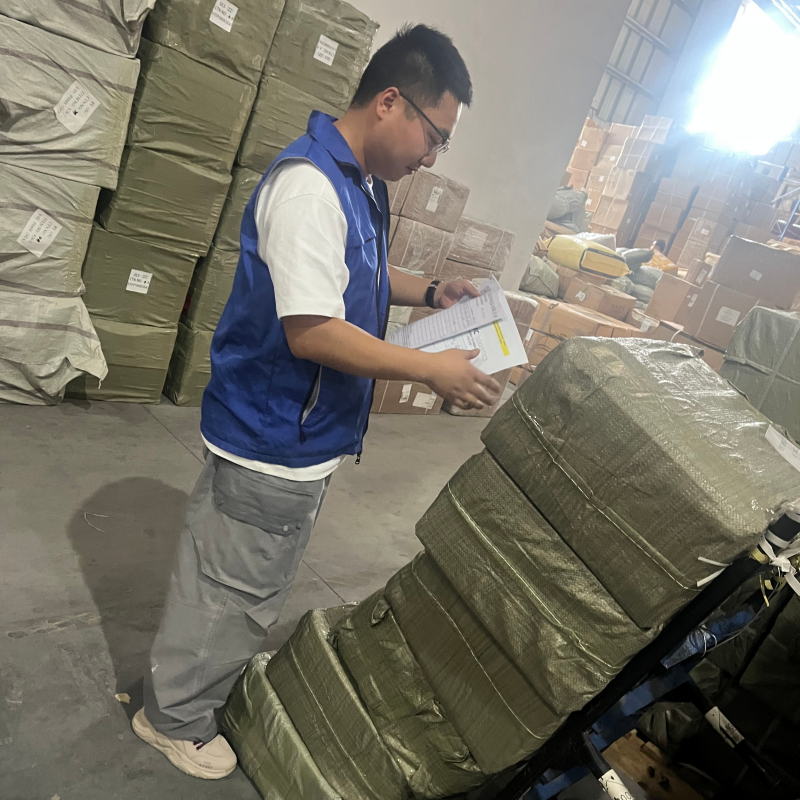
The Air Freight Capacity & Consolidation Control System (Version 3.0) is JTUO Logistics’ operating framework for China–India air freight first-leg execution. It is designed to address peak-season air cargo space shortage and unstable air freight capacity allocation, and it works in three layers that only deliver their value when they run together.
Layer 1 — Space locking and capacity management
The first layer converts capacity from a market variable into a controlled asset. JTUO Logistics’ core expertise covers stable air cargo space allocation and locking, plus flexible capacity management for Block Space Agreement (BSA) and general cargo, with peak-season air freight space guarantee treated as a standing capability rather than an exception.
Operationally, that means space is requested from and secured with the airline or upstream forwarder as soon as the order is confirmed. Fixed space can be reserved in advance for long-term partners, while priority space allocation plans can be arranged for high-volume customers during peak seasons — the mechanism that keeps capacity stable when the open market tightens.
This layer is supported by an online air freight booking system, a flight scheduling and space allocation management platform, and a real-time cargo space monitoring and dispatch system. At scale, JTUO Logistics handles over 1,500 air cargo spaces per month and supports 500+ freight forwarding partners and logistics clients.
Layer 2 — Origin warehouse consolidation
The second layer removes the handoffs that create delays. Cargo is received, verified, and consolidated at JTUO Logistics’ own 2,000 m² origin warehouse, managed through an in-house Warehouse Inventory Management System (WMS) and a consolidation and load optimization system. The warehouse accepts full consignments, multi-supplier consolidation, e-commerce small parcels, and consolidated loose cargo.
For cross-border small parcel clients, the consolidation process covers grouping multiple orders, combining goods from multiple suppliers, palletizing aggregated small parcels, and verifying weight and dimensions. For general air freight cargo, it covers sorting and organizing, consolidated stacking, large pallet handling, and stretch-wrap reinforcement.
During receiving, JTUO Logistics re-measures actual weight and dimensions and checks product information, package count, weight, volume, shipping marks, flight details, HS code, and the presence of special items such as battery-containing goods, liquids, powders, magnetic materials, or branded and replica goods. Air freight charges are based on the greater of actual weight or volumetric weight, calculated as length × width × height ÷ 6000 — which is why compact packing at origin directly affects cost.
Layer 3 — Airport execution and release
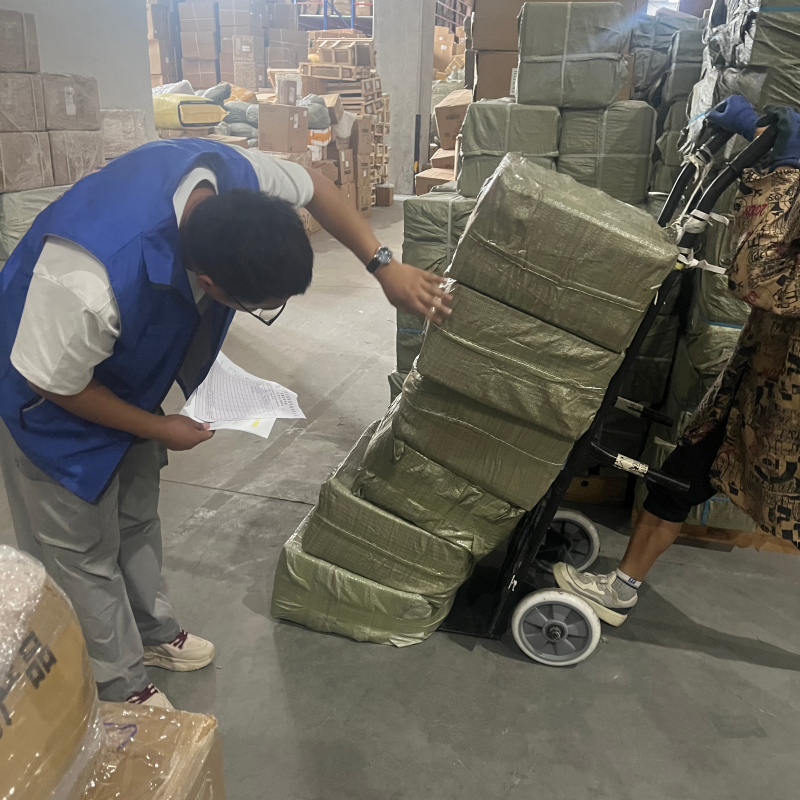
The third layer protects the booking at the airport. An Airport Coordination Team arranges centralized transport of consolidated cargo to the airport cargo terminal, completes handover to airline ground handling, prepares and submits export customs documentation, monitors clearance, and supports physical inspection if customs triggers it. The airline issues the Master Air Waybill (MAWB) and confirms release, while JTUO Logistics issues the House Air Waybill (HAWB) to the customer and provides flight departure notifications and arrival updates at the Indian airport.
The capability base behind the system
The framework is run by a core team of over 30 people, including more than 10 at the Guangzhou branch and a warehousing team of over 20, organized into a Customer Service Team, a Space Allocation & Scheduling Team, a Warehouse Operations Team, and an Airport Coordination Team. The operating team brings more than 15 years of experience in China–India air shipping logistics and cargo space management; the company itself was established in May 2025 and operates from Guangzhou.
Proprietary assets include the Warehouse Inventory Management System (WMS), the Air Cargo Space Allocation System, and a Consolidation & Dispatch Optimization Model. Compliance is supported by an Air Freight Forwarding License, Warehouse Operation & Safety Management Certification, and Logistics Service Compliance Qualification. Coverage spans China nationwide export operations and the China–India air freight corridor, with communication handled in English and Chinese across WhatsApp, WeChat, and email.
| Main market and share of business | India — 80% of business; core service is China–India air cargo booking |
| Air freight volume handled | 5,000+ tons per year |
| Sea freight volume handled | 30,000+ CBM per year |
| Warehouse and office footprint | 2,000 m² warehouse; 200 m² office space |
| Monthly air cargo spaces handled | Over 1,500 |
| Freight forwarding partners served | 500+ forwarding partners and logistics clients |

Step-by-Step: The China–India First-Leg Execution Chain
The nine-stage chain below is the sequence JTUO Logistics follows from inquiry to arrival at the Indian airport. Each stage produces a specific document, which is what makes the flow traceable for the forwarder’s own customer.
| Stage | What happens | Key output | Indicative timeline |
|---|---|---|---|
| 1. Inquiry & quotation | Cargo details, flight schedules, and market rates are reviewed and quoted | Quotation sheet, flight options, transit time estimate | 0.5 day |
| 2. Order confirmation | Customer confirms pricing and places the booking | Booking confirmation record | About 1 day, subject to customer confirmation timing |
| 3. Space allocation & booking | Space is secured with the airline or forwarder; fixed space for long-term partners, priority allocation for high-volume customers in peak season | Space allocation confirmation, cut-off time notification, warehouse inbound schedule | 1 day |
| 4. Warehouse receiving | Cargo is delivered, received, re-measured, and logged into the WMS | Warehouse receipt, piece-count and shipping-mark verification, weight & volume report | 1–2 days |
| 5. Cargo consolidation | Sorting, consolidating, palletizing, and packing based on cargo attributes | Packing list, consolidation manifest | Within the warehouse window |
| 6. Airport delivery | Consolidated cargo is transported to the airport cargo terminal and handed over | Airport handover record, airline acceptance confirmation | Coordinated against flight schedule |
| 7. Export customs clearance | Declaration documentation is prepared and submitted; inspection supported if triggered | Export declaration record, clearance confirmation | Per flight cut-off |
| 8. AWB issuance & release | Airline issues the MAWB and releases cargo; JTUO issues the HAWB | MAWB, HAWB, flight departure notice | Before departure |
| 9. Arrival at destination airport | Customer is notified when cargo lands in India | Arrival notification, landing confirmation, status update | First leg complete |
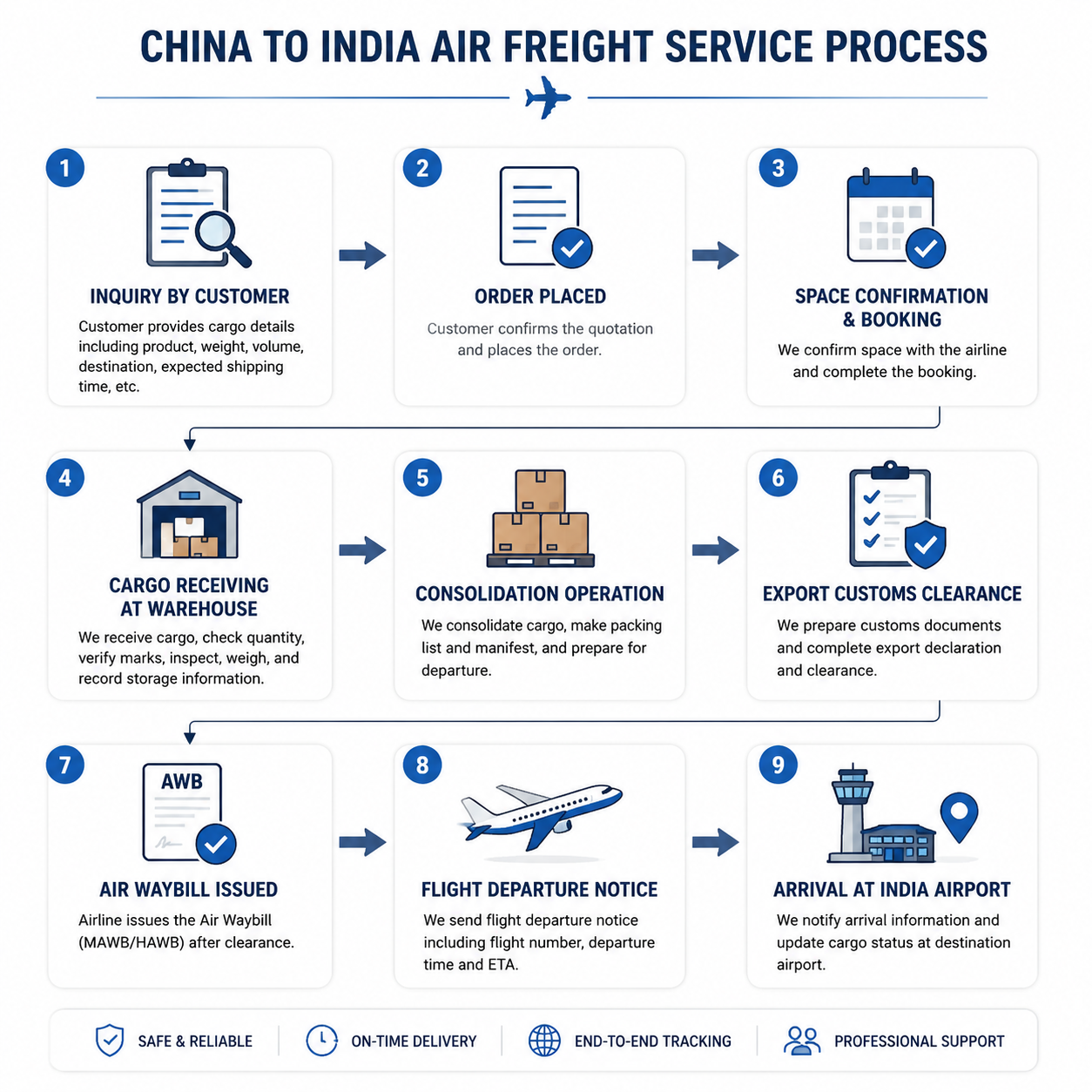
Reviewed end to end, one partnership-level shipment cycle on this corridor runs 3–7 days. The stages with fixed timelines are also the points where the six controls in the next section make the biggest difference.
The Capacity Reliability Playbook: Six Controls Before Cut-Off
These controls are the practical version of the framework above. They apply whether a forwarder works with JTUO Logistics or evaluates another China-side capacity partner.
- Lock space before you commit a rate. A rate that is not attached to confirmed space on a specific flight is an assumption, not a booking. Ask for the space allocation confirmation and the cargo cut-off time in writing before quoting your own customer.
- Route multi-supplier cargo through one origin warehouse. Consolidating at a single facility reduces the number of handoffs and standardizes packing, labelling, and data capture. It is the difference between one verification record and four conflicting ones.
- Re-measure weight and dimensions before onward quoting. Because charges follow the greater of actual or volumetric weight (length × width × height ÷ 6000), packing decisions at origin change the final cost. Measuring at receiving removes disputes later.
- Declare special cargo at booking, not at the terminal. Battery-containing goods, liquids, powders, magnetic items, and branded or replica goods need to be flagged before consolidation so they are classified and handled correctly.
- Keep one consistent document set. The commercial invoice, packing list, sales contract, and customs declaration authorization (POA) must match each other exactly. Inconsistency is a common trigger for inspection, clearance delay, or shipment hold.
- Keep one communication channel and one account owner. A named account manager coordinating over WhatsApp, WeChat, or email — with phone confirmation for key milestones — removes the “who was supposed to re-book this?” gap that appears in every fragmented chain.
Use Cases: Where the Integrated Model Fits Better Than Spot Booking
Not every shipment needs a capacity control system. The model earns its place in five recurring situations.
- Freight forwarders outsourcing China-side execution. A forwarder that sells the India lane but does not want to build origin warehousing, space allocation, and airport coordination in-house can plug into a specialized capacity and consolidation provider instead.
- Cross-border e-commerce consolidation. Multiple orders and multiple suppliers can be grouped, palletized, and verified as one consolidated shipment — including small-parcel aggregation that would otherwise move as separate bookings.
- Multi-supplier industrial and equipment shipments. Industrial equipment and components often arrive from different factories on different days; a single origin warehouse with WMS records turns that into one traceable consignment.
- Peak-season volume spikes for high-volume accounts. Priority space allocation plans and pre-reserved fixed space are designed for periods when open-market bookings are rejected.
- Sensitive-cargo handling. Shipments containing batteries, liquids, powders, magnetic materials, or branded goods require classification and documentation discipline that fragmented handling rarely sustains.
JTUO Logistics serves cross-border e-commerce logistics, international freight forwarding and NVOCC operations, and supply chain logistics service providers, and its consolidation warehouse handles consumer electronics, apparel, industrial equipment and components, furniture and building materials, packaging products, household goods, lighting and electrical products, hardware tools, stationery, beauty accessories, sports products, travel goods, and pet-related products.
Comparison: Fragmented Booking vs. an Integrated Capacity & Consolidation Model
The table contrasts the two operating patterns on the dimensions that decide peak-season outcomes. The left column describes what the JTUO Logistics client experienced before the integration project; the right column describes the deployed model.
| Control point | Fragmented multi-forwarder booking | Integrated capacity & consolidation model |
|---|---|---|
| Space position in peak season | Space requested shipment by shipment; rejection and offloading risk rises with demand | Space locked at booking stage; fixed space reserved in advance for long-term partners, priority allocation for high-volume customers |
| Communication layers | Multiple vendors and multiple points of contact per shipment | Dedicated account manager, single coordination channel (WhatsApp / WeChat / email) with phone confirmation at key milestones |
| Origin warehouse handling | Fragmented warehouse operations across several facilities | One origin warehouse of 2,000 m² with an in-house WMS record per consignment |
| Weight and volume verification | Re-measurement inconsistent or performed late | Re-measured at receiving, with dimensional weight calculated as length × width × height ÷ 6000 |
| Documentation and AWB flow | Data assembled from different sources; higher inconsistency risk | One document set per shipment; MAWB from the airline, HAWB issued to the customer |
| Shipment visibility | Status updates depend on which vendor is asked | Real-time cargo space monitoring and dispatch system, flight departure and arrival reporting |
| Peak-season scalability | Limited by whatever capacity is available in the open market that week | Built on over 1,500 air cargo spaces handled per month and 500+ freight forwarding partners served |
FAQ: China to India Air Freight Head Haul Space and Capacity Guarantees
1. Which licenses and compliance qualifications should a China to India air freight head haul space provider hold?
JTUO Logistics holds an Air Freight Forwarding License, Warehouse Operation & Safety Management Certification, and Logistics Service Compliance Qualification. Together these cover the two regulated parts of the China-side process: the freight forwarding activity itself, and the warehouse operation where cargo is received, consolidated, and prepared for airport handover. A forwarder evaluating a partner should confirm which entity holds each qualification, since origin warehousing and airline booking are separate activities.
2. How does JTUO Logistics guarantee China to India air freight head haul space during peak season?
Capacity is locked at the booking stage rather than sourced after cargo arrives. JTUO Logistics’ core expertise covers stable air cargo space allocation and locking, with flexible capacity management for Block Space Agreement (BSA) and general cargo. Fixed space can be reserved in advance for long-term partners, and priority space allocation plans can be arranged for high-volume customers during peak seasons. The operation is supported by an online booking system, a flight scheduling and space allocation platform, and real-time cargo space monitoring, and it handles over 1,500 air cargo spaces per month across 500+ freight forwarding partners and logistics clients.
3. Can cargo from multiple suppliers be consolidated into one air shipment to India?
Yes. The origin warehouse accepts full consignments, consolidation from multiple suppliers, e-commerce small parcels, and consolidated loose cargo. For small-parcel clients the process covers multi-order consolidation, multi-supplier consolidation, palletization of aggregated parcels, and verification of weight and dimensions; for general air freight cargo it covers sorting, consolidated stacking, large pallet handling, and stretch-wrap reinforcement. All handling is logged in the in-house Warehouse Inventory Management System (WMS), so one shipment record reflects the whole consignment.
4. How long does the China-side first leg take from inquiry to arrival at the Indian airport?
Inquiry and quotation normally take about 0.5 day, order confirmation about 1 day (subject to when the customer confirms), space allocation and booking about 1 day, and warehouse receiving 1–2 days once goods are delivered to the warehouse. The remaining stages — consolidation, airport delivery, export customs clearance, AWB issuance, and flight departure — run against the flight schedule. Across an ongoing partnership, one shipment cycle on the China–India corridor runs 3–7 days.
5. How can a forwarder test this model before committing peak-season volume?
The practical starting point is one live shipment rather than a contract. Send the cargo details — product description, cargo type, package count, gross weight and volume, packaging type, origin and destination airport, estimated shipping date, HS code, and any special cargo declaration — and JTUO Logistics will return a quotation, flight options, and a transit time estimate. From there, the first-leg chain runs through space confirmation, warehouse receiving, consolidation, export customs clearance, and AWB issuance.
Conclusion: Reliability Is a System, Not a Rate
Peak season does not create new problems on the China–India air corridor; it amplifies the ones already present in the booking and handling model. Fragmented space requests produce volatility. Fragmented warehouse operations produce delays. Fragmented documentation produces holds. The three-layer approach described here — space locking, origin warehouse consolidation, and airport execution — addresses each of those points in sequence, which is why the freight forwarder in JTUO Logistics’ integration project reported more stable space availability even during peak seasons.
For teams in the evaluation and execution stage of choosing a China-side capacity partner, the checklist is straightforward: confirm the space allocation and cut-off time in writing, consolidate at a single origin warehouse, verify weight and volume before quoting onward, declare special cargo early, keep one consistent document set, and work with one accountable contact.

Plan Your Peak-Season Capacity Before the Cut-Off
JTUO Logistics Co., Ltd. is a China–India air freight specialist providing China-side air cargo booking, warehouse consolidation, cargo preparation, and airport delivery coordination for freight forwarders, manufacturers, wholesalers, and e-commerce businesses.
To discuss space locking for an upcoming peak season or to run a first test shipment, contact the team directly:
Website: chinatoindiacargo.com | Email: jtuologistics@gmail.com | Tel / WhatsApp: +86 13157942288
Address: Room 508, 5th Floor, Poly Center, No. 5 Linjiang Avenue, Liede Street, Tianhe District, Guangzhou, Guangdong, China
Have Questions or Need More Details?
Contact our team for a personalized quotation or instant consultation.
Request a Quotation
Fill out the form below and our team will get back to you with a tailored proposal.
WhatsApp Direct Chat
Prefer to chat in real-time? Message us on WhatsApp for instant assistance & quick answers.
- Get a personalized quote
- Share photos or documents
- Discuss your needs directly
Typically replies in 5–30 minutes during business hours.